
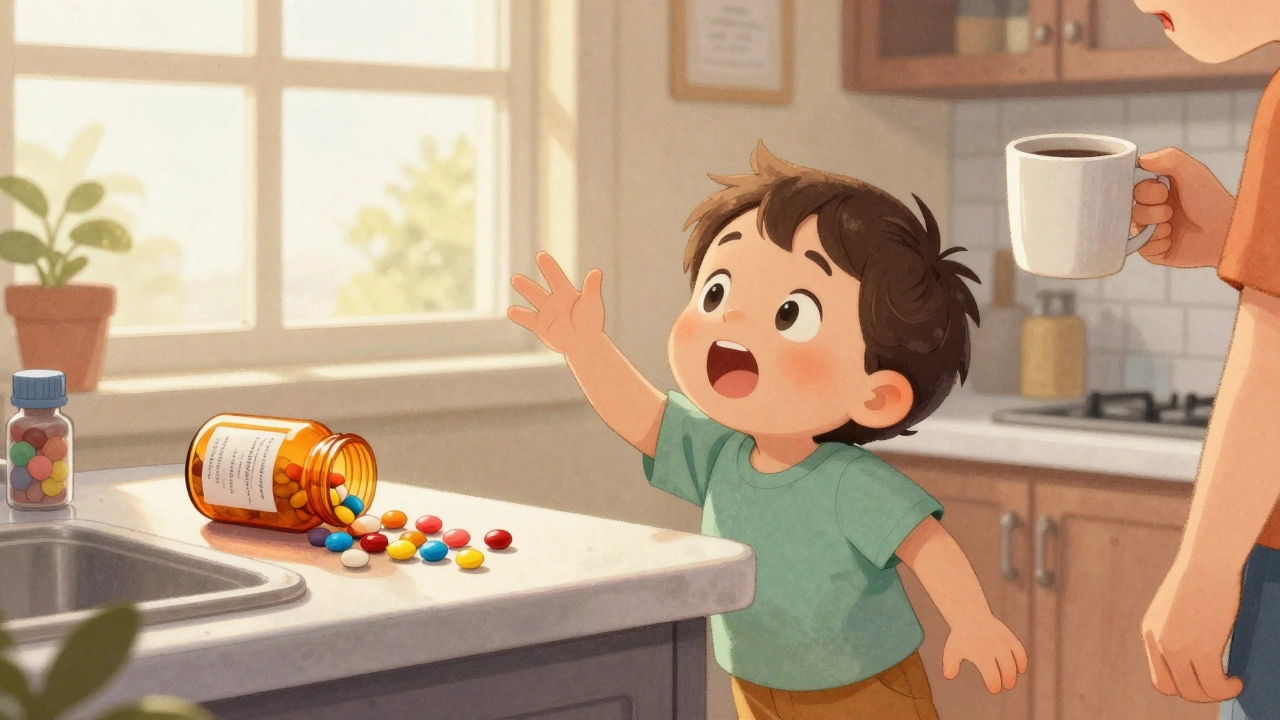
Every year, tens of thousands of children under five end up in emergency rooms because they got into medicine they weren’t supposed to. Not because they were being rebellious. Not because they were curious about drugs. But because a bottle was left on the counter, a teaspoon was used instead of the syringe that came with the medicine, or a parent thought, ‘It’s just one drop extra-how bad could it be?’ The truth is, it can be deadly.
Why Kids Under Five Are at Highest Risk
Children under five are naturally drawn to things they can reach, touch, and taste. To them, a brightly colored bottle of liquid medicine looks like candy. A pill that’s shaped like a dinosaur? A toy. The CDC’s PROTECT Initiative, launched in 2008, identified this age group as the most vulnerable-and for good reason. According to their data, emergency visits for accidental pediatric overdoses spiked to 76,000 in 2010, a 30% jump from the early 2000s. Even today, these incidents remain one of the leading causes of unintentional injury in young kids.What makes it worse? Many parents assume child-resistant caps are enough. They’re not. The Consumer Product Safety Commission found that 10% of kids can open these caps by age 42 months. That’s just over three years old. If your child can climb onto the counter, they can reach the medicine cabinet. And if the cap doesn’t click when twisted shut? It’s not locked.
The PROTECT Initiative: Three Keys to Prevention
The CDC’s PROTECT Initiative isn’t just a slogan. It’s a proven, three-part strategy that’s cut pediatric medication overdoses by 25% since 2010. Here’s what actually works:- Packaging that works: Look for bottles with child-resistant caps that require a firm twist-and-push motion until you hear a click. Flow restrictors-those little plastic inserts inside liquid medicine bottles-slow down how fast the liquid pours out. Since 2022, 95% of liquid medications now use milliliter (mL) labeling only, eliminating confusing teaspoon and tablespoon measurements.
- Dosing that’s exact: Never use a kitchen spoon. Not even the one you use for cereal. A regular tablespoon holds 15 mL. A dosing spoon might hold 5 mL. That’s a 300% overdose right there. Always use the syringe, dropper, or cup that came with the medicine. And if the medicine didn’t come with one? Ask your pharmacist for one. They’ll give it to you free.
- Storage that’s secure: Medications should be stored in a locked cabinet, at least 4 feet off the ground. Not on the nightstand. Not in the purse. Not in the bathroom where kids can reach the sink. One parent on Reddit shared how their 2-year-old got into blood pressure pills left on the nightstand after a doctor’s visit. That child spent three days in the hospital. Lock it. Up. And away.
Common Mistakes That Lead to Overdose
Most overdoses aren’t accidents caused by carelessness. They’re mistakes made because of confusion or misinformation.Confusing concentrations: Infant acetaminophen used to be 80 mg per 0.8 mL. Children’s acetaminophen was 160 mg per 5 mL. If you mixed them up? That’s a massive overdose. Since 2011, manufacturers have standardized both to 160 mg per 5 mL-but many old bottles are still in homes. Always check the label. If it says “Infant” and doesn’t list mL, throw it out and get a new one.
Using kitchen utensils: A 2022 analysis of 1,200 reported cases showed 78.3% of errors came from using spoons, cups, or syringes not meant for medicine. Even a “measured” teaspoon from your kitchen can vary by 20-40%. That’s why the PROTECT Initiative made mL-only labeling mandatory under the CARES Act.
Keeping old or unused meds: A 2023 survey found only 32% of households store medications in locked cabinets. Even fewer dispose of expired pills properly. Unused opioids, even a single pill, can be fatal to a child. The American Academy of Pediatrics now recommends co-prescribing naloxone with every opioid prescription for kids-and teaching caregivers how to use it.

What to Do If Your Child Gets Into Medicine
If you suspect your child has taken medicine they shouldn’t have-don’t wait. Don’t call your pediatrician first. Don’t Google symptoms. Don’t try to make them throw up. Call poison control immediately.In the U.S., the number is 1-800-222-1222. It’s free, available 24/7, and staffed by nurses and pharmacists trained in toxicology. They’ll ask you:
- What medicine was taken?
- How much?
- When?
- How old is your child?
Have the medicine bottle with you when you call. If you don’t know the name, bring the bottle anyway. The poison center can often identify it by color, shape, or imprint code.
If your child is unconscious, not breathing, or having seizures, call 911 and poison control at the same time. If the overdose involves opioids (like oxycodone, hydrocodone, or fentanyl), and you have naloxone (Narcan), administer it right away. The SAMHSA Overdose Prevention Toolkit gives clear instructions for nasal spray and injectable forms. Naloxone is safe for children. It won’t harm them if they didn’t take opioids-it just won’t do anything.
What’s Still Not Working
Progress has been made-but big gaps remain. Only 63% of pediatricians consistently talk about safe storage during well-child visits. That means nearly four in ten kids are leaving the doctor’s office without knowing how to keep medicine out of reach.Smart packaging tech like AdhereIT and Hero Health’s automated dispensers can help-but they cost hundreds of dollars. A 2023 AAP report found 87% of low-income families can’t afford them. Meanwhile, state take-back programs for unused meds are inconsistent. In some places, you can drop off pills at pharmacies. In others, you’re told to flush them or mix them with coffee grounds and throw them in the trash.
And despite FDA approval of naloxone for children, most emergency rooms still treat kids like small adults. The dosing isn’t always adjusted. The protocols aren’t always clear. That’s changing, but slowly.

What You Can Do Today
You don’t need to wait for policy changes or new technology. Here’s what you can do right now:- Lock it up. Buy a cheap lockbox from any hardware store. Put all meds-prescription, OTC, vitamins, supplements-in it. Keep the key or code where only adults can reach.
- Use the right tool. Always use the dosing device that came with the medicine. If it’s missing, ask your pharmacist for a new one.
- Check the label. Make sure it says “mL.” If it says “tsp” or “tbsp,” don’t use it. Return it.
- Dispose safely. If you have old pills, find a take-back location at DEA’s website. If none are nearby, mix pills with kitty litter or coffee grounds, seal them in a plastic bag, and throw them in the trash. Never flush unless the label says to.
- Know the number. Save 1-800-222-1222 in your phone. Tell every caregiver-grandparents, babysitters, relatives-where the meds are stored and how to reach poison control.
Real Stories, Real Lessons
One grandmother shared on Grandparents.com how her 18-month-old granddaughter tried to twist open a child-resistant cap. The cap didn’t fully unlock-giving her time to grab the bottle before the child could drink it. That’s the power of proper packaging.Another parent, on r/Parenting, admitted they left their child’s ADHD medication on the kitchen table after a doctor’s visit. Their 3-year-old got into it. The child vomited, became lethargic, and was rushed to the ER. They spent the night in the hospital. Now? Locked cabinet. Always.
These aren’t rare stories. They’re common. And they’re preventable.
Looking Ahead
By 2025, the FDA plans to require flow restrictors on all liquid opioid formulations. The CDC’s Up and Away campaign will launch in 12 new languages by 2026. The American Society of Health-System Pharmacists will release its first pediatric safety guide in late 2024.But none of that matters if you don’t lock the bottle, use the right syringe, and know what to do if something goes wrong. Prevention isn’t about technology. It’s about habits. And those habits start with you.
What should I do if my child swallows medicine they weren’t supposed to?
Call poison control immediately at 1-800-222-1222. Don’t wait for symptoms. Don’t try to make them vomit. Have the medicine bottle ready when you call. If your child is unconscious, not breathing, or having seizures, call 911 right away. If the overdose involves opioids and you have naloxone, use it immediately.
Are child-resistant caps enough to keep kids safe?
No. Child-resistant caps are designed to slow kids down-not stop them. The Consumer Product Safety Commission found that 10% of children can open them by age 3.5. Always store medicine in a locked cabinet at least 4 feet off the ground, even if the cap is secure.
Can I use a kitchen spoon to measure liquid medicine?
Never. Kitchen spoons vary in size and are not accurate. A teaspoon can hold anywhere from 3 to 7 mL. A dosing syringe or cup that comes with the medicine is calibrated to the exact dose. Always use the tool provided-or ask your pharmacist for one.
What’s the difference between infant and children’s acetaminophen?
Since 2011, both are standardized to 160 mg per 5 mL. But older bottles may still say “Infant” with a different concentration. Always check the label. If it doesn’t clearly say “160 mg per 5 mL,” throw it out and get a new bottle. Never guess-mistakes here can be fatal.
How do I safely dispose of old or unused medications?
Use a drug take-back program if available-many pharmacies and police stations offer them. If not, mix pills with kitty litter or coffee grounds, seal them in a plastic bag, and throw them in the trash. Never flush unless the label says to. For liquid medicines, pour them down the sink with water, then rinse the bottle and recycle it.
Is naloxone safe for children?
Yes. Naloxone is safe for children of all ages, even newborns. It reverses opioid overdoses and won’t harm a child who hasn’t taken opioids. If you’re prescribed opioids for your child, ask your doctor for naloxone and learn how to use it. The SAMHSA Overdose Prevention Toolkit has step-by-step instructions for nasal and injectable forms.
How common are dosing errors with liquid medicine?
Very. Research shows 40% of parents make at least one dosing mistake when giving liquid medicine to children. The biggest errors come from using kitchen spoons, confusing concentrations, or misreading mL labels. Always use the dosing tool that comes with the medicine and double-check the label.
What medications are most often involved in pediatric overdoses?
Liquid acetaminophen and diphenhydramine (Benadryl) are the top two, accounting for over 40% of cases. Opioids, blood pressure meds, and antidepressants are also common. Any medicine that’s colorful, smells sweet, or comes in a bottle is a risk.
12 Comments
Arun kumar
man i never thought about how kitchen spoons are so unreliable for meds. my cousin’s kid ended up in the er last year because she used a regular tsp for ibuprofen. turned out the tsp held like 7ml instead of 5. scary stuff. always use the syringe now. no excuses.
Ella van Rij
Oh please. You think locking up meds is the real problem? It’s the fact that parents don’t even *read* the labels. I’ve seen people give ‘infant’ Tylenol to toddlers because it says ‘for babies’ and assume it’s safer. It’s not about locks. It’s about basic literacy. And no, ‘just one drop extra’ is never okay. That’s how you turn a hospital visit into a funeral.
Alicia Marks
This is so important. I’m a nurse and I see this way too often. Just one tip: keep the poison control number on your fridge. My mom did it after my cousin’s incident, and we all saved it in our phones. Simple. Life-saving.
Rebecca M.
Of course the CDC says ‘lock it up’ - but have you seen the price of those fancy lockboxes? $40? For a box that holds pills? My kid’s daycare has a $2 plastic container with a rubber band. It works. Stop making parents feel guilty for not buying corporate-approved safety gear.
Zed theMartian
Wow. Another ‘PROTECT Initiative’ sermon. Let me guess - you also think child-resistant caps are the only reason we’re not all dead? Please. My cousin’s 2-year-old opened a ‘child-resistant’ bottle in 3 seconds. The cap didn’t even click. The real issue? Lazy parenting. Stop blaming the packaging and start supervising your kids. Or better yet - don’t have them if you can’t be bothered.
ATUL BHARDWAJ
In India, many parents use spoon because no syringe comes. Pharmacist often forget to give. We need free syringes with every medicine. Simple. No need for lockbox if we fix the system.
Jack Dao
Wow. Another sanctimonious lecture on how ‘parents are idiots.’ Let me guess - you’ve never left a pill on the counter? You’ve never confused infant and children’s Tylenol? You’ve never used a spoon because you were tired and didn’t have the syringe? No? Then you’re not a parent. You’re a blogger with a clipboard. Real parents are tired, overwhelmed, and doing their best. Stop judging. Start helping.
Steve World Shopping
Per the CDC’s PROTECT framework, the primary vector of pediatric pharmaceutical toxicity is non-adherence to standardized dosing protocols (SDP) and suboptimal pharmacokinetic containment (SPC). The absence of flow restrictors and mL-only labeling in legacy formulations contributes significantly to dose escalation events (DEEs). Furthermore, parental cognitive load during acute stressors (e.g., nighttime fever) induces decision fatigue, increasing risk of metric misinterpretation. Mitigation requires systemic intervention: mandatory pediatric-safe packaging (PSP) and caregiver pharmacovigilance training (CPT).
Elizabeth Grace
I used to think I was careful. Then my 2-year-old got into my anxiety meds. I didn’t even realize it until he was blue. We got lucky. He’s fine. Now? Everything’s locked. Even my vitamins. I keep the poison control number on my lock screen. If you’re not doing this, you’re playing Russian roulette with your kid’s life.
Lynn Steiner
My mom left her blood pressure pills on the counter. My 18-month-old cousin swallowed 3. She was in ICU for 48 hours. Now I don’t even trust my own family. I keep all meds in my bedroom, locked in a safe. I don’t care if it’s ‘overkill.’ I’d rather be the crazy one than the one who buried a child.
Shannara Jenkins
Thank you for this. I’m sharing this with my entire family - grandparents, babysitters, everyone. I used to think ‘it won’t happen to me.’ Now I know it happens to good people every day. Lock it. Use the syringe. Save the number. It’s not complicated. It’s just critical.
Paul Keller
While the article presents a compelling and well-researched framework for mitigating pediatric medication exposure incidents, it remains fundamentally reactive in nature. The underlying systemic issue lies in the absence of universal, federally mandated pediatric pharmaceutical safety standards across all over-the-counter and prescription formulations. The current reliance on voluntary compliance, parental vigilance, and post-hoc education is insufficient. A truly effective strategy must include: (1) mandatory inclusion of flow restrictors and mL-only labeling on all liquid medications regardless of therapeutic class; (2) integration of automated dispensing systems into Medicaid and CHIP programs; (3) standardized pediatric toxicology training for all ER staff; and (4) national public health campaigns targeting high-risk demographics. Until these structural interventions are implemented, we are merely rearranging deck chairs on the Titanic.