
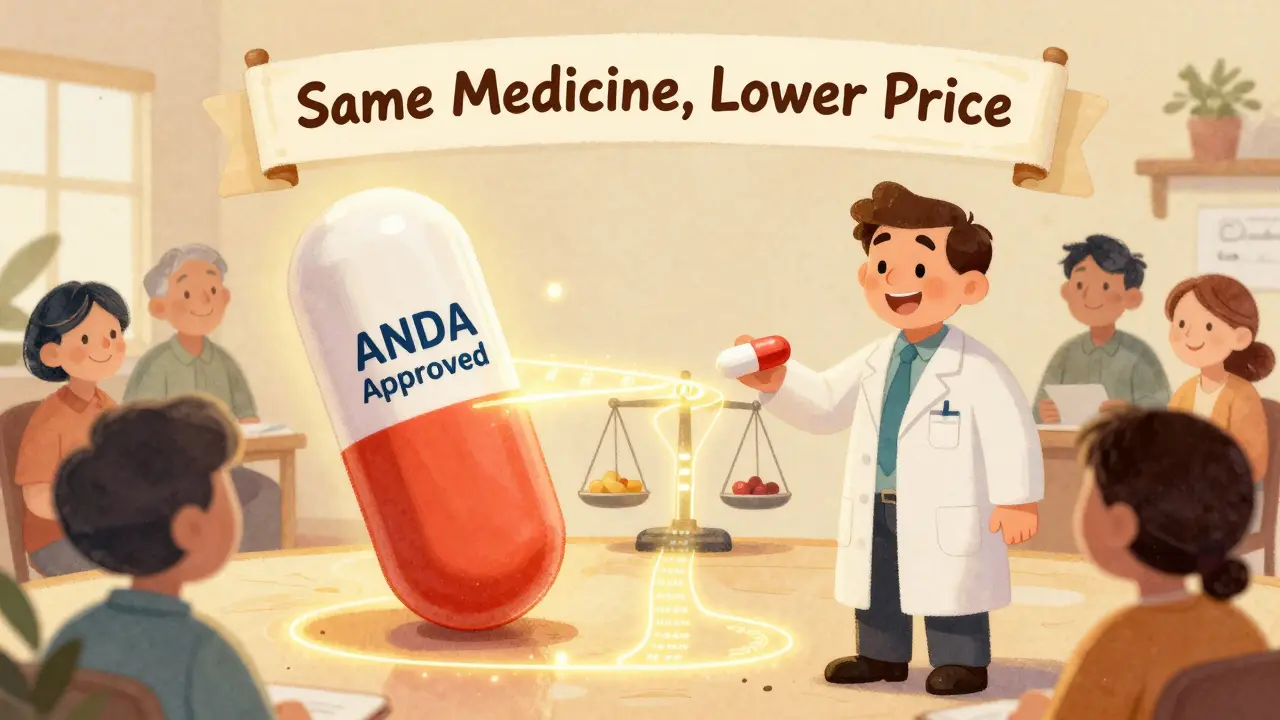
What Is the ANDA Process?
The ANDA process is the legal pathway in the United States that lets generic drug makers get FDA approval to sell copies of brand-name medicines without repeating expensive clinical trials. It’s not a shortcut to safety-it’s a smart, science-based system designed to bring affordable drugs to patients faster. The whole thing started with the Hatch-Waxman Act of 1984, a law that balanced two goals: protecting innovator companies’ patents while letting generics enter the market once those patents expired. Since then, generics have gone from 19% of prescriptions in 1984 to over 90% today, saving U.S. consumers more than $2.2 trillion in the last decade.
Why the ANDA Process Exists
Brand-name drugs cost billions to develop and take over a decade to get approved. The FDA requires full clinical trials to prove they’re safe and effective. But once a drug is approved, the science doesn’t change. If another company makes the exact same pill, with the same active ingredient, dose, and way of taking it, why make patients pay for the same trials again? The ANDA process answers that question. It lets generic companies prove their product works the same way, using bioequivalence studies instead of full clinical trials. That cuts development costs from $2.3 billion to just $5-10 million per drug. Without this, most generics wouldn’t exist-and prices would stay sky-high.
Legal Requirements for an ANDA Submission
To get approval, a generic company must prove four things to the FDA: the drug is identical to the brand-name version, it’s made to the same quality standards, it works the same in the body, and it’s labeled correctly. Each requirement is backed by law and regulation.
- Identical active ingredient: The generic must contain the exact same medicine as the brand-name drug. No exceptions unless the company files a special petition.
- Same dosage form and strength: If the brand is a 10mg tablet taken once daily, the generic must be too. No changing the pill shape, color, or how it’s taken unless approved separately.
- Bioequivalence: This is the core of the ANDA. The generic must show that it releases the medicine into the bloodstream at the same rate and amount as the brand. The FDA requires the 90% confidence interval for peak concentration (Cmax) and total exposure (AUC) to fall between 80% and 125% of the brand. Studies are done with healthy volunteers, using blood samples over time.
- Identical labeling: The package insert must match the brand’s, except for minor changes like the manufacturer’s name or the fact that it’s a generic. No misleading claims about being “better” or “stronger.”
Chemistry, Manufacturing, and Controls (CMC)
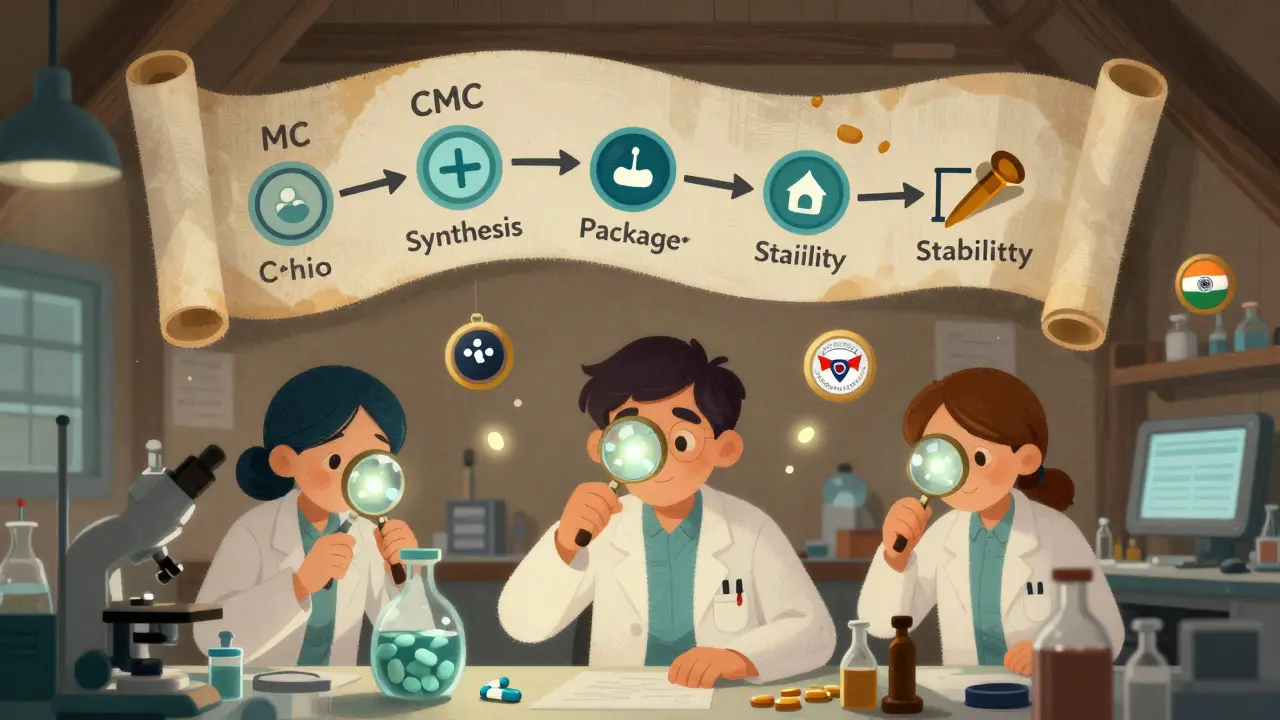
It’s not enough to say the drug works the same. You have to prove you can make it the same, every time. The CMC section is where most ANDAs fail. It includes detailed documentation of:
- How the active ingredient is synthesized
- How the tablet is pressed, coated, and packaged
- Quality control tests for every batch
- Stability data showing the drug doesn’t break down over time
- Validation of the manufacturing equipment and facility
The FDA inspects every manufacturing site-whether it’s in Ohio or India-before approving the ANDA. In 2022, 68% of FDA Form 483 observations (warning notices) came from overseas plants. One company lost three ANDAs because they didn’t properly validate the container closure system. That’s a $10 million mistake.
Patent Certification and Legal Hurdles
Every ANDA must include a patent certification. There are four types:
- Paragraph I: No patent listed
- Paragraph II: Patent expired
- Paragraph III: Patent expires on a certain date; applicant waits until then
- Paragraph IV: Patent is invalid or won’t be infringed
Paragraph IV is the most controversial. If you file it, the brand-name company has 45 days to sue you for patent infringement. If they do, the FDA can’t approve your drug for 30 months-or until a court rules. This is called a “30-month stay.” Some companies use this to delay competition. In 2023, one generic applicant faced a 41-month delay after a Paragraph IV filing, even though their drug was bioequivalent. The CREATES Act of 2019 was passed to stop brand companies from blocking access to samples needed for testing, but litigation remains a major bottleneck.
Costs, Fees, and Timelines
Filing an ANDA isn’t cheap. For fiscal year 2024, the FDA charges $129,500 for a new application and $5,000 for changes after approval. These are called GDUFA fees, part of a user-fee system that funds faster reviews. Under GDUFA III (2023-2027), the FDA aims to approve 90% of standard ANDAs within 10 months. But reality is messier. In 2022, the average review time was 36 months. Why? Because 58% of first reviews come back with deficiency letters. The top two reasons? Incomplete bioequivalence protocols (28%) and weak CMC data (23%).
Companies that succeed usually do three things: hire experienced regulatory staff, hold pre-ANDA meetings with the FDA, and submit a “clean” application. Teva spent $28 million and 42 months getting approval for a generic version of Advair Diskus. Lupin got approval for a generic version of Jardiance in just 9.5 months because they got the CMC right on the first try.
Complex Generics: The New Challenge
Not all generics are created equal. Simple pills? Easy. Inhalers, nasal sprays, eye drops, injectables? Not so much. These are called “complex generics.” They’re harder to copy because the delivery device matters as much as the drug. The FDA approved only 42% of complex generic applications on the first try in 2022, compared to 78% for regular pills. The agency is spending $15 million in 2024 to build better tools for testing these products. But until then, companies face longer reviews, more testing, and higher costs.
Who’s Winning the Generic Race?
The market is dominated by a few big players. Teva leads with 18.7% of the U.S. generic market, followed by Sandoz (14.2%), Amneal (9.8%), and Mylan (8.5%). But hundreds of smaller companies are also in the game. The total U.S. generic market hit $127.3 billion in 2022. Generics make up 90.5% of all prescriptions but only 18.1% of total drug spending. That’s the power of competition. When a second generic enters the market, prices drop another 20-30%. With three or more, they often fall 90% from the brand’s original price.
What’s Next for the ANDA Process?
The FDA is trying to make the process faster and smarter. GDUFA III pushes for 10-month reviews. New guidance is coming for drugs that act locally in the gut-something that’s been unclear for years. AI-assisted document review is being tested to cut through paperwork. But the biggest threat isn’t regulation-it’s patent thickets. Brand companies are filing dozens of patents on minor changes to delay generics. In 2020 alone, they filed 1,450 new patents on already-approved drugs. Legislation like the Affordable Prescriptions for Patients Act of 2023 aims to stop this. If it passes, the ANDA process could become even more powerful.
How to Get Started
If you’re thinking about filing an ANDA, here’s where to begin:
- Find the Reference Listed Drug (RLD) in the FDA’s Orange Book.
- Check patent and exclusivity dates-don’t file too early.
- Design a bioequivalence study that meets FDA guidance.
- Build a GMP-compliant facility or partner with one.
- Prepare your CMC section with extreme detail.
- Submit a pre-ANDA meeting request to the FDA.
- Pay the GDUFA fee and file Form FDA-356h in eCTD format.
Most failures happen in the first 6 months-not because the drug doesn’t work, but because the paperwork is sloppy. A single missing validation report can trigger a refusal to receive. Don’t guess. Follow the FDA’s 147 Refuse-to-Receive criteria. Hire a regulatory affairs specialist with RAC certification. Their median salary is $125,000, but it’s cheaper than a rejected ANDA.
What is the difference between an ANDA and an NDA?
An NDA is for brand-name drugs and requires full clinical trials to prove safety and effectiveness. An ANDA is for generics and skips those trials. Instead, it relies on the FDA’s previous approval of the brand-name drug and proves bioequivalence. An NDA takes 10-15 years and costs $2.3 billion. An ANDA takes 3-5 years and costs $5-10 million.
Can a generic drug have different inactive ingredients?
Yes. The active ingredient must be identical, but inactive ingredients like fillers, dyes, or preservatives can be different. However, those differences can’t affect how the drug is absorbed or how safe it is. If they might, the FDA requires extra testing or a suitability petition.
How long does patent exclusivity last for brand-name drugs?
Brand-name drugs get up to 5 years of data exclusivity from the FDA, meaning no ANDA can rely on their data during that time. Patent protection can last up to 20 years from the date of filing, but extensions can push it longer. The Hatch-Waxman Act allows ANDA submissions as early as 4 years before patent expiration, but approval is blocked until the patent expires or is challenged successfully.
Why do some ANDAs get refused to receive?
The FDA refuses to receive an ANDA if it’s missing critical information before even reviewing it. The top reasons are incomplete bioequivalence protocols, missing CMC data, wrong form submissions, or filing in the wrong format (like PDF instead of eCTD). Of all first submissions, 15-20% get refused to receive. Fixing that takes months and costs more money.
Are generic drugs as safe as brand-name drugs?
Yes. The FDA requires generics to meet the same strict standards for quality, strength, purity, and stability as brand-name drugs. They’re held to the same manufacturing rules (cGMP) and inspected just as often. The only difference is the price. Over 90% of prescriptions in the U.S. are filled with generics because doctors and patients trust them.
11 Comments
Eliana Botelho
Okay but let’s be real-how many of these 'bioequivalent' generics actually make people feel weird? I’ve switched brands three times and each one gives me a different headache. The FDA says it’s the same, but my body’s like, 'nah, this ain’t it.'
Darren Gormley
LMAO 🤡 the FDA approves this? Bro, I work in pharma and I’ve seen CMC docs that look like they were written by a high schooler on caffeine. 58% get deficiency letters? That’s not incompetence-that’s a system designed to fail.
Natasha Plebani
The ANDA process is a brilliant example of epistemic efficiency-leveraging prior empirical validation to minimize redundant ontological burdens. It’s not merely regulatory pragmatism; it’s a hermeneutic recalibration of pharmaceutical epistemology. The bioequivalence paradigm, anchored in pharmacokinetic equivalence, effectively decouples therapeutic efficacy from proprietary capitalization. This is science as social contract.
Mike Rose
so like... generics are just fake drugs but cheaper? i thought they were the same but now i’m confused. why do they even exist if they’re not real? 🤷♂️
Bobbi Van Riet
I’ve been a pharmacist for 18 years and I can tell you this: most patients don’t know the difference between brand and generic, and honestly? They shouldn’t have to. I’ve seen people on insulin, blood pressure meds, even antidepressants switch to generics and thrive. The system isn’t perfect-yeah, some CMC stuff is a mess-but the data doesn’t lie. 90% of scripts? Generics. And the outcomes? Just as good. If you’re scared, ask your doc to stick with brand. But don’t pretend the science is shady because the price tag is lower.
Yanaton Whittaker
USA still leads the world in generic access. China? India? They copy everything and call it innovation. We built a system that protects IP AND gets meds to people. That’s American ingenuity. 🇺🇸🔥
Beth Cooper
Funny how the FDA 'inspects' plants in India but never checks if the same labs are doing double-duty for 17 different companies. And don’t get me started on the 45-day patent lawsuit loophole-Big Pharma buys judges with campaign cash. This isn’t regulation. It’s a pay-to-play cartel. The 30-month stay? That’s just corporate extortion with a white coat.
Diana Dougan
so you're telling me i paid $120 for my blood pressure med and now i pay $4 and it's 'the same'? lol. my grandma died after switching to a generic. coincidence? maybe. but i'm not taking the risk again. #genericfail
Russ Kelemen
Hey, if you’re thinking about filing an ANDA, don’t panic. This system works-but only if you treat it like a marathon, not a sprint. Get a good regulatory team. Do the pre-meeting. Don’t skip the CMC. I’ve seen brilliant scientists fail because they thought ‘it’s just paperwork.’ It’s not. It’s the difference between helping millions and losing millions. You got this.
Donna Fleetwood
I’m a nurse and I’ve watched patients cry because they can’t afford their meds. Then they get the generic and breathe again. I don’t care if it’s made in Ohio or Odisha-what matters is they’re alive. Keep the system honest, sure. But don’t let fear stop someone from getting their life back. 💙
Kathleen Riley
The structural integrity of the ANDA framework, predicated upon the epistemological primacy of bioequivalence as a surrogate endpoint, constitutes a necessary but insufficient condition for ensuring therapeutic parity. One must not conflate regulatory expediency with clinical equivalence, particularly in light of the documented heterogeneity in dissolution profiles across manufacturing batches. The FDA’s 80-125% confidence interval, while statistically defensible, remains a probabilistic approximation, not a deterministic guarantee.