
Every year, the FDA approves hundreds of generic drugs - and each one saves patients and the healthcare system billions. But how much exactly? And why do the numbers jump from year to year? If you’ve ever wondered why your prescription copay dropped from $300 to $15 overnight, it’s not luck. It’s the FDA’s generic approval machine at work.
What Exactly Counts as a 'Savings'?
There are two ways to measure savings from generic drugs, and they tell very different stories. The FDA looks at savings from drugs approved that year - meaning, the first time a generic version of a brand-name drug hits the market. These are called first generic approvals. The Association for Accessible Medicines (AAM) looks at the total savings from every generic drug sold in a year, no matter when it was approved.
Think of it like this: the FDA tracks the impact of a new competitor entering a market. The AAM tracks how much money everyone saved because of all the competitors already in the game. Both matter. One shows the immediate shockwaves. The other shows the steady, massive tide.
Year-by-Year: The FDA’s First Generic Savings
Here’s what the FDA reported for first generic approvals - the big wins that happen when a blockbuster drug finally goes generic:
- 2018: $2.7 billion in savings
- 2019: $7.1 billion - the highest year on record
- 2020: $1.1 billion
- 2021: $1.37 billion
- 2022: $5.2 billion
Why the wild swings? It’s not random. It’s about which drugs lose patent protection. In 2019, multiple high-cost drugs - including ones for heart disease, cancer, and autoimmune conditions - went generic at once. That’s why savings spiked to $7.1 billion. In 2020, fewer big-ticket drugs came off patent, so savings dropped. In 2022, five major drugs accounted for nearly half of the $5.2 billion total. One drug alone saved over $1 billion in its first year.
These aren’t abstract numbers. They’re real dollars taken out of patients’ pockets, insurance bills, and government programs. A single generic version of a $1,200-a-month drug can drop to $40. Multiply that by hundreds of thousands of prescriptions, and you get billions.
Total Generic Savings: The Bigger Picture
But if you only look at new approvals, you miss the full story. The real power of generics comes from their cumulative effect. In 2023, all generic drugs in use saved the U.S. healthcare system $445 billion. That’s more than the entire GDP of Greece.
Here’s how that $445 billion broke down:
- Medicare: $137 billion saved (about $2,672 per beneficiary)
- Commercial insurers: $206 billion saved
- Medicaid: $102 billion saved
Therapeutic areas saw massive savings too:
- Heart disease: $118.1 billion
- Mental health: $76.4 billion
- Cancer: $25.5 billion
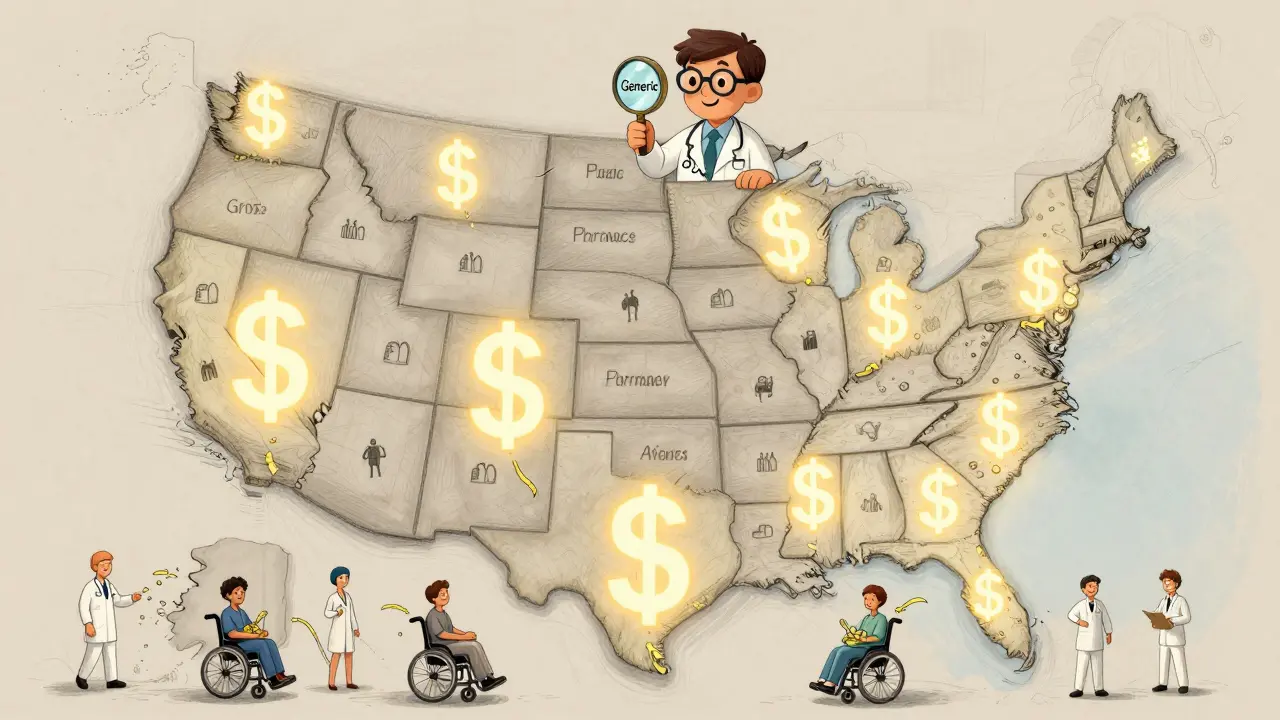
California saved nearly $38 billion in 2023. Alaska saved $354 million. Even small states saved hundreds of millions. This isn’t just about big pharma - it’s about every pharmacy, every clinic, every Medicaid recipient.
How Are These Savings Calculated?
The FDA doesn’t guess. They use real sales data. After a generic drug is approved, they track its price and volume for 12 months. Then they compare it to what the brand-name drug was selling for before. The difference? That’s the savings.
Formula: (Brand price - Generic price) × Generic volume + (Brand price drop × Remaining brand sales)
When a generic hits, the brand doesn’t just lose sales - it usually slashes its price too, just to stay competitive. That’s why savings are even higher than you’d expect. In some cases, prices drop more than 70% after generic entry.
AAM’s method is simpler: they take the total amount spent on all generic drugs in a year and subtract what it would have cost if everyone had still bought the brand-name versions. The gap? That’s the total savings.
Who Benefits the Most?
Patients. That’s who.
Ninety-two percent of generic prescriptions cost $20 or less. The average copay? Just $6.97. For chronic conditions like high blood pressure, diabetes, or depression, that’s the difference between taking your meds and skipping them.
But here’s the catch: not all savings reach the patient. Pharmacy benefit managers (PBMs) negotiate rebates between drugmakers and insurers. A 2023 Senate investigation found only 50-70% of generic savings actually make it to the consumer. The rest gets swallowed by middlemen.
State Medicaid programs see the clearest benefits. California’s Medi-Cal saved $23.4 billion in a single year. That’s enough to cover care for tens of thousands of low-income patients. In states with smaller populations, the savings still add up - often covering entire public health programs.
Why Are Generic Approvals So Important?
Generics make up 90% of all prescriptions in the U.S. But they account for only 13.1% of total drug spending. That’s the power of competition. Without generics, the U.S. would be spending over $3 trillion more on prescription drugs since 2014.
The FDA approved 742 generic applications in 2022 alone. That’s more than two per day. Thanks to the Generic Drug User Fee Amendments (GDUFA), review times dropped from years to months. Now, 95% of applications are reviewed within 10 months.
But not all drugs are easy to copy. Biologics - complex drugs made from living cells - are harder to replicate. That’s why biosimilars (the generic version of biologics) are still catching up. As of August 2024, the FDA had approved 59 biosimilars. Their savings are growing, but they’re still a fraction of what traditional generics deliver.
What’s Next? The Future of Generic Savings
More blockbuster drugs are losing patents. In the next five years, dozens of multi-billion-dollar drugs - including those for Alzheimer’s, obesity, and rare diseases - will go generic. That could push annual savings past $500 billion by 2030.
But there are roadblocks. Brand companies use legal tricks - like patent thickets, REMS restrictions, and settlements that delay generics - to protect their profits. The FDA’s 2023 Drug Competition Action Plan is trying to shut those down.
Complex generics - like inhalers, injectables, and topical creams - are harder and slower to approve. The FDA is working on new guidelines to speed those up. If they succeed, we’ll see savings in areas where patients currently pay hundreds a month just to breathe or manage pain.
One thing’s clear: generics aren’t just cheaper drugs. They’re the backbone of affordable healthcare in America. Without them, millions would go without treatment. With them, the system keeps running - and people keep living.
Why This Matters to You
Even if you don’t take generics yourself, you pay for them. Through taxes, insurance premiums, and government spending. Every dollar saved on prescriptions means less pressure on healthcare costs overall.
If you’re on a chronic medication, check if a generic version exists. Ask your pharmacist. It could cut your monthly bill in half - or more.
And if you’re following healthcare policy, remember: each FDA approval isn’t just paperwork. It’s a financial lifeline for families, hospitals, and the entire system.
How much do generic drugs save patients per year?
In 2023, generic drugs saved U.S. patients and payers a total of $445 billion. On average, that’s over $1,300 per person in the country. For individuals, the average generic copay is just $6.97, compared to over $100 for brand-name drugs.
Why do generic savings vary so much from year to year?
Savings spike when high-cost brand-name drugs lose patent protection. In 2019, several blockbuster drugs went generic at once, leading to $7.1 billion in savings. In 2020, fewer big drugs came off patent, so savings dropped to $1.1 billion. It’s not about how many generics are approved - it’s about how expensive the drugs are that they replace.
Do all generic savings go directly to patients?
No. While generics lower the list price, pharmacy benefit managers (PBMs) often keep a portion of the savings through rebates. A 2023 Senate investigation found only 50-70% of the savings actually reach patients at the pharmacy counter. The rest goes to insurers and middlemen.
What’s the difference between a generic and a biosimilar?
Generics are exact copies of small-molecule drugs, like pills for blood pressure or diabetes. Biosimilars are similar - but not identical - copies of complex biologic drugs, like injections for cancer or autoimmune diseases. Biosimilars are harder and more expensive to develop, so they’ve been slower to enter the market. As of 2024, only 59 have been approved by the FDA.
How do I know if a generic version of my drug is available?
Ask your pharmacist or check the FDA’s online database of approved generic drugs. You can also search by brand name on sites like Drugs.com. If your drug has been on the market for more than 10-12 years, there’s likely a generic available. Don’t assume your doctor knows - ask.
Are generic drugs as safe and effective as brand-name drugs?
Yes. The FDA requires generics to have the same active ingredient, strength, dosage form, and route of administration as the brand-name drug. They must also meet the same strict quality standards. Over 90% of prescriptions filled in the U.S. are generics - and they work just as well.
Final Thought: Generics Are the Silent Heroes of Healthcare
They don’t get headlines. No one throws parades for a pill that costs $5 instead of $300. But without them, millions would go without treatment. Without them, Medicare and Medicaid would collapse under the weight of drug costs. Without them, healthcare in America wouldn’t be sustainable.
Every year, the FDA approves hundreds of these quiet heroes. And every year, they save the country tens of billions.
8 Comments
Harriet Hollingsworth
Let me get this straight - we’re celebrating a government agency for doing its JOB? The FDA approves generics, and suddenly it’s a miracle? People die because they can’t afford meds, and we’re acting like this is some heroic feat? No. This is basic. This is expected. Stop giving out medals for not letting people starve.
And don’t even get me started on PBMs. Those middlemen are the real villains. They take half the savings and call it ‘negotiation.’ Meanwhile, grandma’s insulin still costs $400 because the system is rigged. This isn’t progress - it’s damage control.
Also, ‘generic’ doesn’t mean ‘cheap junk.’ It means ‘same drug, no marketing.’ But sure, let’s keep pretending Big Pharma is the victim here.
And yes, I capitalized every sentence. Because grammar matters when you’re talking about human lives.
Deepika D
Hey everyone, I just want to say how deeply moved I am by this post - and I want to share something that changed my life. When I was living in Mumbai, my mom had diabetes, and the brand-name insulin cost more than our monthly rent. Then, one day, the pharmacist handed me a small white bottle with a simple label - ‘Insulin Glargine, 100 units/mL, Generic.’ It cost $3.50. Three dollars and fifty cents. We cried.
That’s what generics do. They don’t just save money - they save dignity. They let a mother breathe. They let a father take his kid to school without worrying about which pill to skip. The FDA isn’t just approving drugs - they’re approving hope.
And yes, PBMs are shady? Absolutely. But that doesn’t mean we stop fighting for more generics. We fight harder. We demand transparency. We push for biosimilars. We educate our communities. I now volunteer at a local clinic teaching people how to check the FDA’s database. It’s not glamorous. But it’s powerful.
Every time you ask your pharmacist, ‘Is there a generic?’ - you’re not just saving money. You’re changing the system. One pill at a time. 💪❤️
Bennett Ryynanen
Bro. The FDA isn’t some saint. They’re just the only thing standing between Big Pharma and turning every pill into a luxury car. You think your $5 blood pressure med is a gift? Nah. It’s the result of someone fighting lawsuits, lobbying, and patent trolling for years. And you know who wins? The guy who doesn’t give a damn and just files the damn application.
And don’t even start with ‘but biosimilars are slow.’ Yeah, because pharma companies are paying lawyers to delay them like it’s a damn Netflix subscription. I’ve seen it. My cousin’s biologic cost $12K a year. The biosimilar? $3K. Took 7 years to get here. SEVEN YEARS. For a drug that saves lives.
So yeah, $445 billion saved? Good. Now let’s make sure 100% of it hits the patient. Not some PBM CEO’s yacht.
And stop calling it ‘savings.’ Call it ‘justice.’
Chandreson Chandreas
It’s funny, right? We build cathedrals for gods we can’t see… but we don’t build monuments for the people who make sure the medicine works at 1/10th the price.
Generics are the quiet monks of healthcare. No fanfare. No TED Talks. Just consistency. A pill. A promise. A life.
I think about how much of our suffering is manufactured - by patents, by greed, by the illusion that innovation = exclusivity. But here’s the truth: healing doesn’t need a brand name. It just needs access.
And yet… we celebrate the inventor of the drug, not the person who made it affordable. We worship the spark, not the flame that keeps the house warm.
Maybe we’re not broken because we can’t afford meds.
Maybe we’re broken because we’ve forgotten how to value life over profit.
🙏💊
Darren Pearson
While the quantitative data presented is undeniably compelling, one must exercise caution in ascribing moral superiority to the generic drug approval process without contextualizing the broader pharmaceutical innovation ecosystem. The R&D expenditures required to bring a novel therapeutic to market exceed $2.6 billion on average, and the patent system exists not as a mechanism of exploitation, but as an incentive structure to ensure continued advancement.
Furthermore, the assertion that PBMs are solely predatory ignores their role in negotiating formularies, managing utilization, and ensuring access to a diverse array of medications. To reduce this complex ecosystem to a binary of ‘good generics’ versus ‘evil middlemen’ is intellectually lazy and economically illiterate.
That said, the magnitude of savings - $445 billion - is indeed staggering and warrants continued policy attention. However, we must avoid conflating affordability with accessibility. The latter requires infrastructure, education, and equitable distribution - not merely regulatory approvals.
Let us not mistake efficiency for equity.
Stewart Smith
So the FDA approves a drug that saves billions… and we all act like they just cured cancer?
Meanwhile, the same people who cheer these approvals are the ones who voted for politicians who defunded the FDA’s budget for years.
And yet, somehow, the system still works? That’s not a win. That’s a miracle. And we’re acting like it’s normal.
Also, ‘ask your pharmacist’ - yeah, because I’m sure they’re not too busy being yelled at by insurance reps to answer questions.
Anyway. I’m just glad my $7 copay exists. But I’m not gonna throw a parade for it. We should be angry. Not grateful.
Retha Dungga
why do we even care about the numbers man like who even counts this stuff i just want my pills to not cost my rent and if the fda can make that happen then good for them but dont make it sound like some big win its just not being a monster 🤷♀️💸
Aaron Bales
Ask your pharmacist. Always. If your drug is older than 10 years, a generic exists. You don’t need to be an expert. Just ask. It’s that simple.