
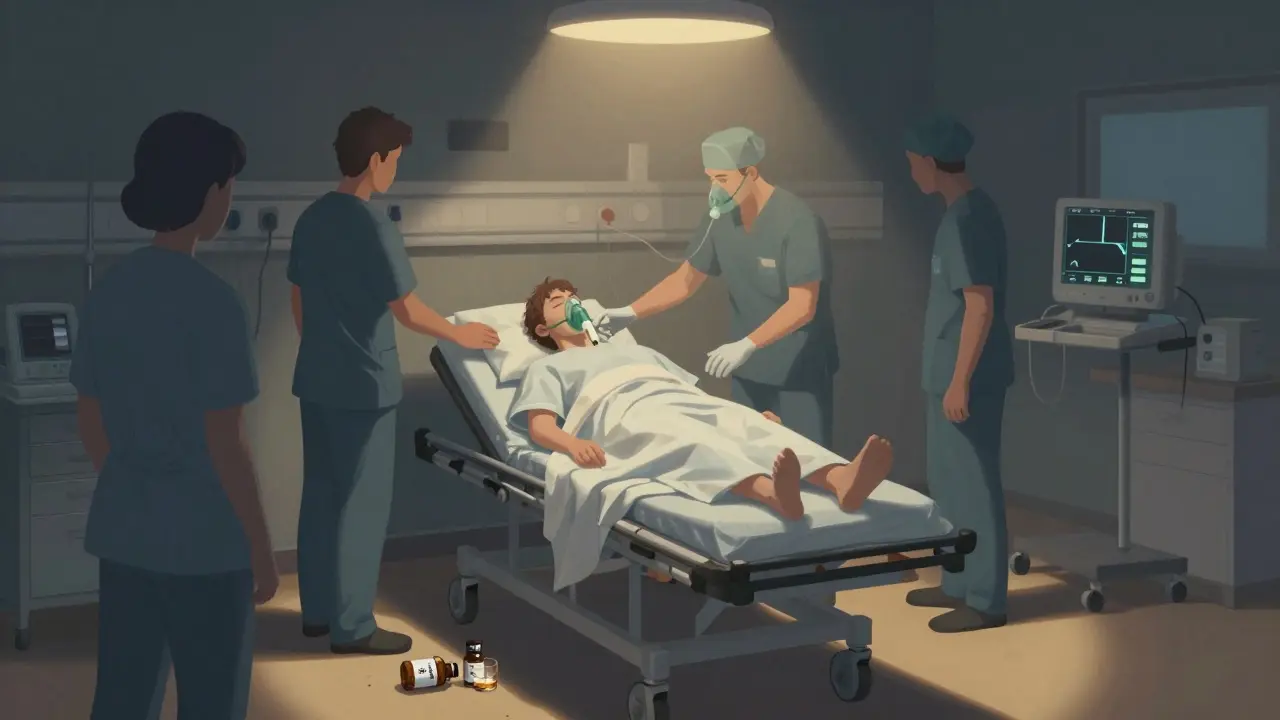
When someone overdoses on benzodiazepines, time isn’t just a factor-it’s the difference between life and permanent brain damage. You might think of benzodiazepines as safe, sleepy-time pills: Xanax, Valium, Ativan. But when taken in large doses-or mixed with alcohol or opioids-they can shut down breathing. And when breathing stops, the brain starves. In 2022, over 112,000 benzodiazepine overdose cases were reported in the U.S. alone. While pure benzodiazepine overdoses rarely kill, benzodiazepine overdose combined with opioids is 15 times more likely to cause death. This isn’t theoretical. It’s happening in emergency rooms every day.
What Happens During a Benzodiazepine Overdose?
Benzodiazepines work by boosting GABA, the brain’s main calming chemical. Too much of it? The brain goes quiet. Muscles relax. Breathing slows. In mild cases, the person might be drowsy, slurred-talking, or uncoordinated. In severe cases, they stop breathing. Their heart rate drops. Blood pressure falls. And if no one intervenes, they die.
But here’s the twist: isolated benzodiazepine overdose is rarely fatal. Studies show that 87% of cases result in only mild to moderate drowsiness. Deep coma requiring a ventilator? That happens in just 4.3% of cases. The real danger comes from what’s mixed in. Nearly 92% of benzodiazepine-related deaths involve opioids, alcohol, or both. This isn’t an accident-it’s a pattern. Illicitly made benzodiazepines like etizolam and clonazolam are 3 to 10 times stronger than prescription versions. People think they’re taking one drug. They’re actually taking a lethal combo.
Immediate Steps: The ABCDE Protocol
Emergency teams don’t guess. They follow ABCDE: Airway, Breathing, Circulation, Disability, Exposure. This isn’t a suggestion-it’s the standard in the UK, the U.S., and across Europe.
- Airway: Is the person responsive? If they can’t answer, their airway is at risk. Use the Glasgow Coma Scale. A score of 8 or below means you need an anesthesiologist now.
- Breathing: Count breaths. Fewer than 10 per minute? That’s a red flag. Check oxygen saturation. If it’s below 90%, give 15 liters per minute of oxygen through a non-rebreather mask. If they have COPD, switch to a Venturi mask to avoid CO2 buildup.
- Circulation: Monitor heart rate and blood pressure. Use pulse oximetry and ECG. Low blood pressure? Start IV fluids. No pulse? Begin CPR.
- Disability: Check blood sugar. Hypoglycemia can look like overdose. Test for acetaminophen and aspirin too. A simple finger-stick glucose test can rule out a mimicker.
- Exposure: Look for pills, needles, or notes. Ask bystanders. Check their wallet. They might have taken more than one thing.
Every minute counts. If breathing is too slow, prepare for intubation. Don’t wait for the person to turn blue. By the time cyanosis appears, it’s too late.
Why Flumazenil Is Rarely Used
You’ve probably heard of flumazenil-the drug that reverses benzodiazepines. It sounds perfect. But in practice, it’s dangerous.
Flumazenil works fast. It blocks benzodiazepines from binding to brain receptors. But it also has a short half-life-just 41 minutes. That means the sedation can come back. You might wake someone up, only to have them slip back into coma 30 minutes later. That’s why repeat doses are needed every 20 minutes.
And here’s the kicker: if the person is dependent on benzodiazepines-say, someone taking Xanax daily for anxiety-flumazenil can trigger violent seizures. A 2022 study found a 38% seizure risk in dependent patients. Even worse, many overdoses involve other drugs. Trazodone, opioids, alcohol-all can lower the seizure threshold. One ER nurse on Reddit described a patient who seized 90 seconds after flumazenil because he’d taken his regular antidepressant with his benzo. He didn’t survive.
Today, 78% of U.S. emergency departments no longer stock flumazenil. The American College of Medical Toxicology says it’s appropriate in only 0.7% of cases. The European Resuscitation Council explicitly says: don’t use it. The American Heart Association removed it from ACLS guidelines in 2023. Flumazenil isn’t a magic fix. It’s a risk with very narrow use.
What About Activated Charcoal?
Activated charcoal traps toxins in the gut. Sounds useful, right? But benzodiazepines are absorbed in minutes. If more than an hour has passed, charcoal does nothing. Emergency Care BC’s 2021 data shows it only reduces absorption by 45% if given within 60 minutes. Beyond that? Zero benefit. And if the patient is drowsy, giving charcoal risks choking. Most protocols now avoid it unless ingestion was under 60 minutes and the airway is secure.
Monitoring: It’s Not Over When They Wake Up
Many patients are discharged too early. Sedation fades faster than coordination. Someone might seem alert, but their balance is still off. They can’t walk straight. They’re at risk of falling, hitting their head, or crashing a car.
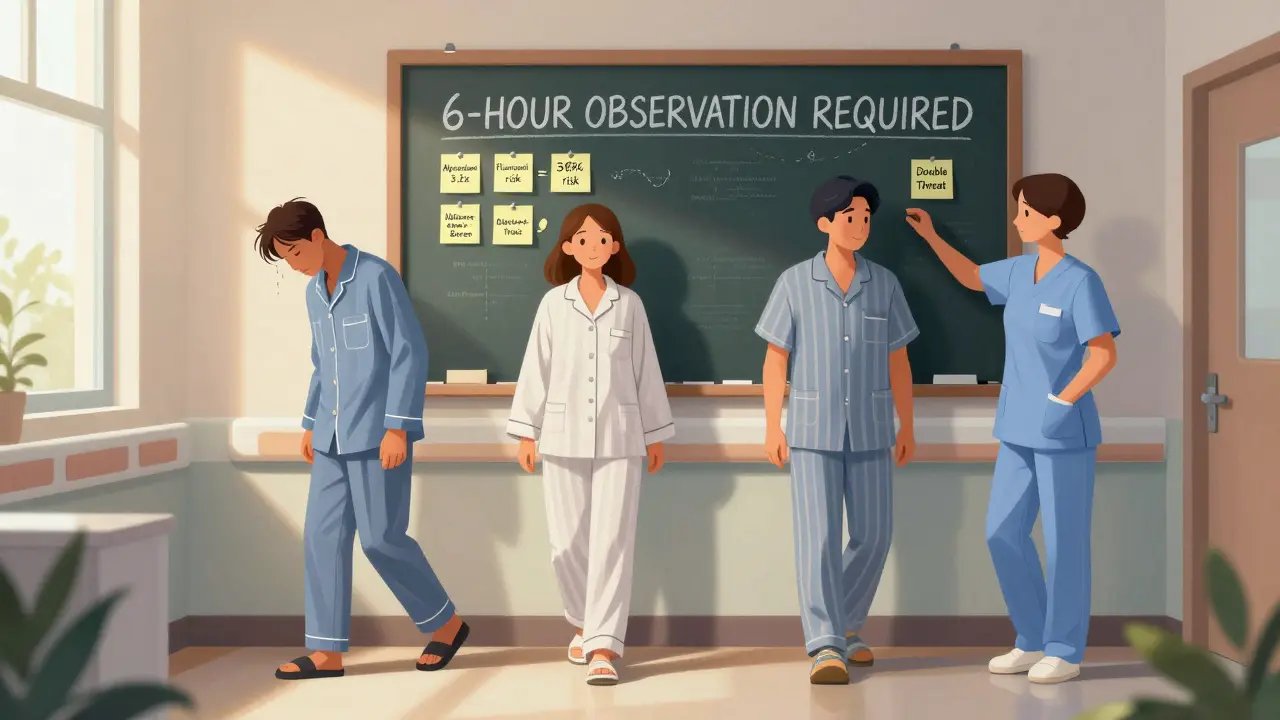
Asymptomatic patients need at least 6 hours of observation. Symptomatic patients? Stay until full recovery-which can take 12 to 48 hours. Elderly patients, those with liver disease, or those who took long-acting benzos like diazepam often take longer. Alprazolam, in particular, causes deeper sedation and is 3.2 times more likely to require intubation than other benzodiazepines.
Use standardized tools like the Pasero Sedation Scale. Reassess every 15 minutes after any intervention. Document respiratory rate, oxygen levels, and consciousness level. Don’t rely on how the patient looks. Use numbers.
What’s Changing in 2026?
Two big shifts are happening now.
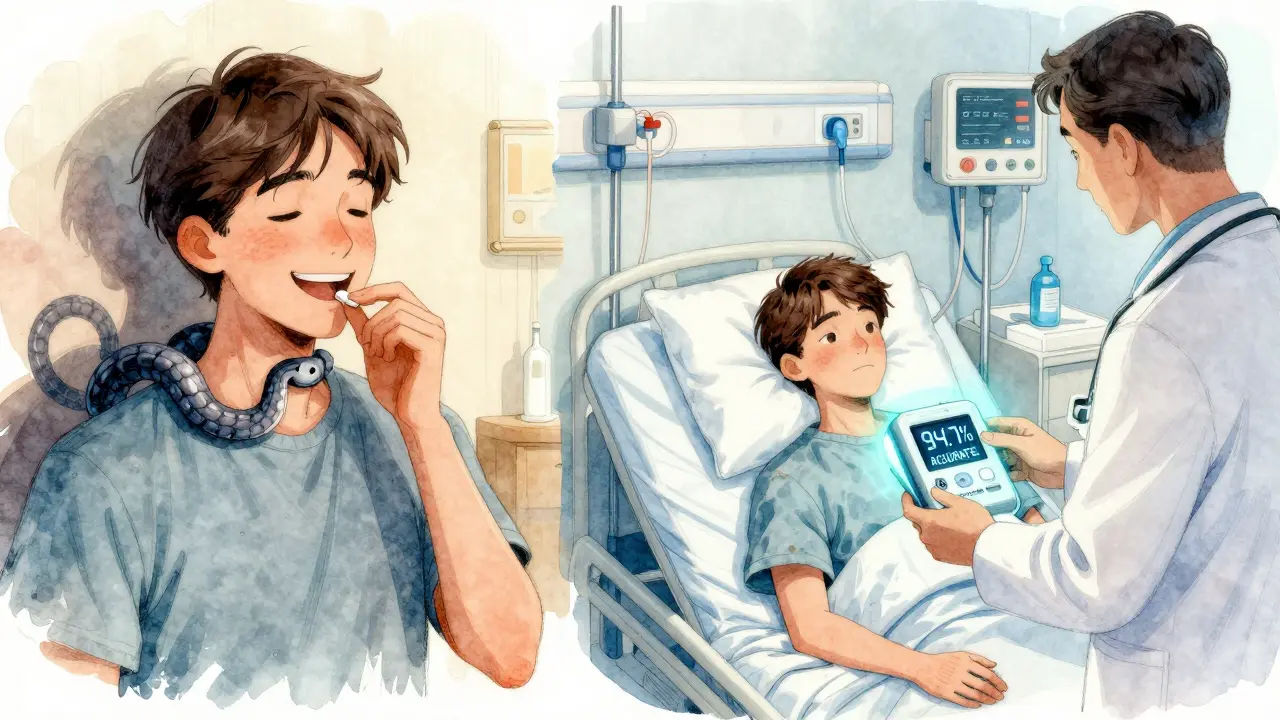
First, new tools are arriving. The FDA approved the BenzAlert™ monitor in early 2023. It measures benzodiazepine levels in real time. In trials, it predicted when sedation would wear off with 94.7% accuracy. This means doctors won’t have to guess how long to watch someone. They’ll know.
Second, harm reduction is expanding. In 2020, only 12 U.S. states included benzodiazepine recognition in naloxone distribution. By January 2023, that jumped to 37. First responders now carry naloxone for opioid overdoses-and they’re trained to spot benzo sedation too. Why? Because if someone overdoses on opioids and benzos together, naloxone fixes the opioid… but the benzo still shuts down breathing. You need both awareness and time.
Illicit benzos are rising fast. Etizolam and clonazolam are now responsible for 68% of severe overdoses in the Western U.S. These aren’t pills from a pharmacy. They’re made in labs, sold online, and often mislabeled as Xanax. They’re stronger. More unpredictable. And they’re not detected by standard urine screens.
Key Takeaways
- Isolated benzodiazepine overdose rarely kills-but mixing it with opioids or alcohol is deadly.
- Flumazenil is rarely used. It’s risky, short-acting, and can cause seizures.
- Supportive care-airway, oxygen, monitoring-is the gold standard.
- Observation time must be long enough. Sedation fades before coordination returns.
- Activating charcoal after 60 minutes does nothing. Avoid it unless timing is certain.
- New tools like BenzAlert™ and expanded harm reduction programs are changing outcomes.
Can you die from a benzodiazepine overdose alone?
Death from benzodiazepines alone is extremely rare-only 0.01% to 0.05% of cases. Most deaths occur when benzodiazepines are mixed with opioids, alcohol, or other depressants. In those cases, the risk of respiratory arrest increases by 15 times.
Why is flumazenil not recommended for most overdoses?
Flumazenil has a short half-life (41 minutes), so sedation often returns. More importantly, it can trigger seizures in people with chronic benzodiazepine use or those who’ve taken other drugs like antidepressants. Studies show a 38% seizure risk in dependent patients. Because of this, most emergency departments no longer stock it.
How long should someone be monitored after a benzodiazepine overdose?
Asymptomatic patients need at least 6 hours. Symptomatic patients should be monitored until all signs of CNS depression resolve-this can take 12 to 48 hours, especially in older adults or those with liver problems. Ataxia (loss of coordination) often lasts longer than drowsiness, so discharge before full recovery creates fall risks.
Are newer benzodiazepines like etizolam more dangerous?
Yes. Illicitly made benzodiazepines like etizolam and clonazolam are 3 to 10 times more potent than traditional ones. They’re harder to detect on standard drug screens and are now responsible for 68% of severe overdose cases in the Western U.S. Their strength and unpredictability make them a growing public health threat.
Does activated charcoal help in benzodiazepine overdose?
Only if given within 60 minutes of ingestion, and even then, it only reduces absorption by about 45%. After that, benzodiazepines are fully absorbed. Giving charcoal later doesn’t help-and if the patient is sedated, it can cause aspiration. Most current guidelines advise against its routine use.
What Comes Next?
Emergency teams are shifting from reaction to prevention. More hospitals are training staff to recognize illicit benzos. More naloxone kits now include benzodiazepine awareness cards. Research is underway for longer-acting reversal agents-something that could last hours, not minutes. Until then, the best tools are simple: oxygen, airway management, time, and vigilance.
For every patient who walks out of the ER after an overdose, there’s a lesson: don’t assume a pill is what it says it is. Don’t assume one drug is safe. And never underestimate how quickly a calm night can turn into a silent, breathless emergency.
9 Comments
Rex Regum
Let me guess-you’re one of those people who thinks benzos are ‘safe’ because your cousin took Xanax for three years and ‘never had a problem.’ Newsflash: your cousin’s lucky. Most people don’t wake up after mixing it with fentanyl-laced ‘Xanax’ they bought off Instagram. This whole post is just a PSA for people who think addiction is a moral failing, not a chemical trap. Wake up. The system is rigged. The DEA doesn’t even test for etizolam. You’re being poisoned and told to ‘just stop.’
Kelsey Vonk
Wow. This is so well-researched. 🥹 I’ve been a nurse for 12 years and I still learn something new every time I read this. The part about flumazenil triggering seizures in chronic users? Heartbreaking. I had a patient last year-she was on 4mg diazepam daily for PTSD, took a friend’s ‘sleep aid’ that turned out to be clonazolam, and boom-seizure after flumazenil. She’s fine now, but it took 11 days in the ICU. We need more education, not just protocols. 🙏
Emma Nicolls
thank you for this i didnt know how dangerous these are when mixed i always thought they were just sleepy pills like tylenol pm
my aunt took one with a glass of wine and ended up in the hospital for 3 days
she said she didnt even feel like she did anything wrong
why is this not on every pill bottle??
Jimmy V
Flumazenil is a trap. Period. You don’t reverse a benzo overdose-you manage it. Oxygen. Airway. Time. That’s it. The rest is theater. And activated charcoal? Useless after 60 minutes. Stop pretending you’re doing something. You’re not. You’re just buying time. And if you’re discharging someone after 6 hours because they ‘seem fine’-you’re a liability. Ataxia lingers. People die falling down stairs. Read the Pasero scale. Use it. Or stop.
Richard Harris
Interesting read. I work in a rural ER in Wales-we don’t even have flumazenil here. We just watch, oxygenate, and wait. Sometimes for 36 hours. It’s boring, but it works. The real issue? People don’t know what they’re taking. I had a lad last month who thought he was buying ‘Valium’ off Snapchat. Turned out to be etizolam. He was in a coma for 18 hours. No one told him it was 7x stronger. That’s the real crisis-not the drug, but the ignorance.
Katherine Rodriguez
Why are we even talking about this like it’s a medical mystery? It’s simple. People are dumb. They take pills they don’t understand. They mix them with alcohol because ‘it helps them chill.’ They buy stuff online because it’s cheap. No one’s gonna save them from their own stupidity. Stop treating them like victims. They made their choice. Now they get to live with the consequences. Or die. Whatever.
Devin Ersoy
Oh honey, you’re adorable. You really think the FDA’s ‘BenzAlert™’ is gonna fix this? That’s like putting a Band-Aid on a hemorrhage. The real problem? The pharmaceutical industry *wants* you dependent. They’ve been selling you this ‘safe benzo’ myth for decades. Now they’re monetizing the crisis with $12,000 monitors. Meanwhile, the street drugs are cheaper, stronger, and unregulated. The system doesn’t want to fix this-it wants to profit from it. And you? You’re just another data point.
Scott Smith
For anyone reading this: if you or someone you know is using benzos long-term, talk to a doctor before stopping. Abrupt withdrawal can kill. If you’re using them recreationally-stop. Don’t wait for an ER visit. If you’re mixing them with anything-stop. It’s not worth it. This isn’t fearmongering. It’s fact. And if you’re a provider? Listen to the data. Don’t let tradition override science. We’ve got better tools now. Use them.
Sally Lloyd
So… let me get this straight. The government’s pushing this ‘BenzAlert™’ thing, but they won’t regulate the labs making etizolam? And naloxone kits are being handed out… but no one’s talking about the fact that 80% of these overdoses happen in places with zero harm reduction infrastructure? This smells like a distraction. Who benefits? Who’s funding this? Who’s controlling the narrative? I’ve seen this script before. It’s never about saving lives. It’s about control.