

Imagine breaking out in tiny, burning bumps on your chest the moment you start jogging, walking to your car on a warm day, or even eating a spicy meal. For people with cholinergic urticaria (CU), this isn’t unusual-it’s everyday life. Also called heat hives, this condition isn’t caused by an allergen like pollen or peanuts. Instead, it’s your body’s overreaction to a rise in core temperature. When you sweat, your nerves send signals that trigger mast cells to flood your skin with histamine, causing red, itchy, pinprick-sized bumps surrounded by larger red flares. These aren’t just annoying-they can be painful, embarrassing, and limit everything from exercise to social events.
What Exactly Happens in Your Body?
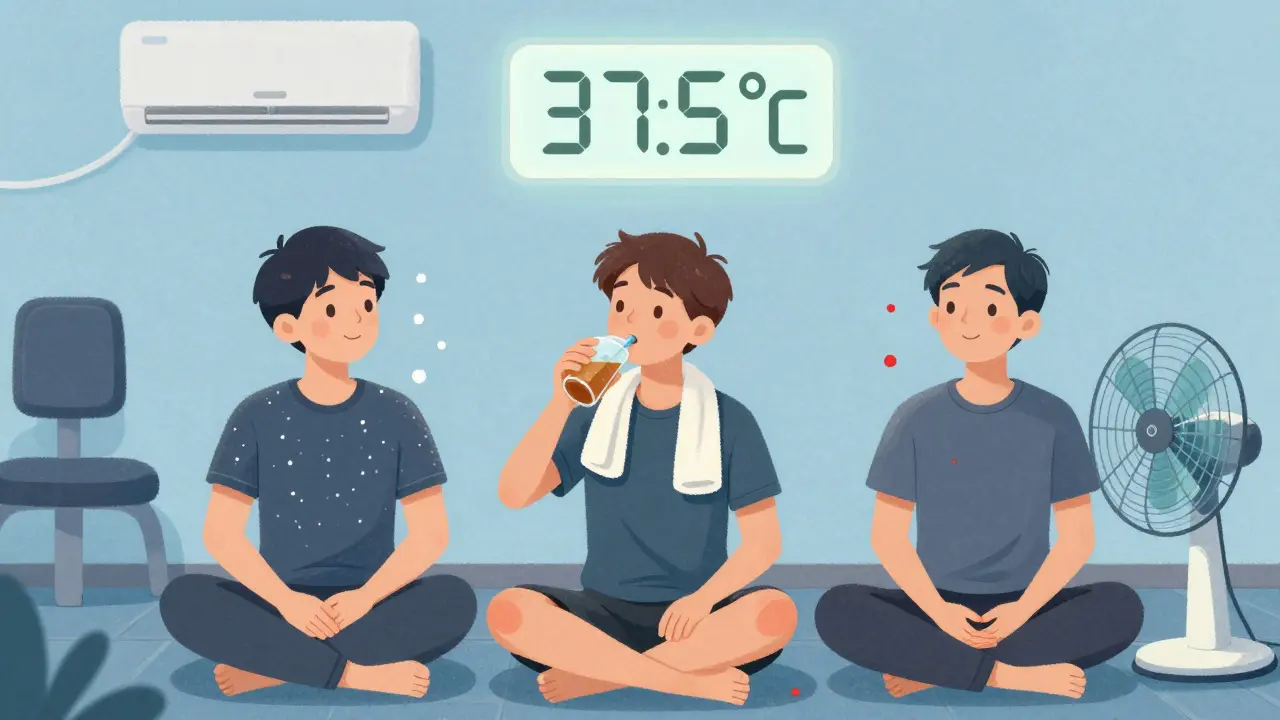
Cholinergic urticaria is a physical urticaria, meaning it’s triggered by an external physical factor-in this case, heat. Unlike allergic hives that respond to foods or medications, CU kicks in when your body temperature climbs just 0.5°C above normal (around 37.5°C or 99.5°F). This usually happens during exercise, hot showers, emotional stress, or even eating hot food. The reaction isn’t delayed. Most people see their first bumps within 2 to 15 minutes, and they peak within 30 minutes. They don’t last long-usually gone in 90 minutes-but the cycle repeats every time you heat up.
The science behind it is specific. Studies show that people with CU have lower levels of an enzyme called acetylcholinesterase (AchE) and higher activity of cholinergic receptors (CHRM3) in sweat glands. This imbalance makes their skin hypersensitive to acetylcholine, a neurotransmitter released when you sweat. The immune system misreads this as a threat, sending inflammatory cells like CD4+ and CD8+ T cells to the skin. That’s why the bumps show up on areas that sweat most: chest (78% of cases), face (65%), upper back (62%), and arms (58%). You rarely see them on palms or soles-those areas don’t sweat as much.
How Common Is It?
Cholinergic urticaria affects about 5-7% of all people who get hives. That might sound small, but given that 15-20% of the general population will experience hives at some point, that means millions worldwide have CU. It’s most likely to show up between ages 15 and 25. Many people first notice it during high school or college, when they start working out or dealing with stress. About 30% of cases go away on their own within 7 to 10 years, but for others, it’s a lifelong condition. It’s more common in warmer climates-Southeast Asia reports 0.11% prevalence, while Scandinavia sees only 0.03%. Climate change could make this worse, with models predicting a 15-25% rise in cases in temperate regions by 2040.
How Is It Different From Other Hives?
Not all hives are the same. Here’s how CU stands out:
- Cold urticaria: Happens when skin is exposed to cold (below 4°C). Bumps appear on arms or legs after touching ice or cold air.
- Solar urticaria: Triggered by sunlight-only on exposed skin, within 1-3 minutes.
- Dermatographism: Lines appear where you scratch or rub your skin. CU hives are scattered, not linear.
- Pressure urticaria: Takes 6-8 hours to show up after sitting on a hard chair or wearing tight jeans. CU hits fast-within minutes.
The big difference? CU is tied to internal heat, not external triggers. You don’t need to touch something hot-you just need to raise your core temperature. That’s why avoiding it is so hard.

What Are the Symptoms?
The hallmark of CU is small (1-3 mm), red, raised bumps that feel like pinpricks or needles under the skin. They’re often surrounded by a red, flushed area that can be warm to the touch. Common sensations include:
- Intense itching or tingling
- Warmth or burning across the chest and back
- Flushing (reddening) of the face, neck, or upper body
- Sometimes, dizziness, nausea, or headache
For 12.3% of people, symptoms go beyond the skin. They may experience low blood pressure (below 90 mmHg), rapid heartbeat (over 100 bpm), wheezing, or even difficulty breathing. In 8.7% of cases, this can escalate to anaphylaxis-requiring an epinephrine auto-injector. Many patients are misdiagnosed as having exercise-induced anaphylaxis, which leads to wrong treatments. If you get hives during exercise and also feel lightheaded or short of breath, talk to an allergist.
What Triggers It?
The biggest trigger? Physical activity. Nearly 9 in 10 people with CU report exercise as their main cause. That doesn’t mean you have to quit working out-but you do need to adjust how you do it. Other common triggers include:
- Hot showers or saunas
- Spicy foods (capsaicin raises body temp)
- Emotional stress (fight-or-flight response heats you up)
- Wearing non-breathable clothing (synthetics trap heat)
- Hot weather or humid environments
One Reddit user summed it up: “I’ve missed 14 weddings in three years because I can’t risk overheating in formal attire.” Social events, gym sessions, even cooking dinner can become minefields.
How Is It Diagnosed?
There’s no blood test for CU. Diagnosis relies on history and a simple test called the passive warming test. In this procedure, you sit in a warm room (around 38°C) while your core temperature is monitored. A small increase-just 0.5°C above baseline-will trigger the classic hives in 94% of confirmed cases. Your doctor may also ask you to log your activities and symptoms to spot patterns. Many patients take 2 to 3 months to identify their personal trigger point. For some, it’s 37.8°C. For others, it’s 38.5°C. Knowing your threshold is key.
How Is It Treated?
There’s no cure-but it’s manageable. First-line treatment is second-generation antihistamines:
- Cetirizine (Zyrtec): 10-20mg daily. 68% effective in clinical trials.
- Loratadine (Claritin): 10mg daily. Less sedating than older versions.
For people who don’t respond, doctors may increase the dose up to four times the normal amount. Studies show 73% of patients improve with higher doses. If that still doesn’t work, adding an H2 blocker like famotidine (Pepcid) 20mg twice daily can help 57% of cases. These drugs block a different histamine receptor, giving you a second line of defense.
For severe, treatment-resistant cases, omalizumab (Xolair)-a biologic originally used for asthma and chronic hives-was approved for CU in Europe in June 2023. It works by targeting IgE antibodies. In trials, 78% of patients achieved complete symptom control. But it costs $3,500 per month in the U.S., so it’s not an option for most.
Prevention: What Actually Works
Since you can’t stop sweating, prevention is about controlling heat buildup:
- Exercise smart: Work out in air-conditioned spaces. Use fans. Avoid peak heat hours. Try swimming-it cools you fast.
- Dress right: Wear moisture-wicking fabrics (polyester blends, not cotton). Loose, light-colored clothing helps heat escape.
- Pre-cool: Drink a cold beverage before exercise. Use a damp towel on your neck.
- Avoid triggers: Skip spicy foods if they set off your hives. Limit hot showers. Manage stress with breathing exercises or meditation.
- Use cooling tech: New wearable garments from ThermaCare (in partnership with Mayo Clinic) reduce flare frequency by 63% during exercise tests. These aren’t widely available yet, but they point to the future.
One patient shared: “Since switching to air-conditioned workouts and moisture-wicking shirts, my flare-ups dropped from daily to 1-2 times a month.” That’s the kind of change that restores quality of life.
What About Long-Term Outlook?
Most people with CU adapt. Symptoms often lessen with age. Research shows 30% of cases resolve within 7-10 years. But for now, managing it means being smart about heat. The future looks promising: researchers are targeting specific biomarkers for diagnosis, with two expected to be validated by 2026. Smart clothing that monitors core temperature in real time could become mainstream by 2028, helping patients stay under their personal trigger threshold. For now, the goal isn’t to eliminate heat-but to control it.
Can cholinergic urticaria be cured?
There is no permanent cure for cholinergic urticaria, but symptoms often improve with age. About 30% of people see their hives disappear completely within 7-10 years. Treatment focuses on managing triggers and controlling reactions with antihistamines or other medications.
Is cholinergic urticaria dangerous?
For most people, it’s just uncomfortable. But in about 12% of cases, it can lead to systemic symptoms like low blood pressure, rapid heartbeat, or wheezing. In 8.7% of patients, it can trigger anaphylaxis. If you experience dizziness, trouble breathing, or chest tightness during a flare, you should carry an epinephrine auto-injector and see an allergist.
Why do I get hives when I sweat but not when I’m hot without sweating?
It’s not the heat alone-it’s the sweat. CU is triggered by the release of acetylcholine from nerve fibers in sweat glands. If you get hot but don’t sweat (like in a dry sauna), you may not trigger a reaction. But if your body starts sweating-even slightly-you activate the immune response. That’s why it’s called cholinergic: it’s tied to the neurotransmitter involved in sweat production.
Can I still exercise with cholinergic urticaria?
Yes-but you need to adapt. Exercise is the top trigger, but it’s also essential for health. Try shorter, cooler workouts. Use fans or air conditioning. Wear moisture-wicking clothes. Pre-cool with cold drinks or towels. Many patients successfully maintain fitness with smart adjustments. Quitting exercise isn’t necessary-just changing how you do it.
Are antihistamines the only treatment option?
No. While second-generation antihistamines like cetirizine are first-line, some patients need higher doses or combination therapy with H2 blockers like famotidine. For severe cases, biologics like omalizumab (Xolair) have been approved in Europe and show strong results. Other options under study include new mast cell stabilizers and drugs targeting specific immune pathways. Talk to a specialist to explore alternatives if standard treatments aren’t working.
11 Comments
Mike Hammer
Been dealing with this for years. I used to think I was just "overheating" until I read about acetylcholine triggering the reaction. Turns out, it’s not the sweat-it’s the neurotransmitter release. That’s why I can sit in a sauna and be fine, but a 10-minute jog in 70°F weather turns me into a walking rash. Moisture-wicking shirts? Game changer. Also, cold showers before exercise. No joke.
Mandeep Singh
You people are overcomplicating this. It’s not rocket science. Your body’s weak. You sweat, your immune system flips out. Simple. Stop being dramatic. I’ve seen people in India who work in 45°C heat without a single hive. It’s not climate. It’s laziness. Go outside. Build tolerance. Stop hiding in air-conditioned boxes. You think you’re special? You’re not. Just toughen up.
Erica Banatao Darilag
I’m so sorry to hear how debilitating this can be. I have a friend with CU and she described it as feeling like her skin was being pricked with hot needles during yoga. She’s been on high-dose cetirizine for two years now. It’s not perfect, but it’s allowed her to return to swimming-something she thought she’d lost forever. I just want to say: you’re not alone. And if you’re reading this and struggling, please talk to a specialist. There’s hope.
Chiruvella Pardha Krishna
Heat is not the enemy. The body’s reaction to heat is a reflection of the soul’s inability to adapt. We live in a world of artificial comfort, and our biology has become a fragile thing. Cholinergic urticaria is not a disease-it is a signal. A warning that we have surrendered too much to convenience. The sweat is not the problem. The surrender is.
Joe Grushkin
Wow. So we’re supposed to believe that a neurotransmitter imbalance causes hives? Next you’ll tell me my allergies are caused by bad vibes. I’ve had hives since I was 12 and never once thought it had anything to do with acetylcholine. You people need to stop pretending science is magic. I’ve tried every antihistamine. None worked. So I stopped caring. I just live with it. And yeah, I still go to the gym. I don’t care if I look like a lobster.
Virginia Kimball
Y’all, I just found out my roommate has this and I’m obsessed with how smart she is about managing it. She pre-chills with ice packs on her neck, drinks frozen electrolyte cubes, and wears these silver-threaded shirts that feel like a cloud. She’s back to hiking, dancing, even cooking spicy curry without a flare. It’s not about giving up-it’s about hacking your body. I’m so proud of her. If you’re reading this and feeling hopeless? There’s a way. You just gotta find your version of cool.
Michael Page
I wonder if this is linked to the modern reduction of environmental stimuli. We live in climate-controlled environments, shielded from natural temperature variation. Our autonomic nervous system, once finely tuned to ambient shifts, now overreacts to minor deviations. Perhaps CU is not a malfunction, but a misalignment. A symptom of disconnection from the natural rhythm of bodily adaptation.
Sarah Barrett
Interesting how the distribution maps so closely to sweat gland density. Chest, back, face-those are the areas with the highest concentration of eccrine glands. And the fact that palms and soles are spared? That’s because those are apocrine zones, not eccrine. The cholinergic receptor density aligns perfectly. This isn’t random. It’s anatomical precision. Science is beautiful.
Daniel Dover
Antihistamines work. That’s it. No need for biologics or wearable tech. Just take your meds. Simple. Done.
Betty Kirby
Ugh. I’ve seen so many people use this as an excuse to avoid exercise. It’s not a disability. It’s a lifestyle choice. If you’re too weak to handle a little heat, maybe you shouldn’t be working out at all. I’ve never had hives. I run in 90°F humidity. You could too. You’re just choosing comfort.
Kapil Verma
India has 1.4 billion people. We don’t have air conditioning. We don’t have fancy shirts. We sweat. We work. We live. And we don’t get hives. This is a first-world problem. You have too much money, too much comfort, too much time to overthink your sweat. Go to work in the sun. Eat spicy food. Live. Stop paying for expensive meds and gadgets. Your body was made for this.