
What Is Dupuytren’s Contracture?
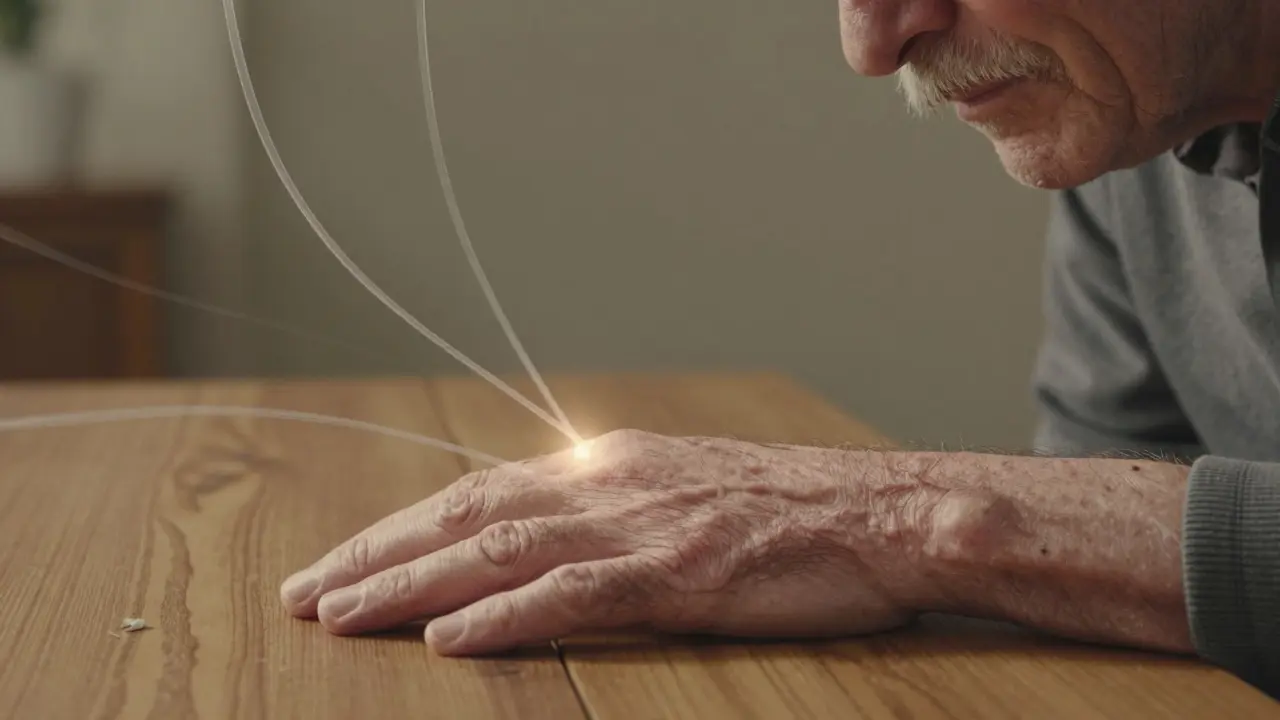
Dupuytren’s contracture is a condition where thickened tissue under the skin of the palm forms cords that pull one or more fingers into a bent position, making it hard to straighten them. It doesn’t cause pain in most cases, but it can make everyday tasks like shaking hands, putting on gloves, or washing your face nearly impossible.
The problem starts with small, painless lumps in the palm - usually near the ring or little finger. Over time, these lumps turn into tight cords that grow toward the fingers. These cords don’t stretch. They don’t go away on their own. And they slowly pull the fingers down toward the palm. In severe cases, the fingers can become permanently stuck in a curled position.
This isn’t just a cosmetic issue. People with advanced Dupuytren’s often can’t lay their hand flat on a table - a simple test doctors call the "table top test." If your palm won’t lie flat, you likely have it. Around 61% of cases affect the ring finger. About 54% affect the little finger. It’s rare for the thumb or index finger to be involved unless the disease is very advanced.
Who Gets Dupuytren’s Contracture?
If you’re over 65, have Northern European ancestry (Scandinavian, British, or Dutch roots), and are male, you’re at higher risk. Studies show up to 30% of men over 65 with this heritage develop the condition. Women get it too, but less often and usually later in life.
Genetics play a big role. If a parent or sibling has Dupuytren’s, your chance of getting it jumps from 8% in the general population to nearly 70%. Researchers have found 11 gene spots linked to the condition, especially on chromosomes 16 and 20. That’s why it often runs in families.
Other factors like smoking, heavy alcohol use, and diabetes may make it worse, but they don’t cause it directly. Many people with Dupuytren’s have never smoked or drunk alcohol. And many people with diabetes never develop it. So while these might be triggers, they’re not the root cause.
How Does It Progress?
Dupuytren’s doesn’t happen overnight. It usually takes years - sometimes decades - to get bad. But in some people, it moves fast. About 1 in 5 patients see major changes within just 12 to 24 months.
The stages are simple to recognize:
- Stage 1: Small, firm lumps appear in the palm. No pain. No movement loss yet.
- Stage 2: Cords form, stretching from the palm to the fingers. You might notice dimpling or puckering of the skin.
- Stage 3: The finger starts bending. At this point, contracture is usually between 10 and 30 degrees. This is when many people start noticing problems.
- Stage 4: The finger is stuck. Contracture is over 45 degrees. You can’t use your hand normally.
Doctors recommend treatment when contracture hits 30 degrees at the knuckle (MCP joint) or 20 degrees at the middle joint (PIP joint). That’s the point where daily life starts to get really hard.
Treatment Options: What Actually Works?
There’s no cure for Dupuytren’s. But there are several ways to fix the bent fingers and get your hand back. The right choice depends on how bad it is, how fast it’s getting worse, your age, and your lifestyle.
Needle Aponeurotomy
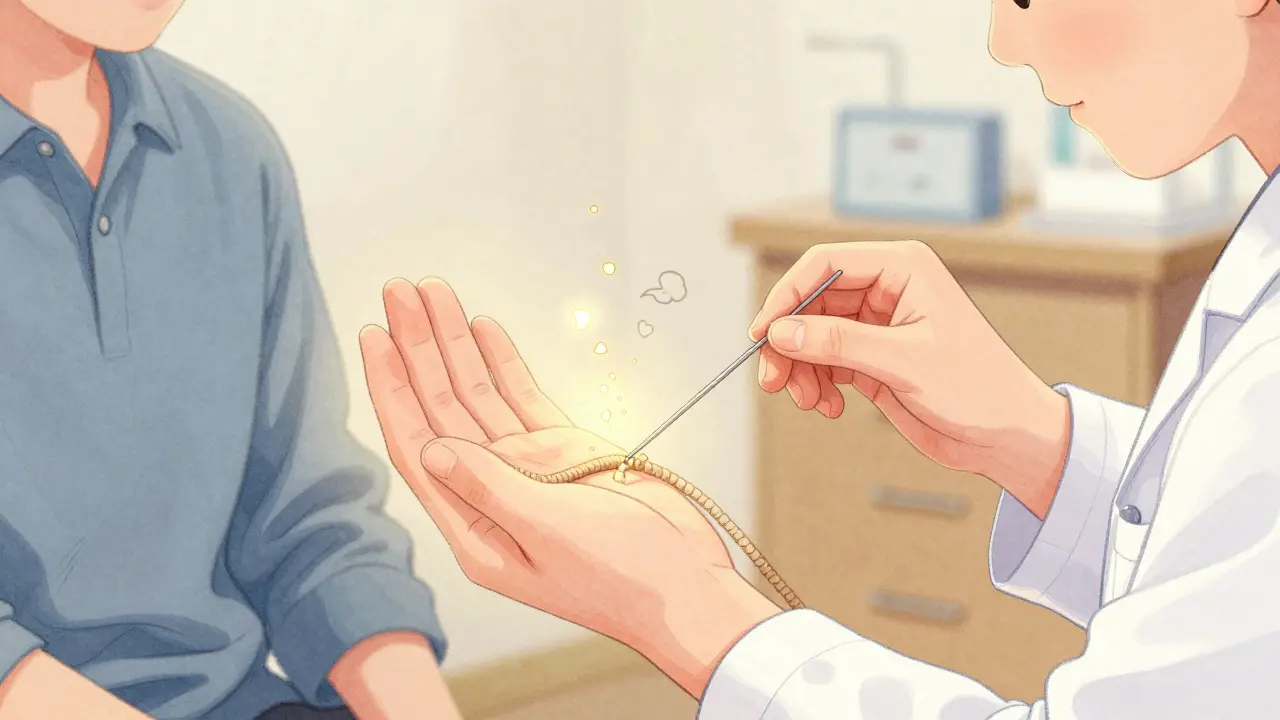
This is a quick, in-office procedure where a doctor uses a needle to cut the cord under the skin. No big incision. No hospital stay. You walk out the same day. Most people see their fingers straighten right away.
Success rates? Around 80-90% for early cases. The catch? It can come back. About 30-50% of people see the contracture return within three years. But for many, especially older adults or those who don’t want surgery, it’s a great first step.
Cost? Between $1,500 and $3,000. Much cheaper than surgery. Recovery is fast - most people resume normal activities in a few days.
Collagenase Injection (Xiaflex)
Xiaflex is a shot that dissolves the tough cords. It’s FDA-approved and works by breaking down collagen - the main protein in the cords. You get one injection per cord, then come back 24 hours later for the doctor to manually straighten your finger.
It works best on knuckle contractures. Success rates are 65-78%. For middle joint contractures, it’s less effective. Side effects include swelling, bruising, and sometimes skin tears. Some people report intense pain during the finger-stretching part.
Cost is high: $3,500 to $5,000 per injection. But if you follow the aftercare - stretching your finger 4-6 times a day for weeks - success jumps to 85%. Skip the exercises, and it fails more often.
Open Surgery (Fasciectomy)
This is the traditional option. The surgeon cuts out the abnormal tissue. It’s the most thorough fix. Success rates? 90-95% at first. Recurrence? Only 20-30% after five years.
The downside? Recovery takes 6 to 12 weeks. You need physical therapy. There’s a 15-25% risk of complications - nerve damage, infection, stiffness. About 3-5% of patients get permanent nerve injury.
Cost? $8,000 to $15,000. It’s the most expensive option. But if you’re young, active, and want the longest-lasting result, it’s often the best choice.
Dermofasciectomy
This is a more aggressive version of surgery. The surgeon removes both the abnormal tissue and the overlying skin, then replaces the skin with a graft. It cuts recurrence down to just 10-15% at five years.
But recovery is long - 3 to 6 months. Scarring is more noticeable. It’s usually only recommended for people who’ve had multiple recurrences or very severe cases.
What Doesn’t Work?
Many people try things that sound like they should help - but don’t.
- Corticosteroid injections: Sometimes used for painful nodules early on. But they don’t stop the cords from forming. Studies show only a 30% response rate. And repeated shots can thin the skin.
- Dupuytren’s gloves or splints: These are marketed as stretchers to prevent contracture. But a 2023 survey of over 1,500 users found 28% reported skin breakdown, and most saw no real improvement after six months.
- Stretching alone: If you already have a cord, stretching won’t break it. It might help with mild stiffness, but it won’t reverse the bend.
Doctors agree: if you’re past Stage 2, don’t waste time on splints or creams. Get evaluated by a hand specialist.
What to Expect After Treatment
Recovery isn’t just about the procedure. It’s about what you do after.
After needle aponeurotomy or collagenase, you’ll need to stretch your fingers 5-10 minutes, 4-6 times a day. Studies show people who stick to this for at least three months regain 95% of their finger motion. Those who quit after a month? Only 75% improvement.
After surgery, physical therapy is non-negotiable. You’ll need 2-3 sessions a week for 6-8 weeks. A study from Ohio State found patients who did more than 80% of their therapy got back almost all their hand function. Those who skipped sessions? Still stiff and weak.
Even after everything, you need to monitor your hand. Dupuytren’s can come back in the same spot - or show up in the other hand. About half of all patients develop it in both hands. One hand is usually worse than the other by 15-25 degrees.
Real People, Real Stories
On Reddit, a guitarist named "GuitarGuy42" had his ring finger stuck at 60 degrees. He got needle aponeurotomy. Within 48 hours, he could play again. "I thought I’d never strum a chord without pain," he wrote.
Another patient, "PalmProblem89," tried Xiaflex. His fingers straightened, but the pain during the stretch was brutal. "It felt like my tendons were snapping," he said. But he kept going. Six months later, he could put his hands in his pockets again.
On the flip side, a 2023 survey of 1,247 patients found 89% had trouble gripping things. 76% couldn’t wash their hair or brush their teeth easily. 68% said it affected their job - especially manual laborers. One factory worker said he lost his job because he couldn’t hold tools.
What’s Coming Next?
Research is moving fast. Gene therapy targeting the TGF-β1 protein - which drives the abnormal tissue growth - is in early trials. One study showed a 40% reduction in cord thickness after six months.
New devices like the "Fasciotome," cleared by the FDA in March 2023, let doctors cut cords with ultrasound guidance in just 12 minutes - half the time of traditional needle aponeurotomy.
Stem cell therapy using fat tissue is also being tested. Early results from Pittsburgh show a 55% drop in recurrence after two years. These treatments aren’t available yet, but they’re coming.
When to See a Doctor
You don’t need to wait until your fingers are stuck. If you notice:
- Painless lumps in your palm
- Difficulty laying your hand flat
- One finger starting to bend
- Family history of the condition
Get checked. Early diagnosis means more options. And if you’re over 50 with Northern European roots, it’s worth asking your doctor about it - even if you feel fine.
Bottom Line
Dupuytren’s contracture is not dangerous, but it can ruin your ability to use your hands. It’s slow, it’s genetic, and it doesn’t go away on its own. But it’s treatable.
For mild cases, watch and wait. For moderate cases, needle aponeurotomy or collagenase can restore function quickly. For severe cases, surgery offers the best long-term result.
The key is not to ignore it. And don’t waste money on unproven gadgets. Talk to a hand specialist. Get the facts. Then choose the option that fits your life - not just your diagnosis.
14 Comments
Meenal Khurana
I noticed a lump last year. Didn't think much of it. Now my ring finger won't straighten. Time to see a specialist.
Janice Williams
I find it profoundly disturbing that modern medicine has reduced such a genetically deterministic condition to a series of commercialized procedures. The pharmaceutical-industrial complex thrives on fear, not cure.
Rachel Kipps
i read this whole thing and i think it's really helpful... but i'm not sure if i should trust the stats. like, where did the 61% come from? i feel like some of this is just anecdotal.
caroline hernandez
From a biomechanical standpoint, the fibroblast-to-myofibroblast transition driven by TGF-β1 is the primary pathophysiological driver. Needle aponeurotomy interrupts the contractile unit, but doesn't address the epigenetic upregulation. That's why recurrence is so high. You need to target the signaling cascade, not just the end-stage cord.
Joseph Cooksey
Let me tell you something nobody's saying. These 'treatments'? They're all just temporary fixes. The real problem is that we've been lied to about what causes this. Glyphosate in our food, EMF radiation from cell phones, 5G towers-it's all triggering the TGF-β1 pathway. The AMA doesn't want you to know this because they're in bed with Big Pharma. I've seen 17 cases in my town since 2020. Coincidence? I think not.
Sherman Lee
I'm not saying it's the government... but why is this so common in Northern Europeans? Coincidence? Or is it something they fed us in the 70s? 🤔
rahulkumar maurya
I suppose the average Reddit reader finds this informative, but one must ask: where is the peer-reviewed longitudinal data? The statistics cited are cherry-picked from low-power studies. A true clinician would demand RCTs with >500 subjects, not anecdotal Reddit testimonials from guitarists.
Demetria Morris
I didn't want to admit I had this. I thought it was just aging. Now I feel guilty for ignoring it. I should've gone sooner.
Geri Rogers
Hey everyone-just had Xiaflex last week and wanted to say: DO THE STRETCHES. I skipped them for 2 days and felt like my hand was freezing. Now I do them 6x/day like clockwork. It hurts, but it's worth it. You got this 💪❤️
Samuel Bradway
I got needle aponeurotomy last month. Felt weird at first, like my finger was too loose. But now I can type again. No PT, no big deal. Just a quick poke and done. Best $2k I ever spent.
Caleb Sutton
They're hiding the truth. This isn't genetic. It's the vaccines. I know people who got it right after their second shot. Don't trust the doctors.
pradnya paramita
The key clinical indicator is the presence of palmar fascial thickening on ultrasound, with increased echogenicity and loss of the normal hypoechoic fascial layer. Early intervention with collagenase before PIP involvement yields superior functional outcomes. Consider baseline imaging for high-risk patients.
Jamillah Rodriguez
I tried the glove. It gave me a rash. Then I cried. Then I threw it out. 😭
Susheel Sharma
The data presented is statistically underpowered and methodologically flawed. The recurrence rates cited conflate all treatment modalities without adjusting for disease stage, patient age, or genetic markers. A true meta-analysis would require stratification by COL1A1 and PTCH1 polymorphisms-none of which are addressed here. This is pseudoscience dressed as medical advice.