
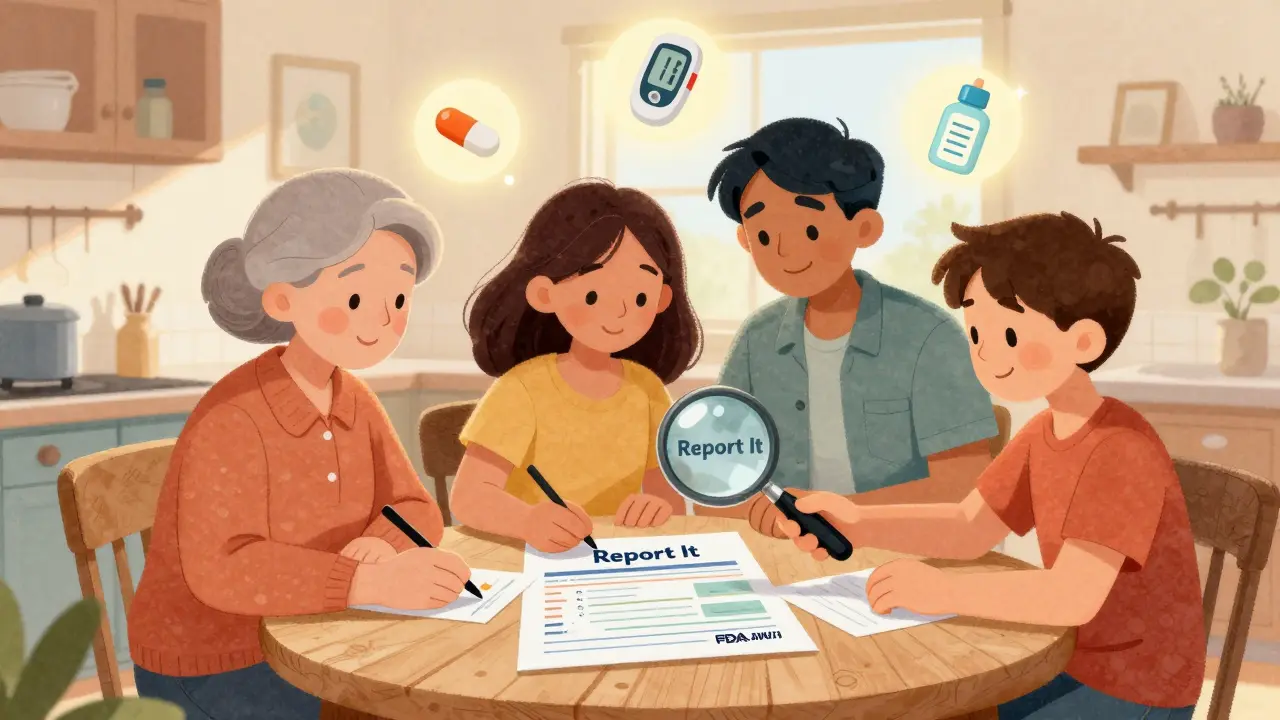
Adverse Event Checker
Is Your Event Reportable?
This tool helps you determine if your medical experience meets FDA criteria for reporting through MedWatch. The FDA defines a serious adverse event as one that results in:
- Death
- Life-threatening illness or injury
- Hospitalization (or prolonging an existing hospital stay)
- Permanent disability
- Birth defect
- Requires medical or surgical intervention to prevent permanent harm
If your experience matches any of these criteria, you should consider reporting it to FDA MedWatch.
Every year, millions of people in the U.S. take prescription drugs, over-the-counter medicines, or use medical devices like glucose monitors or insulin pumps. Most of the time, they work as expected. But sometimes, something goes wrong. A medication causes a severe rash. A device malfunctions during use. A patient ends up in the hospital after taking a common painkiller. When that happens, FDA MedWatch is the system that helps the government find out what went wrong - and potentially stop it from happening to others.
What is FDA MedWatch?
FDA MedWatch is not a hotline or a website you visit once and forget. It’s the U.S. Food and Drug Administration’s official system for collecting reports about harmful side effects, product failures, and safety problems with medical products. This includes prescription and over-the-counter drugs, biologics like gene therapies, medical devices, even CBD products and cosmetics.
The system has been around for decades, but it’s more important than ever. Clinical trials test drugs on thousands of people - but not millions. Real-world use reveals problems that never showed up in labs. That’s where MedWatch comes in. A single report from a patient or doctor can trigger a safety review, a label change, or even a product recall.
MedWatch works because of two types of reporters: those who are required to report, and those who can choose to report. Manufacturers, hospitals, and importers must report serious problems by law. But anyone - patients, caregivers, nurses, pharmacists - can file a report too. And that’s the key. Public reports make up about 20% of all submissions, but they often capture the real-life stories behind the data.
When Should You Report?
You don’t need to be a doctor to know when something is wrong. If you or someone you care about has a serious reaction after using a medicine or device, you should report it. The FDA defines a serious adverse event as one that results in:
- Death
- Life-threatening illness or injury
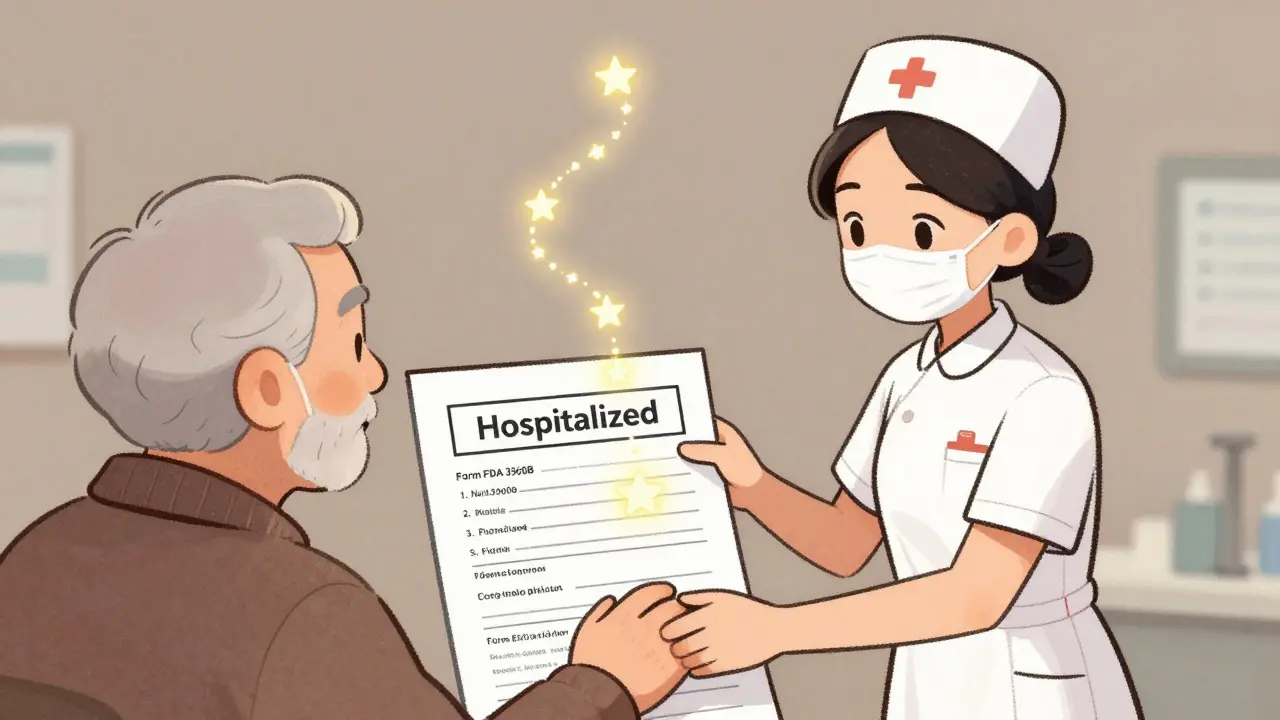
- Hospitalization (or prolonging an existing hospital stay)
- Permanent disability
- Birth defect
- Requires medical or surgical intervention to prevent permanent harm
For example: You take a new blood pressure pill and end up in the ER with a rapid heartbeat and chest pain. That’s reportable. Your diabetic partner’s glucose monitor gives false readings, and they nearly go into ketoacidosis. That’s reportable. A child develops a severe rash after using a new lotion. That’s reportable.
Even if you’re not sure - report it anyway. The FDA doesn’t expect you to be an expert. They just need the facts: what you took, when, and what happened.
How to Report: Two Forms, Two Paths
There are two simple forms depending on who you are.
Form FDA 3500B - For Patients and Consumers
This is the easiest one. It’s designed for people without medical training. You can fill it out online at the FDA’s MedWatch portal, or download and mail it. It asks for basic info:
- Your name and contact info (optional - you can report anonymously)
- The product name (drug, device, or cosmetic)
- When you used it
- What happened - in your own words
- Did you see a doctor? What did they say?
It takes about 10 to 20 minutes. The form has big buttons, clear fonts, and simple language - but some terms still trip people up. Words like “event abated” or “dose frequency” can be confusing. If you’re unsure, bring the form to your doctor. They can help explain what happened medically, and even submit it for you.
Form FDA 3500 - For Healthcare Professionals
Nurses, pharmacists, doctors, and other medical staff use this version. It’s more detailed because they have access to medical records. It asks for:
- Professional credentials (MD, RN, PharmD, etc.)
- Specialty (cardiology, oncology, etc.)
- Product details including dosage, route of administration
- Timeline of events
- Lab results or clinical notes (if available)
Most professionals complete this in under 15 minutes. One nurse practitioner in Texas told the FDA: “I get a confirmation letter every time. It makes me feel like my report matters.”
What Happens After You Submit?
Once you hit submit, your report goes into the FDA’s database - the Adverse Event Reporting System (AERS). It’s not just filed away. Trained analysts review thousands of reports every week, looking for patterns. If 10 different people report the same rare side effect from a new drug, that’s a red flag.
The FDA doesn’t respond to every individual report. But if your report is part of a trend, they might:
- Update the drug’s warning label
- Send out a safety alert to doctors
- Require the manufacturer to study the issue further
- Order a recall
Dr. Janet Woodcock, former head of the FDA’s drug center, said it best: “MedWatch reports are essential for identifying safety signals that may not have been evident during clinical trials.”
Why So Many Reports Are Missing
Here’s the hard truth: only 1% to 10% of serious side effects are ever reported. That means for every one report the FDA gets, 10 to 100 others go unreported.
Why? People don’t know how. They think it’s not their job. They assume “it was just bad luck.” Some are scared of the process. Others don’t realize their report could save someone else’s life.
The FDA admits this. Their own 2019 study found that 62% of consumers needed help understanding just three terms on the form. That’s why they’ve redesigned the online portal to be more user-friendly. Still, underreporting remains a huge problem.
Think of it this way: if 100 people have the same reaction to a drug, and only one reports it - the FDA sees one case. But if 10 people report it? Now they see a pattern. Now they act.
What You Can Do Right Now
You don’t need to wait for a crisis. Here’s how to be ready:
- Keep a list of all medications and devices you use - including doses and start dates.
- Save the labels and packaging. The lot number matters.
- Know what to report - if it caused hospitalization, disability, or nearly killed someone, it counts.
- Report even if you’re unsure. The FDA would rather have 100 false alarms than miss one real danger.
- Share the form with family, friends, or caregivers. Many seniors or people with limited mobility need help.
If you’re a caregiver for someone with chronic illness, this is especially important. A single report from you could lead to a life-saving change in how a drug is used.
What’s New in MedWatch?
In 2021, the FDA launched a redesigned MedWatch portal. It’s mobile-friendly, faster, and available in Spanish. You can now sign up for email alerts about drug recalls or label changes. The website also lets you view updated drug labels going back to 2002 - so you can see exactly what changed.
The FDA is also testing AI tools to help people fill out forms more accurately. In the future, your electronic health record might automatically flag a potential adverse event and ask if you want to report it. But for now, manual reporting is still the backbone of the system.
What About Other Countries?
The European Union has EudraVigilance. Canada has its own system. But in the U.S., MedWatch is the only official channel for reporting adverse events to the FDA. There are no alternatives. If you want your report to reach the FDA - this is the only way.
Frequently Asked Questions
Do I have to give my name when I report?
No, you can report anonymously. But if you leave your contact info, the FDA might follow up if they need more details. That’s rare - most reports are reviewed without contact.
Can I report a side effect from a supplement or CBD product?
Yes. MedWatch covers CBD products, dietary supplements, and cosmetics regulated by the FDA. Even if the product is sold online without a prescription, if it caused harm, report it.
What if I’m not sure if the reaction was caused by the product?
Report it anyway. The FDA doesn’t need you to prove causation. They look for patterns. If multiple people report similar events, they investigate further. Your report adds to the puzzle.
Do I need to go through my doctor to report?
No. Your doctor is not required to report. You can report yourself. But if you’re unsure about medical details, bringing the form to your doctor can help you fill it out more accurately.
How long does it take for the FDA to act on a report?
There’s no set timeline. Some reports lead to quick alerts - like a recall issued within weeks. Others take months or years if the signal is subtle. But every report is reviewed, analyzed, and added to the database. You’re helping build the evidence.
Next Steps: How to Get Started
Go to the FDA’s MedWatch website. Find the online reporting portal. Pick Form FDA 3500B if you’re a patient, or 3500 if you’re a professional. Answer the questions honestly. Don’t worry about perfection. Just give the facts: what, when, how bad.
Then - submit. It takes less time than ordering coffee online. But it could save someone’s life.
One report won’t change the world. But 1,000 reports? That’s how safety gets improved. That’s how drugs get safer. That’s how the system works.
9 Comments
Sandy Wells
MedWatch is great in theory but who has time for this? I got a rash from a new pill and just went to my doctor. He said 'it'll pass' and gave me a new prescription. That's all I need.
Desiree LaPointe
Oh honey, you mean the same FDA that approved Vioxx and then acted like it was surprised when people started dropping dead? 🤦♀️ Let me guess - next they’ll tell us aspirin causes ‘unforeseen metabolic chaos’ because someone once took it with a margarita. This isn’t safety - it’s performative bureaucracy with extra steps.
Johny Prayogi
Just filed my first MedWatch report after my mom’s insulin pump glitched and nearly sent her into DKA. Took 15 mins. No drama. No judgment. Just facts. If you’re hesitating - do it. You’re not bothering anyone. You’re protecting someone’s future. 💪❤️
Nicole James
Have you ever wondered… what if the FDA doesn’t actually want to fix anything? What if they’re just collecting data to sell to Big Pharma? I’ve seen the patterns - every time someone reports a serious reaction, the drug gets a new warning label… and the price goes up 30%. Coincidence? Or is this just surveillance disguised as safety? 🕵️♀️
Jackie Tucker
Oh look, another feel-good PSA about ‘reporting side effects.’ How noble. How virtuous. How utterly irrelevant. The real problem? The FDA’s database is a black hole of unread reports. I once submitted a 3-page narrative about a seizure after a new antihistamine. Got a robotic auto-reply. That’s not safety - that’s emotional labor for the state.
Thomas Jensen
I’ve been reporting every weird symptom since my husband’s chemo drug caused nerve damage. I know it’s not glamorous. I know no one reads them. But if one kid doesn’t get the same reaction because of what I wrote… then it mattered. And that’s all I need.
matthew runcie
Good post. Simple. Clear. I reported a weird reaction to a generic thyroid med last year. Took 10 minutes. No one called. No one thanked me. But I sleep better knowing I tried.
Paul Cuccurullo
It’s astonishing how many lives hang on a single report. A mother in Ohio, a veteran in Texas, a child in Arizona - all reporting the same rash, the same dizziness, the same collapse. These aren’t statistics. They’re stories. And each one deserves to be heard - not just filed. The system may be slow, but it’s the only one we have. And it works - if we make it work.
Allison Priole
So i just want to say i never knew you could report cbd stuff on medwatch like i thought it was all like ‘legal gray area’ and no one cared but turns out they do?? and i just reported my cousin’s hives after using a new gummy and i felt kinda powerful?? like wow i did a thing that might help someone else?? also i spelled hives wrong in the form but i think they got it??