

When you’re facing a cancer diagnosis, the immediate focus is on survival. But for many people, especially those in their 20s, 30s, or early 40s, there’s another quiet question lurking beneath the surface: Will I ever be able to have children? Chemotherapy doesn’t just attack cancer cells-it can also damage the ovaries or testes, sometimes permanently. The good news? There are proven ways to protect your fertility before treatment starts. And time is not on your side.
Why Fertility Preservation Matters Before Chemo
Not all chemotherapy drugs affect fertility the same way. But according to the American Society of Clinical Oncology, about 80% of common chemo regimens-especially those used for breast cancer, lymphoma, and leukemia-carry a high risk of damaging reproductive cells. Alkylating agents like cyclophosphamide are the worst offenders. They can cause premature ovarian failure in 30% to 80% of women under 40, depending on the dose and age. For men, sperm production can drop to zero after just one cycle of certain drugs. The goal of fertility preservation isn’t just about future dreams. It’s about control. When cancer treatment hits, your body changes fast. Your hormones shift. Your menstrual cycle stops. Your sperm count plummets. If you don’t act before treatment begins, you might lose the chance forever.Options for Women: Egg Freezing, Embryos, and Tissue
For women, there are three main options that have been used successfully for decades.- Embryo cryopreservation is the most established method. It involves stimulating the ovaries with hormones for 10-14 days, retrieving mature eggs, fertilizing them with sperm (from a partner or donor), and freezing the resulting embryos. Success rates are high: women under 35 have a 50-60% chance of a live birth per embryo transfer. But it requires sperm, which can be a barrier for single women or those without a partner.
- Oocyte cryopreservation (egg freezing) skips the fertilization step. Eggs are retrieved the same way, but frozen unfertilized. Vitrification-the modern freezing technique-keeps 90-95% of eggs alive after thawing. Pregnancy rates are around 4-6% per egg, meaning most women need to freeze 15-20 eggs to have a reasonable chance. It’s more flexible than embryo freezing, but still requires 10-14 days of hormone injections and clinic visits.
- Ovarian tissue cryopreservation is the only option for girls who haven’t gone through puberty or for women who can’t delay chemo. Surgeons remove a small piece of ovarian cortex (about the size of a thumbnail) through a minimally invasive laparoscopic procedure. The tissue is frozen, then later reimplanted when the patient is ready to conceive. Success rates are around 65-75% for restoring ovarian function. Over 200 live births have been reported globally since the first successful transplant in 2004. It’s still considered experimental by the FDA, but it’s the only option for prepubertal patients.
Some women also consider ovarian suppression using GnRH agonists like goserelin (Zoladex). These are monthly shots that temporarily shut down ovarian function during chemo. Studies show they can reduce the risk of premature ovarian failure by 15-20%. But they don’t guarantee fertility. They’re often used alongside other methods, not as a standalone solution.
Options for Men: Sperm Banking Is Simple-And Effective
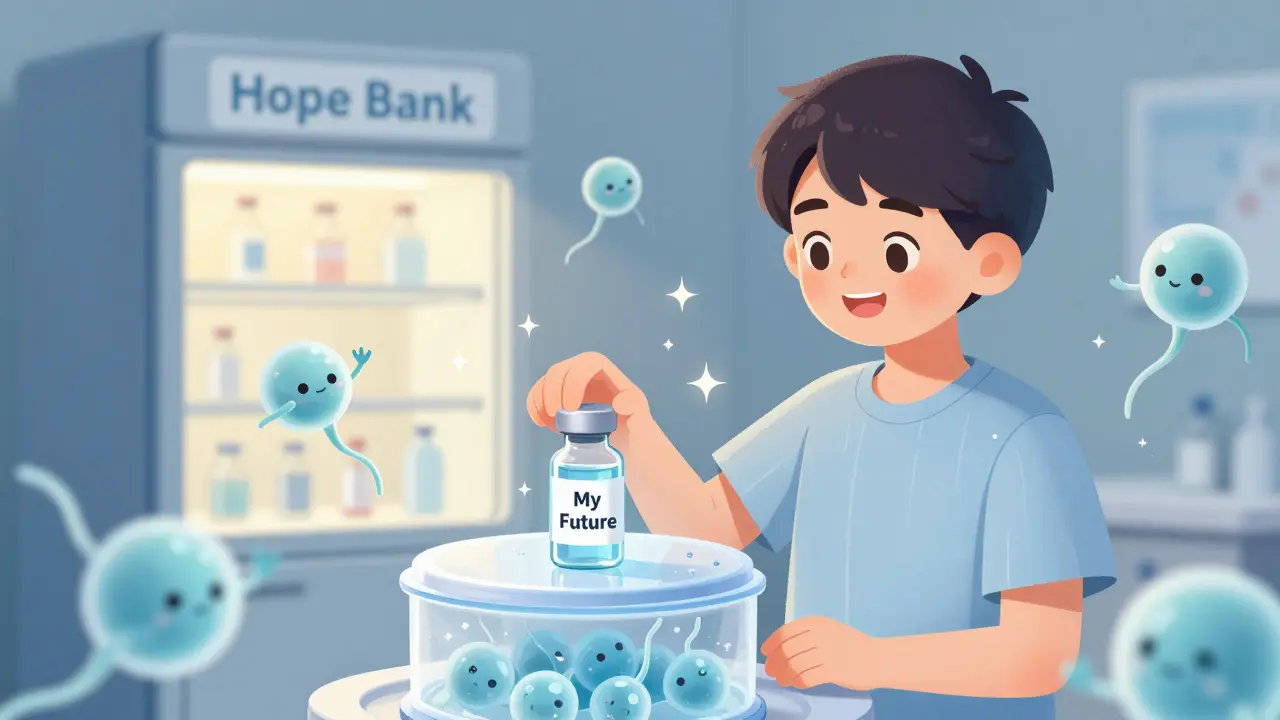
For men, the path is simpler. Sperm banking is quick, non-invasive, and highly reliable. You provide a sample-usually after 2-3 days of abstinence-via masturbation. The lab freezes it using glycerol-based solutions. Post-thaw, 40-60% of sperm typically remain motile. One sample can be divided into multiple vials for future use. There’s no need to wait for hormone treatments or surgery. Many clinics can collect samples within 24 hours of diagnosis.For boys who haven’t reached puberty, testicular tissue cryopreservation is still experimental. Researchers are working on growing sperm from frozen tissue in the lab, but no live births have been reported yet. For now, it’s only available through clinical trials.
What About Radiation? Shielding Can Help
If you’re getting radiation therapy-especially to the pelvis or abdomen-shielding can make a big difference. Custom lead shields placed over the testicles can reduce radiation exposure by 50-90%. For women, radiation to the ovaries is harder to shield, but in some cases, doctors can move the ovaries out of the radiation field through a procedure called ovarian transposition. This involves surgically relocating the ovaries higher in the abdomen, away from the radiation beams. It’s not perfect, but it’s been used successfully for decades in cervical and rectal cancer patients.Timing Is Everything
This is the hardest part: you have to act fast. The window for egg or embryo freezing is typically 10-14 days from the start of hormone stimulation to egg retrieval. But some clinics now offer “random-start” protocols, which let you begin stimulation at any point in your cycle-cutting the wait time to just 11 days on average. For men, sperm banking can be done in a single day. But if you wait too long, chemo may already be damaging your sperm count. Some leukemia patients have just 48-72 hours between diagnosis and the first chemo dose.According to data from the Oncofertility Consortium, only 37% of eligible patients complete any form of fertility preservation. Why? Because treatment starts too quickly. Doctors are focused on survival. Patients are overwhelmed. And not every hospital has a fertility specialist on call.
Cost, Insurance, and Access
Fertility preservation isn’t cheap. Egg freezing can cost $10,000-$15,000 per cycle. Sperm banking is much cheaper-usually under $1,000 for initial processing and one year of storage. Insurance coverage varies wildly. As of 2026, 24 U.S. states require insurers to cover fertility preservation for cancer patients. But Medicaid covers it in only 12 states. Many patients report denials, especially for egg freezing.Access is another hurdle. Rural patients travel an average of 178 miles to reach a fertility clinic. Urban patients? Just 22 miles. That gap can mean the difference between saving your fertility and losing it.
Emotional and Practical Realities
This isn’t just a medical decision. It’s emotional. A 2022 study of 127 cancer patients found that 68% of women under 35 regretted not pursuing fertility preservation when delays pushed them past the 21-day window. Reddit threads are full of stories: women crying while freezing eggs the day before chemo. Men who didn’t bank sperm because they thought they’d “just get better.” Parents of young children who were told there was “nothing they could do.”And even if you do everything right, success isn’t guaranteed. Freezing 20 eggs doesn’t mean you’ll have a baby. It means you’ve given yourself a fighting chance. Some women go on to have children naturally after chemo. Others need IVF. A few use donor eggs or adoption. The path forward is personal.
But one thing is clear: if you don’t ask, you won’t be offered. Oncologists are trained to treat cancer-not fertility. You have to bring it up. Say it out loud: “I want to know my options for having children after this.”
What’s Next? New Hope on the Horizon
Science is moving fast. In 2023, the FDA approved a new closed-system vitrification device that cuts contamination risks by 92%. Researchers in Europe successfully activated frozen ovarian tissue in the lab-bypassing the need for reimplantation. And a $4.7 million NIH trial is testing artificial ovaries grown from stem cells. Early results in primates show 68% follicle survival.By 2040, half of all childhood cancer survivors will need fertility services. The infrastructure is expanding. More hospitals now have dedicated oncofertility teams. More insurers are covering it. More patients are speaking up.
But for now, the tools we have are real. And they work. If you’re facing chemotherapy, don’t assume your fertility is gone. Ask. Research. Act. Because your future self might thank you for it.
Can I still preserve my fertility if I’ve already started chemotherapy?
Once chemotherapy begins, the chances of preserving fertility drop sharply. Eggs and sperm can be damaged within hours or days of the first dose. If you’ve already started treatment, it’s still worth asking your oncologist or a fertility specialist. Some options, like ovarian suppression with GnRH agonists, may still be helpful if started early enough. But procedures like egg or sperm freezing are no longer possible after chemo begins.
Does fertility preservation delay cancer treatment?
In most cases, no. Fertility preservation procedures like sperm banking or ovarian tissue removal can be done in under a week. Even egg freezing, which takes 10-14 days, rarely delays cancer treatment by more than 2 weeks. For aggressive cancers like leukemia, doctors will not delay treatment. But for slower-growing cancers like breast or lymphoma, the delay is often manageable and considered safe. The European Society of Human Reproduction and Embryology warns that delaying treatment by more than 2 weeks can increase relapse risk in high-risk cases, so timing must be carefully coordinated with your oncology team.
Is egg freezing worth it if I’m over 35?
Success rates decline with age. For women over 35, the chance of a live birth per frozen egg drops below 3%. That means you may need to freeze 25-30 eggs or more to have a reasonable chance. But if you’re facing chemotherapy that will likely destroy your remaining eggs, even a low chance is better than none. Many women over 35 still choose to freeze eggs-not because they’re certain they’ll use them, but because they want to keep the option open. It’s about preserving choice, not guaranteeing a baby.
What if I’m single and don’t want to use donor sperm?
You still have options. Oocyte cryopreservation (egg freezing) doesn’t require sperm. You can freeze your eggs now and use them later with donor sperm-or choose adoption or surrogacy. Some clinics offer “egg-only” freezing packages specifically for single women. Ovarian tissue cryopreservation is also an option, though it’s more invasive and still considered experimental. You don’t need a partner to protect your future fertility.
Can I get pregnant naturally after chemotherapy?
Yes, some people do. About 20-30% of women under 30 regain natural fertility after chemo, especially if they received lower doses or non-alkylating drugs. Men may also see sperm recovery over time, though it can take years. But it’s unpredictable. Even if you get your period back or sperm counts improve, your fertility may still be reduced. That’s why preserving fertility before treatment is the safest bet. Don’t rely on the hope of natural recovery.
Are there any risks to fertility preservation?
The procedures themselves are generally safe. Hormone stimulation for egg freezing can cause bloating, mood swings, or rarely, ovarian hyperstimulation syndrome (OHSS)-but this is uncommon in cancer patients because they’re monitored closely. Surgery for ovarian tissue removal carries standard risks like infection or bleeding, but it’s minimally invasive. GnRH agonists can cause menopausal symptoms like hot flashes and bone loss. The biggest risk isn’t medical-it’s missing the window. Waiting too long to ask means losing the chance altogether.
9 Comments
Oana Iordachescu
While I appreciate the clinical precision of this article, I must point out that the FDA's approval of 'experimental' procedures like ovarian tissue cryopreservation is a deliberate obfuscation of regulatory boundaries. The pharmaceutical-industrial complex has long prioritized profit over patient autonomy-witness how insurance denials are systematically engineered to shift costs onto individuals. The 24-state mandate? A performative gesture. Real access requires dismantling the entire oncology-fertility industrial apparatus, not just adding a few more vials to the freezer.
Michaela Jorstad
You're not alone in feeling overwhelmed. Seriously-this is one of those moments where your body is being invaded from every side: cancer, hormones, time, money, fear. But please, please don’t give up. Egg freezing? It’s exhausting. It’s expensive. It’s emotional. But it’s also possible. And you deserve to have options. Even if it’s just one egg. Even if it’s just hope. You’re not just fighting cancer-you’re fighting for your future self. And that matters. 💪❤️
Ellen Spiers
Let us not indulge in the sentimental fallacy that fertility preservation constitutes 'control.' The very premise presumes a biomedical model that pathologizes reproduction as an endogenous right, rather than a socially constructed expectation. The data cited-50-60% live birth rates per embryo transfer-are statistically misleading; they conflate cumulative success with per-cycle efficacy. Moreover, the normalization of 'vitrification' as a panacea ignores the systemic erosion of reproductive autonomy under neoliberal healthcare frameworks. The 37% completion rate is not a failure of patient agency-it is a symptom of structural neglect.
Robin bremer
bro this article literally saved my life. i just got diagnosed and was about to say 'nah i dont care' but then i read about sperm banking and was like... wait, i can still be a dad??!? 😭❤️🔥
Courtney Hain
Have you considered that the entire fertility preservation framework is a capitalist construct designed to make vulnerable people pay for the illusion of choice? The FDA’s 'experimental' label for ovarian tissue transplants isn’t scientific-it’s financial. Why? Because if they approved it, insurance would be forced to cover it. But if it’s 'experimental,' then hospitals can charge $50k and call it 'research.' And don’t get me started on the fact that egg freezing requires 14 days of hormone injections, which means you have to be physically stable enough to endure them-which excludes anyone with aggressive cancers. This isn’t empowerment. It’s a performance of hope that benefits clinics, not patients. The real solution? Universal healthcare that treats fertility as a human right, not a premium add-on. And until then, we’re just rearranging deck chairs on the Titanic.
Caleb Sciannella
As someone who has worked in oncology ethics for over a decade, I find the framing of fertility preservation as a 'personal choice' deeply problematic. It shifts responsibility from systemic failure to individual initiative. In countries with universal healthcare, fertility preservation is integrated into standard oncology protocols-not an optional add-on. The disparities in access-178 miles for rural patients versus 22 miles for urban-are not accidents. They are policy failures. We must advocate not just for awareness, but for structural reform: mandatory oncofertility consults, federal funding for storage, and elimination of insurance exclusions. The science is ready. The ethics are clear. The political will is the only missing ingredient.
James Roberts
Wow. So let me get this straight: you’re telling me that if I’m a guy with leukemia and I wait 72 hours because I thought 'I’ll just do it later,' I’m basically signing a death warrant for my future kids? And if I’m a woman over 35, I’m supposed to freeze 30 eggs just to have a shot? And if I’m poor and live in Montana, I’m just out of luck? And the FDA calls this 'experimental'? Yeah. I get it. We’re all just one step away from being told to 'have a nice day' while our reproductive futures get auctioned off to the highest bidder. 😌
madison winter
It’s ironic, isn’t it? We’re told to fight for survival, yet the very act of survival requires us to perform fertility in a way that feels like a second surgery. The emotional labor of deciding whether to freeze eggs while your body is already being dismantled by chemo… it’s not medical. It’s theological. And yet, no one talks about the grief of choosing between a future you might never have, and a present you’re barely surviving. I froze mine. I don’t know if I’ll ever use them. But I needed to believe I still had a choice. Even if it was an illusion.
Jeremy Williams
Just to clarify: sperm banking is not 'simple.' It’s one of the most emotionally complex acts a man can perform-especially if he’s never been sexually intimate before. The clinic room, the privacy curtain, the awkward silence, the fear of being judged for 'not being man enough' to produce… it’s a trauma layered on top of trauma. And yet, no one talks about that. They just say 'it’s easy.' It’s not. It’s sacred. And it deserves more than a pamphlet and a 10-minute window before chemo starts.