
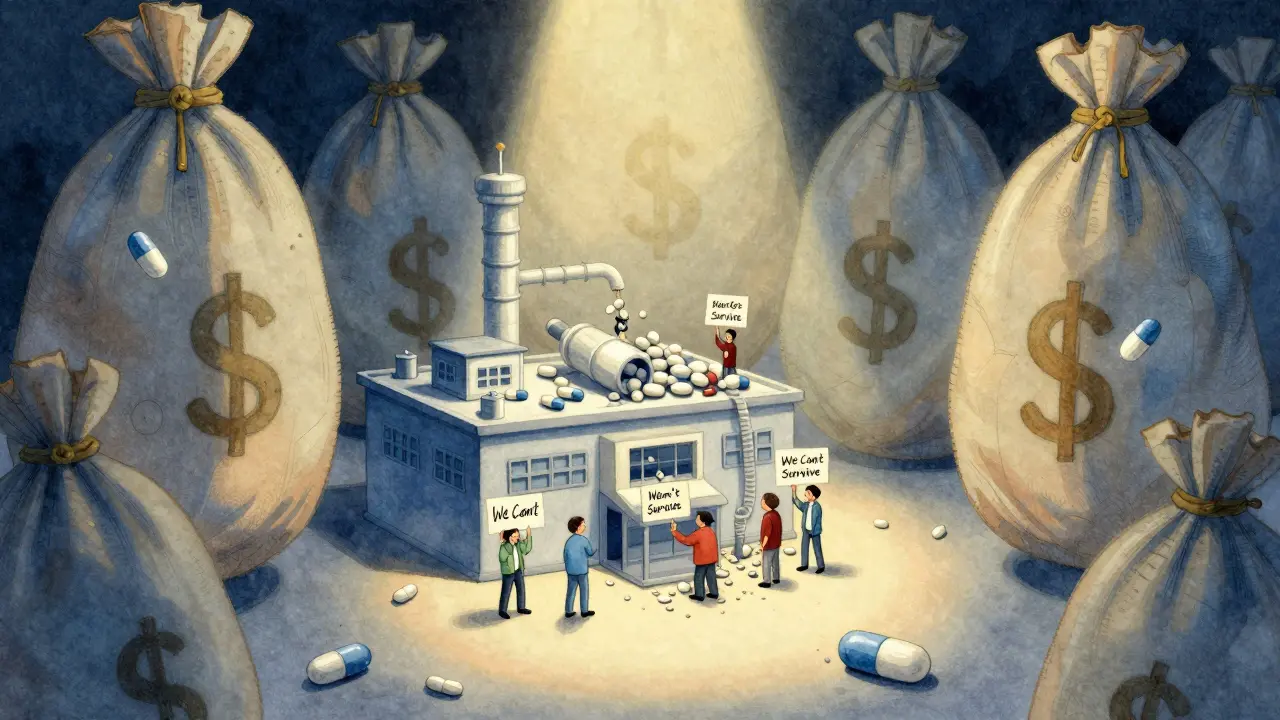
Generic drugs make up 90% of prescriptions filled in the U.S., but they only cost 10% of what brand-name drugs do. That sounds like a win for patients - and it is. But behind those low prices is a manufacturing industry struggling to stay alive. In 2025, the U.S. generic drug market brought in just $35 billion, down 6.1% over five years. Meanwhile, companies like Teva lost $174 million last year. How can a sector that saves the healthcare system over $400 billion annually be losing money? The answer lies in how these companies make money - or fail to.
The commodity trap: why simple generics are no longer profitable
Most people think of generic drugs as cheap copies of brand-name pills. And for the most part, they are. But that’s exactly the problem. When a drug’s patent expires, dozens of manufacturers jump in to make the same tablet. The result? A race to the bottom on price. One company cuts its price by 5 cents. Another cuts it by 10. Soon, the profit margin on a single pill is less than a penny. Take a common blood pressure pill like lisinopril. Over 20 companies make it. The wholesale price dropped from $12 per 30 tablets in 2015 to under $2 today. Manufacturers are lucky to make 20% gross margin - down from 50-60% just a decade ago. Some are selling at a loss just to keep their factories running. That’s not business. That’s survival. This isn’t just about greed or greedier buyers. Pharmacy benefit managers (PBMs) - the middlemen between insurers and pharmacies - have negotiated pricing so aggressively that manufacturers have almost no control. They’re forced to accept whatever price the PBM offers. And if they refuse, they’re dropped from formularies. No formulary placement means no sales. No sales means no revenue. No revenue means no factory.The rise of complex generics: where real margins live
Not all generics are created equal. Some drugs are hard to copy. They might need special delivery systems - like patches, inhalers, or long-acting injections. Others have tricky chemical formulas that are hard to replicate without years of R&D. These are called complex generics. And they’re where the profitable players are now focusing. For example, lenalidomide, a drug used to treat multiple myeloma, has a complex formulation that requires precise manufacturing controls. Only a handful of companies can make it reliably. Teva started producing it as a generic and saw revenue jump 18% year-over-year. That’s not because they sold more pills. It’s because they could charge more - and still make 40%+ margins. Complex generics aren’t easy to make. They require specialized equipment, deep scientific knowledge, and FDA approval that can take 3-5 years. The cost to file one Abbreviated New Drug Application (ANDA) averages $2.6 million. But the payoff? Higher barriers mean fewer competitors. Fewer competitors mean pricing power. That’s the shift happening across the industry: from volume to value.Contract manufacturing: selling your factory, not your pills
Another path out of the commodity trap is to stop selling drugs altogether. Instead, sell your ability to make them. Contract manufacturing organizations (CMOs) don’t brand their own products. They take orders from brand-name companies or generic makers who don’t have their own production lines. This segment is growing fast - projected to hit $91 billion by 2030. Companies like Egis Pharmaceuticals launched dedicated CMO divisions in 2023 to tap into this demand. Why does this work? Because manufacturing a drug is expensive. Building a cGMP-compliant facility costs over $100 million. Most small generic companies can’t afford it. So they outsource. Big pharma doesn’t want to tie up capital in factories either. They’d rather focus on R&D and marketing. For a generic manufacturer, becoming a CMO means stable, recurring revenue. No more bidding wars over a $0.02 pill. Instead, you get paid to run a line, meet quality standards, and ship batches. Margins are lower than specialty generics - maybe 15-20% - but they’re consistent. And you’re not at the mercy of PBM price cuts.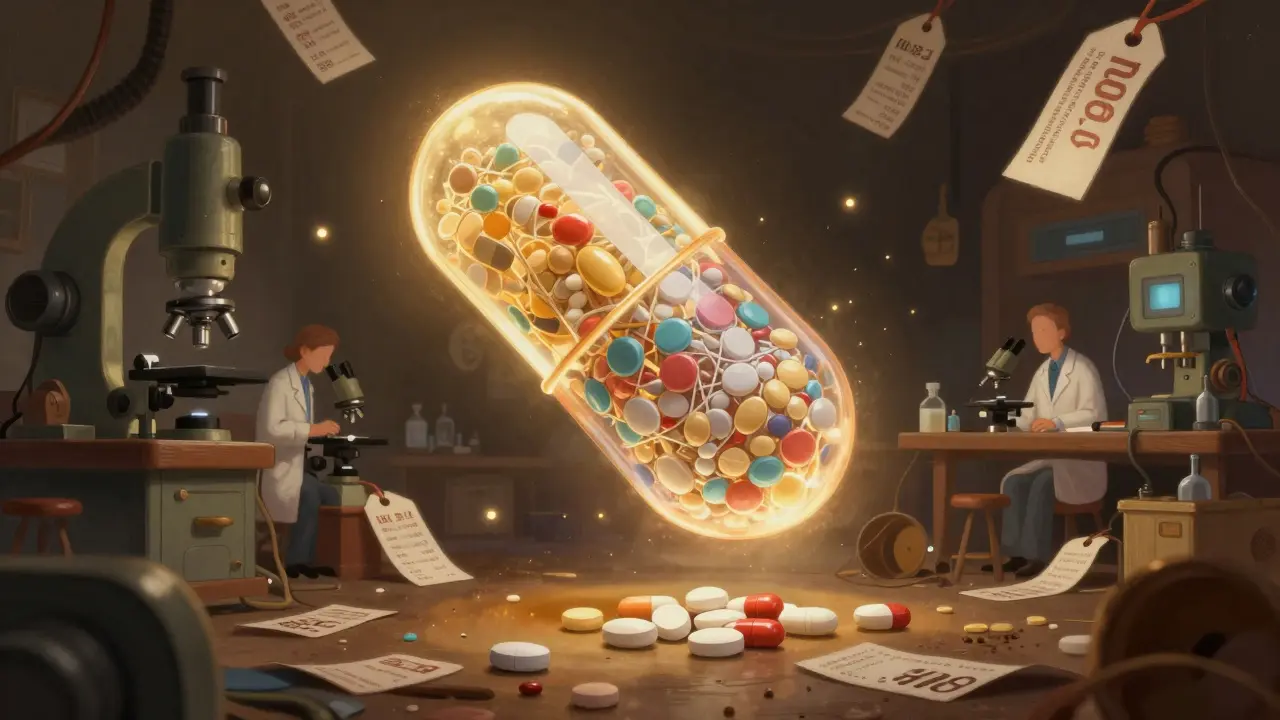
Consolidation: the only way to survive the squeeze
The market is getting smaller, but the players are getting bigger. In 2020, Mylan and Upjohn merged to form Viatris. Teva sold off its non-core assets. Companies that stayed small and stuck to simple generics are disappearing. Why? Because scale matters. Only big players can afford the $100 million factories, the legal teams to fight patent challenges, and the supply chains to handle raw material shortages. A small manufacturer trying to enter the market today has a 65% chance of failing within two years, according to McKinsey. That’s not because they’re bad. It’s because the system is rigged against them. Mergers also help companies diversify. Viatris didn’t just combine two companies - it cut out its OTC and API divisions to focus on what it could profitably do: distribute complex generics and biosimilars. Teva doubled its R&D budget to $998 million in 2024, not to invent new drugs, but to make better versions of existing ones - like extended-release versions of old drugs that are harder to copy. This isn’t innovation for innovation’s sake. It’s survival.Global differences: why Europe and Asia still make money
The U.S. isn’t the whole world. In Europe, generic drug prices are regulated differently. Governments set reimbursement rates, but they don’t force manufacturers into bidding wars. As a result, margins are higher - often 30-40%. In India and China, production costs are lower, and governments actively support generic exports. That’s why over 70% of the world’s generic APIs (active pharmaceutical ingredients) come from these two countries. But it’s not all easy. Emerging markets come with risks: currency swings, political instability, and shifting regulations. A manufacturer in Brazil might make good margins one year, then lose everything when the government changes its pricing rules. Still, for companies looking to grow, these markets offer a lifeline. The U.S. is a high-volume, low-margin market. Europe is medium-volume, medium-margin. Asia is high-volume, low-cost. Smart companies are playing all three.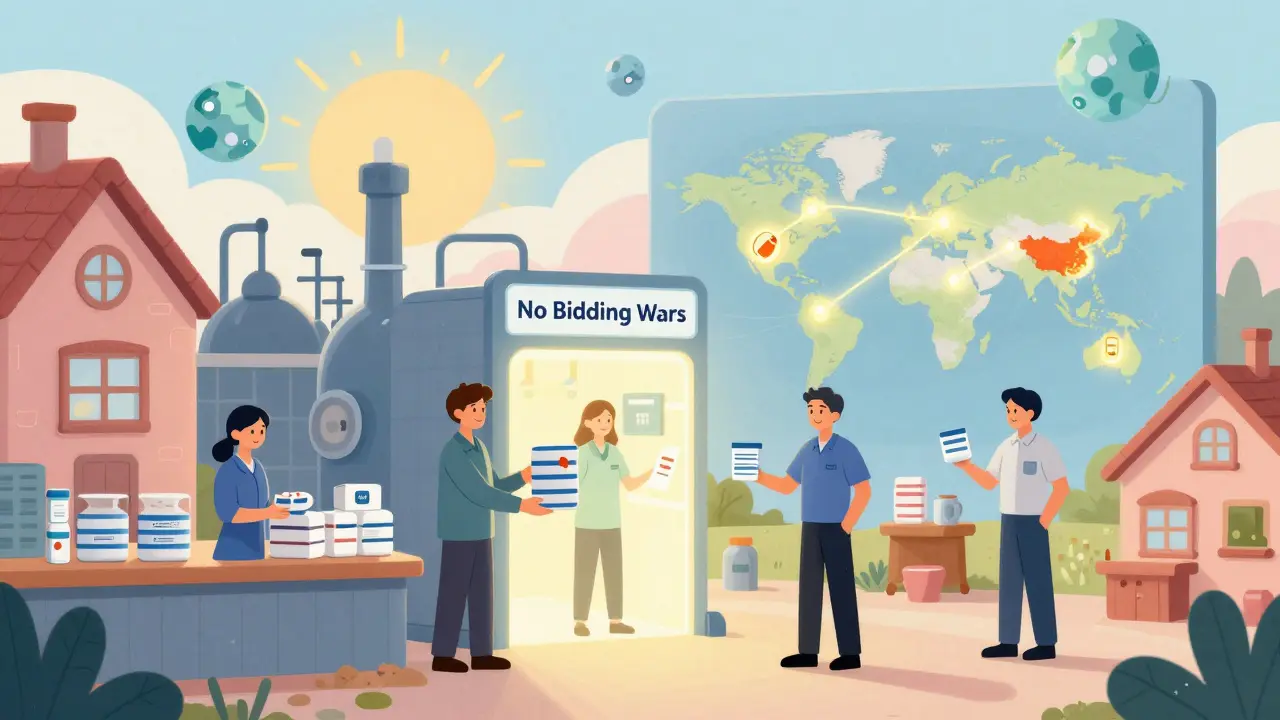
The sustainability question: can this system last?
Here’s the real problem: if no one can make money making generic drugs, who will make them? We’ve already seen shortages. In 2024, the FDA listed over 300 drugs in short supply - many of them generics like insulin, antibiotics, and chemotherapy agents. Why? Because the price is too low. No one wants to produce them. The system is failing its own purpose. Dr. Aaron Kesselheim from Harvard put it plainly: “The relentless price competition in generics has created a market failure.” But there’s hope. Over 50 blockbuster drugs will lose patent protection between 2025 and 2033. That includes Humira, Eliquis, and Enbrel - drugs that each brought in over $10 billion a year. When those patents expire, there will be a massive wave of new generic opportunities. Companies that have invested in complex generics, CMOs, and global supply chains will be ready. Those still stuck in the commodity trap won’t. The Association for Accessible Medicines predicts the global generic market will hit $600 billion by 2033. That’s not a fantasy. It’s math. But only if the industry can fix its business model.What’s next for generic manufacturers?
If you’re a generic manufacturer today, you have three choices:- Get out - sell your business to a bigger player or exit the market.
- Get complex - invest in hard-to-make drugs, specialty formulations, or combination products.
- Get contracted - turn your factory into a service provider for others.
Why are generic drug prices so low in the U.S.?
Generic drug prices in the U.S. are driven down by intense competition and powerful pharmacy benefit managers (PBMs) who negotiate prices on behalf of insurers. With dozens of manufacturers making the same drug, the only way to win business is to offer the lowest price - often below production cost. This system saves patients money but makes it nearly impossible for manufacturers to earn a profit on simple generics.
What’s the difference between simple and complex generics?
Simple generics are easy-to-copy pills like aspirin or metformin, made by dozens of companies with low margins. Complex generics involve difficult formulations - like injectables, inhalers, or extended-release tablets - that require advanced technology and regulatory expertise. Fewer companies can make them, so competition is lower, and margins are higher - often above 40%.
Can generic manufacturers still be profitable today?
Yes - but only if they move away from commodity drugs. Companies focusing on complex generics, biosimilars, or contract manufacturing are seeing growth and healthy margins. Teva and Viatris are examples. Those still producing basic pills like ibuprofen or hydrochlorothiazide are losing money or going out of business.
Why do generic drug shortages keep happening?
Shortages happen when manufacturers can’t make a profit on a drug. If the price is too low to cover production, shipping, and compliance costs, companies stop making it. This is especially common for older, low-cost drugs like antibiotics or chemotherapy agents. The system rewards low prices but doesn’t reward reliability - leading to critical shortages.
Is contract manufacturing a good option for small generic makers?
Yes - if they have a compliant manufacturing facility. Contract manufacturing removes the risk of pricing wars and gives steady income. Instead of trying to sell pills, you sell production capacity. Many small and mid-sized manufacturers are shifting to this model because it’s more predictable and less dependent on PBM negotiations.
12 Comments
Katherine Carlock
Wow this is wild. I had no idea generic drugs were this broken. I fill prescriptions all the time and just assumed they were cheap because manufacturers were efficient. Turns out they’re barely scraping by. That’s scary when you think about shortages.
Sona Chandra
INDIA IS THE REAL HERO HERE. We make 70% of the world’s APIs and you guys still act like we’re some back-alley pharmacy? We’re the reason your insulin isn’t $500 a vial. Stop pretending you’re saving money when you’re just outsourcing your crisis.
Jennifer Phelps
so like if the price of lisinopril dropped to under 2 bucks how come my copay is still 15? who’s pocketing the difference? pbs are the real villains here
beth cordell
THIS IS WHY WE NEED TO FIX HEALTHCARE 😭💔
Generic drugs are literally life-saving and we’re making it impossible for people to make them? That’s not capitalism, that’s just dumb. Also, shoutout to India 🇮🇳👏👏👏
Lauren Warner
Let’s be real. This isn’t about profitability. It’s about systemic failure. The FDA approval process is a bottleneck designed to protect big pharma’s monopolies under the guise of safety. Complex generics? That’s just regulatory capture dressed up as innovation. And don’t even get me started on PBMs - they’re the middlemen who turned healthcare into a casino.
Jose Mecanico
Interesting how the article mentions consolidation but doesn’t talk about antitrust. If Viatris and Teva control so much of the complex generic space, aren’t we just replacing one monopoly with another? Maybe we need public manufacturing options.
Alex Fortwengler
Of course the system’s rigged. Big Pharma owns Congress. PBMs are just their puppets. And now they’re pushing ‘complex generics’ so they can charge more under the guise of ‘innovation’. Classic. They want you to think this is a supply issue when it’s a profit issue. Wake up. The pills aren’t expensive - the greed is.
jordan shiyangeni
It’s not just the manufacturers failing - it’s the entire ideological framework of American healthcare that equates ‘low price’ with ‘public good.’ That’s a fallacy. A drug that costs $0.02 per pill but requires a $100 million facility to produce safely is not ‘cheap’ - it’s a public health liability. The market doesn’t reward sustainability, only extraction. And now we’re paying the price in shortages, in deaths, in preventable suffering. This isn’t capitalism. This is negligence masquerading as economics.
Abner San Diego
Let’s not pretend this is about business. America’s been outsourcing its medicine to India and China for decades while pretending we’re the land of innovation. We don’t make anything anymore - we just negotiate prices and call it progress. Meanwhile, our factories rust and our people die waiting for insulin. Maybe it’s time we stop blaming PBMs and start rebuilding our own supply chain.
Eileen Reilly
so like… if complex generics are the future why arent more people talking about this? and also why do i still pay 20 bucks for amoxicillin? someone’s making money somewhere
Monica Puglia
For anyone feeling overwhelmed by this - you’re not alone. This system is broken, but change is possible. Small manufacturers turning into CMOs? That’s smart. India’s role? Vital. We need policy that rewards reliability over lowest bid. And we need to stop treating medicine like a commodity. You’re not buying toothpaste - you’re buying survival. 💙
Cecelia Alta
Everyone’s missing the point. This isn’t about complex generics or contract manufacturing - it’s about the fact that we’ve turned healthcare into a financial instrument. The real winners here aren’t Teva or Viatris - it’s the hedge funds that own them. The people making the pills? They’re getting paid minimum wage. The patients? They’re getting rationed. And the CEOs? They’re getting bonuses. This isn’t a business model crisis. It’s a moral collapse. And until we stop pretending profit and public health can coexist without one destroying the other, we’re just rearranging deck chairs on the Titanic.