
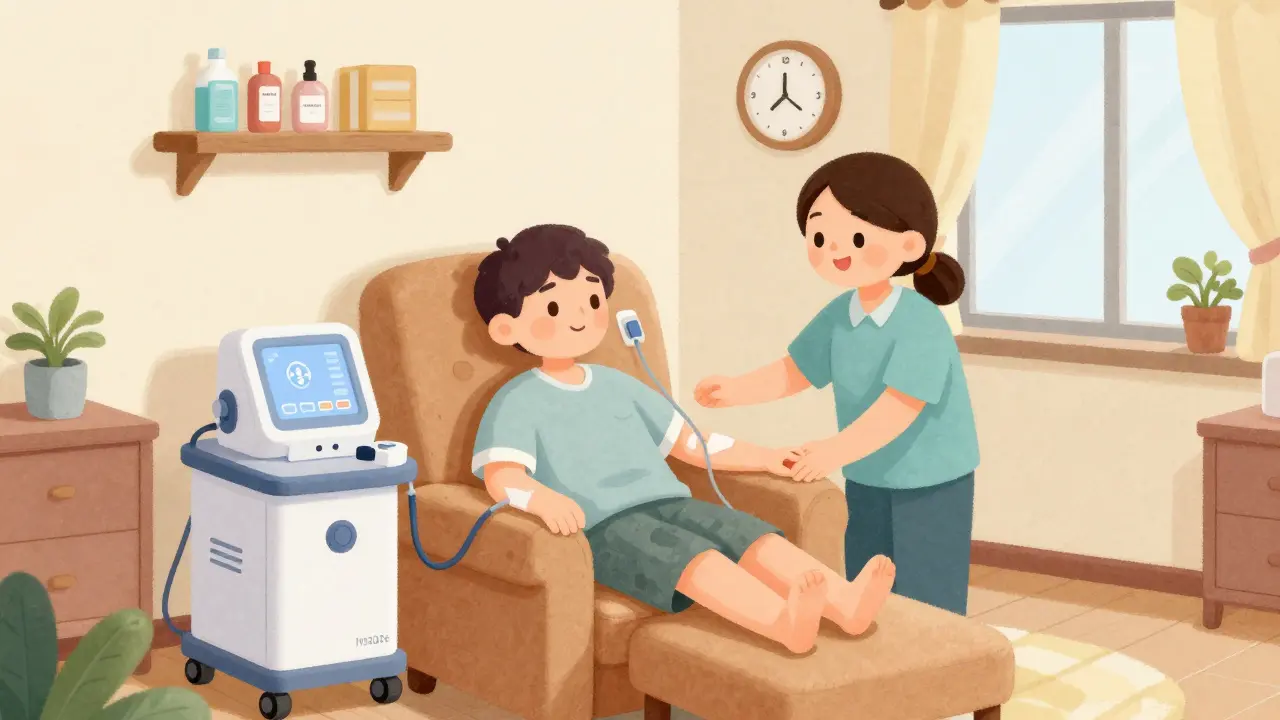
For many people living with end-stage renal disease, dialysis isn’t just a medical procedure-it’s a daily reality that shapes everything from work to sleep to family life. In-center hemodialysis, done three times a week at a clinic, is common. But for those who can manage it, home hemodialysis offers a different path-one with more control, better outcomes, and a lot more responsibility.
What Is Home Hemodialysis?
Home hemodialysis (HHD) is when patients perform their own dialysis treatments in their living spaces, using specialized machines. Unlike in-center dialysis, where nurses handle most of the setup and monitoring, HHD puts the patient-and often a trained care partner-in charge. This isn’t a last resort. It’s a clinically supported option that’s been shown to improve survival, reduce hospital visits, and boost quality of life.
The machines used today are far more advanced than the bulky systems of the 1980s. Modern devices like the NxStage System One are portable, quiet, and designed for home use. They connect to a standard water line and electrical outlet, making setup possible in most households. But before anyone starts dialyzing at home, there’s a long road of preparation.
Training: How Long Does It Really Take?
Training for home hemodialysis isn’t a quick course. It’s a hands-on, multi-week process that covers everything from needle insertion to emergency response. The time required varies, but most programs take between 3 and 12 weeks, with 4 to 6 weeks being the most common range.
Here’s what training typically includes:
- Setting up a clean treatment area-usually a dedicated 6x6 foot space with proper drainage and ventilation
- Learning how to clean and disinfect the machine, tubing, and dialyzer after every session
- Mastering vascular access care, including needle insertion (self-cannulation) into an arteriovenous fistula
- Understanding fluid removal targets and how to adjust dialysis prescriptions based on weight and blood pressure
- Recognizing machine alarms and troubleshooting common issues like air bubbles or low pressure
- Managing supplies: ordering, storing, and tracking dialysate, needles, and disinfectants
- Logging every treatment, including time, fluid removed, and any symptoms
Training isn’t just about technical skills. Patients must also understand how diet, medications, and fluid intake affect their treatment. Many programs use simulation tools-like virtual reality trainers-to help patients practice needle insertion before touching their own skin. Studies show this approach cuts training time and reduces anxiety. At the University of Washington Medical Center, using VR simulators raised patient competency rates from 78% to 92%.
And here’s a key point: you can’t do this alone. Most programs require a trained care partner. This could be a spouse, adult child, or close friend. They learn everything the patient learns. Why? Because if your machine alarms in the middle of the night, you need someone who knows how to stop the treatment, shut off the blood flow, and call for help. About 30% of potential candidates are turned away simply because they don’t have someone who can commit to this role.
Home Hemodialysis Schedules: More Than Just Three Times a Week
Not all home hemodialysis is the same. The schedule you choose directly impacts your health. There are three main types:
1. Conventional Home Hemodialysis
This mirrors the standard in-center schedule: three sessions per week, lasting 3 to 4 hours each. It’s the easiest to transition into if you’ve been doing in-center dialysis. But it doesn’t offer the biggest clinical advantages.
2. Short Daily Home Hemodialysis
This is where home dialysis really shines. Five to seven sessions per week, each lasting 2 to 3 hours. Because treatments are shorter but more frequent, your body doesn’t get overloaded with toxins and fluid between sessions. Studies show this schedule leads to:
- 28% lower risk of death compared to in-center dialysis
- Better blood pressure control-many patients can reduce or stop blood pressure meds
- Reduced left ventricular hypertrophy (thickening of the heart muscle)
- Improved energy levels and fewer cramps
One patient in Melbourne, who switched from in-center to short daily HHD, said, “I used to sleep 12 hours after dialysis. Now I play with my grandkids.”
3. Nocturnal Home Hemodialysis
This involves dialyzing while you sleep, typically 6 to 10 hours, 3 to 7 nights a week. The slow, long sessions allow for near-complete toxin removal without the stress on your body. It’s especially effective for:
- Lowering phosphate levels by 42% compared to conventional dialysis
- Reducing phosphate binder use by an average of 3.2 tablets per day
- Improving sleep quality (many patients report feeling more rested)
Some patients find it hard to sleep with the machine running. But newer models are whisper-quiet, and many use earplugs or white noise machines without issue.

Outcomes: Why Home Dialysis Works Better
Multiple large studies confirm that home hemodialysis leads to better outcomes than in-center treatment.
- A 2019 review in the American Journal of Kidney Diseases found home dialysis patients scored 37% higher on quality-of-life measures.
- The U.S. Renal Data System reported a 15-20% lower mortality rate for home hemodialysis patients, especially those on frequent schedules.
- A 2021 study in the Clinical Journal of the American Society of Nephrology showed short daily HHD patients had significantly fewer hospitalizations for heart failure and infections.
Why? Because home dialysis allows for more complete, gentle, and frequent clearance of waste. In-center treatments are often rushed, and fluid buildup between sessions can strain the heart. Home dialysis avoids this.
But outcomes aren’t just about numbers-they’re about daily life. Patients report:
- 85% feel more energetic
- 92% say schedule flexibility improved their lives
- 78% save at least 10 hours per week by skipping clinic trips
On the flip side, challenges exist. Machine alarms can be stressful. Supply logistics-ordering, storing, and rotating equipment-take effort. And the emotional toll of being responsible for your own treatment isn’t always talked about. One Reddit user wrote, “I love my freedom, but some nights I cry because I’m so tired of being the one who has to fix everything.”
Space, Equipment, and Home Setup
You don’t need a hospital room, but you do need a dedicated space. Most machines require:
- A 6x6 foot area with a hard floor (no carpet)
- A dedicated 120-volt, 20-amp electrical circuit
- A water line with 40-80 psi pressure
- A floor drain or special waste line for dialysate fluid
Water quality is critical. The system must use reverse osmosis (RO) to purify water before it becomes dialysate. Monthly water and dialysate cultures are required, along with logs of chlorine levels and disinfection cycles. Medicare and state health departments enforce these rules strictly.
Portable machines like the NxStage System One make travel easier. You can take it on a plane with advance notice. But standard home machines? They stay home. If you’re traveling, you’ll need to arrange dialysis at a clinic-something that requires planning months in advance.

Barriers and Real-World Challenges
Despite the benefits, home hemodialysis isn’t for everyone-and it’s not widely available.
- Only 12% of U.S. dialysis centers offer HHD training programs.
- 71% of nephrologists say lack of staff training time is the biggest barrier.
- 63% say reimbursement doesn’t cover the cost of training and follow-up visits.
And then there’s the care partner issue. Many patients are single, live alone, or have family members who can’t commit to the training. Some centers are experimenting with remote monitoring and AI-assisted alarms, but these aren’t yet standard. Solo home hemodialysis is possible with special devices and training-but it’s rare and tightly regulated.
Even with all the advantages, the learning curve is steep. Most patients need 20-30 supervised treatments before they feel confident. Self-needling is the hardest skill-about 45% of trainees struggle with it. That’s why many programs now use training gloves and practice arms before moving to real skin.
The Future: More Access, Better Tech
Things are changing. The 2021 Advancing American Kidney Health initiative set a goal of 80% of new dialysis patients starting with home dialysis or transplant by 2025. We’re not there yet-but progress is happening.
- New FDA-approved devices like the WavelinQ endoAVF system make vascular access easier.
- Medicare’s 2025 payment changes will tie reimbursement to patient outcomes, not location, making home dialysis more financially viable for clinics.
- Companies are developing AI-powered monitors that can detect early signs of complications and alert caregivers.
As technology improves and awareness grows, home hemodialysis will likely become the standard-not the exception-for many patients. But right now, it’s still a choice that requires courage, support, and a lot of preparation.
Is Home Hemodialysis Right for You?
If you’re considering it, ask yourself:
- Do I have a reliable care partner who’s willing to learn and show up?
- Can I handle the responsibility of managing my own treatment?
- Do I have space and plumbing in my home that can support the equipment?
- Am I ready for the emotional weight of being in control-when things go wrong, I’m the one who has to fix it?
It’s not easier than in-center dialysis. But for many, it’s better. Better sleep. Better health. More life.
Can I do home hemodialysis by myself?
Solo home hemodialysis is possible but rare and highly regulated. Most programs require a trained care partner to be present during every treatment. Some portable machines, like the NxStage System One, have features that allow solo use under strict protocols, but this requires additional training, special equipment, and approval from your nephrologist. The majority of patients still use a care partner for safety.
How long does home hemodialysis training take?
Training typically lasts between 3 and 12 weeks, with most programs completing in 4 to 6 weeks. The length depends on your learning pace, the type of machine, and whether you’re learning self-needling. Some centers now use virtual reality simulators to shorten training to as little as 3 weeks while improving competency rates.
What are the most common problems with home hemodialysis?
The most frequent issues include machine alarms (especially during the first few months), difficulty with needle insertion (self-cannulation), managing supplies and inventory, and emotional stress from being responsible for your own care. About 67% of users report machine alarms as a major source of anxiety, and 52% say care partner dependency causes tension in relationships.
Is home hemodialysis covered by Medicare?
Yes. Medicare covers home hemodialysis the same way it covers in-center dialysis, including all equipment, supplies, training, and follow-up visits. As of 2025, Medicare pays for up to 25 training sessions for home hemodialysis-more than for peritoneal dialysis. You may still have out-of-pocket costs for things like travel or non-covered medications, but the core treatment is fully covered.
What’s the difference between home hemodialysis and peritoneal dialysis?
Home hemodialysis uses a machine to filter blood through an external dialyzer, similar to in-center dialysis. Peritoneal dialysis uses the lining of your abdomen (peritoneum) as a filter, with fluid exchanged through a catheter. HHD typically requires more equipment and a care partner, but offers more precise control over fluid and toxin removal. Peritoneal dialysis is more flexible for solo use but has higher infection risks and is less effective at removing certain toxins.
Can I travel with a home hemodialysis machine?
Yes, but it depends on the machine. Portable systems like the NxStage System One are designed for travel and can be taken on planes with advance notice. Standard home machines are not portable and require you to arrange dialysis at a clinic when traveling. Always plan at least 4-6 weeks ahead and coordinate with your dialysis center to ensure you have access to treatment abroad or during trips.
13 Comments
Shivam Pawa
Home hemodialysis is one of those things that sounds insane until you live it. The machine whirring softly at 3am, the smell of disinfectant in the kitchen, the way your hands know where to stick the needle before your brain catches up. It’s not glamorous. But waking up without that crushing fatigue? Worth every drop of sweat and fear.
Diane Croft
My mom started HHD last year. She’s got five sessions a week now. Used to be couch-bound. Now she gardens. Bakes pies. Takes the bus to the library. It’s not magic. It’s science. And it works.
Donna Zurick
Training was brutal but the VR simulators saved me. Practicing needle insertion on a fake arm for weeks made the real thing feel like muscle memory. No more shaking. No more tears. Just steady hands and quiet nights.
Tobias Mösl
This whole home dialysis thing is a corporate scam. Big Pharma and the clinics don’t want you doing this yourself. They make more money off you being trapped in a chair for hours. They push this ‘freedom’ narrative so you’ll stop asking why the system is so broken. And don’t get me started on how they charge for water filters. It’s predatory.
tatiana verdesoto
I work with a lot of dialysis patients. One thing I always say: the care partner isn’t just a helper. They’re the emotional anchor. The person who holds your hand when the alarm goes off at 2am. The one who remembers to order extra saline. The quiet hero nobody talks about. Give them a medal.
Ethan Zeeb
Anyone who thinks this is easy is delusional. You’re not just managing a machine. You’re managing your entire life. Your sleep, your diet, your relationships, your sanity. And if your partner gets tired? Too bad. You’re still the one who has to fix it. This isn’t empowerment. It’s exploitation dressed up as innovation.
Darren Torpey
Imagine your body is a car. In-center dialysis is like taking it to the shop every three days for a 3-hour oil change. Home dialysis? You’re doing a 20-minute top-off every night. No buildup. No sputtering. No engine stress. You’re not just surviving-you’re humming.
Lebogang kekana
Here in South Africa, we don’t even have access to these machines. My cousin in the US does HHD. I cried when she sent me a video of her doing it at home. She’s alive. I’m watching my uncle die in a clinic with no water pressure. This isn’t healthcare. It’s a lottery.
Jessica Chaloux
I’ve been doing HHD for 4 years. Some nights I just sit there and cry. Not because I’m in pain. Because I’m so damn tired of being the only one who knows how to fix this. And no one ever asks if I’m okay. Not even my husband. 😔
Mariah Carle
There’s a deeper truth here. Dialysis isn’t just about kidneys. It’s about autonomy. About reclaiming your body from the medical industrial complex. The machine is just the tool. The real treatment? Learning to trust yourself again. That’s the real surgery.
Justin Rodriguez
Just wanted to add: water quality matters more than people think. If your RO system fails, you’re not just getting dirty water-you’re getting endotoxins. That’s how you get sepsis. Monthly cultures aren’t bureaucracy. They’re your lifeline. Always log them. Always.
Raman Kapri
The claim that home hemodialysis reduces mortality by 15-20% is statistically misleading. The studies cherry-pick patients who are already healthier, more educated, and have better social support. The real-world data shows no significant difference for the average patient. This is marketing masquerading as medicine.
Megan Nayak
They say home dialysis gives you freedom. But freedom from what? From being a patient? Or freedom to be a slave to a machine? You trade one form of control for another. And when you’re alone at 3am with an alarm blaring, who’s really in charge? The machine? Or the ghost of your own fear?