
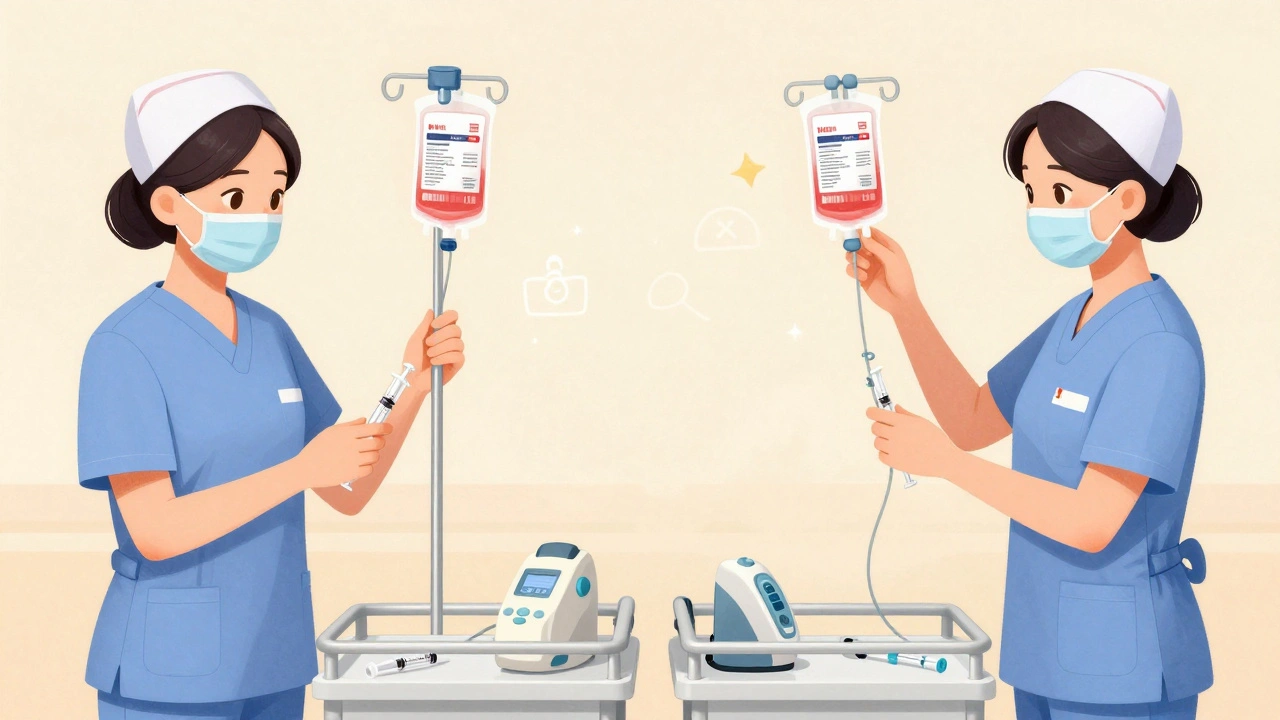
Every year, thousands of patients are harmed because a medication was given wrong - not because the drug itself is dangerous, but because the system failed to catch a simple mistake. The most dangerous errors don’t come from rare drugs. They come from common ones: insulin, heparin, potassium, chemotherapy. These are high-alert medications. A single wrong dose can kill. That’s why hospitals don’t just rely on one person to check them. They require a second set of eyes - an independent double check.
What Makes a Medication High-Alert?
A high-alert medication isn’t necessarily more likely to be misused. It’s the consequences that make it dangerous. If you give a patient 10 times too much insulin, they can go into a coma within minutes. Give too much potassium chloride intravenously, and their heart can stop. These drugs have a narrow safety margin - meaning the difference between the right dose and a deadly one is tiny. The Institute for Safe Medication Practices (ISMP) first published its official list of high-alert medications in 2001. Their latest update, released January 9, 2024, includes 19 categories. Not all of them require a double check every time. But the highest-risk ones do. These include:- IV insulin (both infusions and pushes)
- Neuromuscular blocking agents (paralytics)
- Potassium chloride concentrate (1 mEq/mL or higher)
- Potassium phosphate concentrate (1 mEq/mL or higher)
- IV heparin (including flushes over 100 units/mL)
- Direct thrombin inhibitors (like argatroban and bivalirudin)
- Chemotherapeutic agents (all forms)
- Injectable narcotic patient-controlled analgesia (PCA) pumps
- Total parenteral nutrition (TPN) and lipid infusions
- Continuous renal replacement therapy (CRRT) solutions
These aren’t just “maybe dangerous.” They’re known killers if misused. That’s why hospitals treat them differently.
What Is an Independent Double Check (IDC)?
An independent double check isn’t two people standing next to each other nodding at a label. It’s not a rushed sign-off while someone scrolls on their phone. It’s a formal, structured process where two licensed clinicians - usually a nurse and another nurse, or a nurse and a pharmacist - verify the medication separately, without talking to each other until both are done. According to VHA Directive 1195 (updated October 18, 2024), an IDC requires:- Two clinicians working alone and apart
- Each verifying all five rights: right patient, right medication, right dose, right route, right time
- Independent calculation of doses (no sharing math)
- Verification of pump settings, bag labels, and IV tubing
- Comparison of results only after both have completed their checks
This independence is everything. If the first person says, “It looks like 10 units,” the second person might unconsciously look for 10 units - even if it’s actually 100. That’s called confirmation bias. Real independent checks catch that.
ECRI Institute found in 2023 that when done correctly, IDCs prevent 95% of high-alert medication errors before they reach the patient. But when done poorly - like two people checking together - effectiveness drops to 40%. That’s not just a small difference. It’s the difference between life and death.
Which Medications Actually Need a Double Check?
Not every high-alert medication requires an IDC every single time. That’s a common misunderstanding. The ISMP warns against overusing manual double checks. They’re time-consuming, labor-intensive, and if used too broadly, they become meaningless. Hospitals use a risk-based approach. Here’s what most top-performing institutions do:- Always require IDCs: IV insulin, heparin infusions, chemotherapy, paralytics, potassium chloride, PCA pumps
- Require IDCs in high-risk situations: Pediatric patients, renal failure, ICU settings
- Use technology instead: Smart pumps with dose error reduction systems for infusions like TPN or CRRT solutions
- Don’t require IDCs for low-risk forms: Oral insulin, subcutaneous heparin flushes, oral potassium
Providence Health System limits IDCs to only those medications listed on their MAR (Medication Administration Record). WVU Medicine requires them for 10 specific categories. The Veterans Health Administration mandates them for all high-alert meds. The difference? One is blanket, the others are smart.
Research from the Journal of Patient Safety (2017) shows that institutions using IDCs only for the highest-risk drugs - and pairing them with smart pumps - reduced errors by 63%. Those relying only on manual checks saw just a 42% reduction.
How to Verify Correctly: The Five Rights Plus
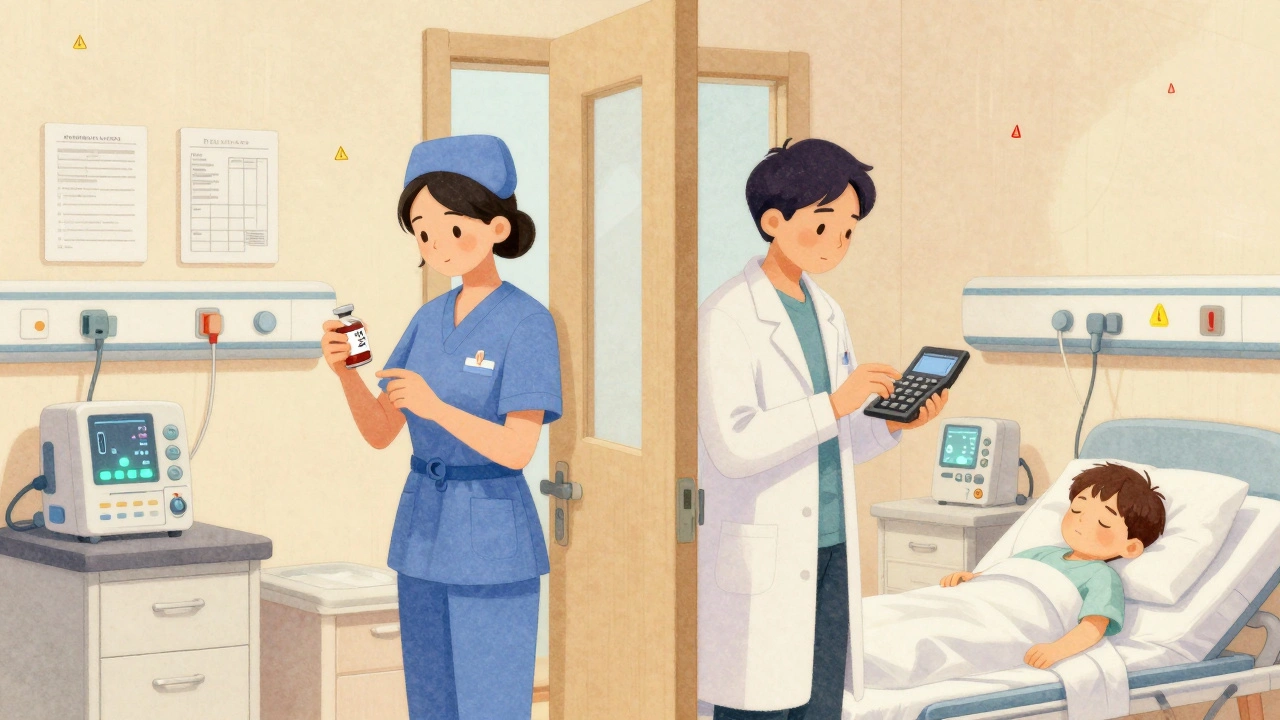
A good double check doesn’t just match the label to the order. It digs deeper. Here’s what a real IDC includes:- Right patient: Two forms of ID - name and date of birth. Not just a wristband. Scan the barcode if available.
- Right medication: Check the drug name on the order, the label on the vial/bag, and the eMAR. Don’t assume “heparin” means the same thing - is it 10 units/mL or 1000? Check the concentration.
- Right dose: Recalculate the dose independently. If the order says 5 units/hour insulin and the pump is set to 50, you catch it. Don’t trust the first person’s math.
- Right route: Is this meant to go IV? Or is it supposed to be subcutaneous? Giving IV potassium through a peripheral line can kill. Double-check the route.
- Right time: Is this dose due now? Or is it scheduled for later? Administering a dose early or late can cause harm, especially with insulin or anticoagulants.
- Right pump settings: For infusions, verify rate, volume, and duration. Is the pump programmed for mL/hour or units/hour? Is the lockout correct on a PCA pump?
At Johns Hopkins Hospital, after implementing strict IDCs for IV heparin, dosing errors dropped from 12.7% to 2.3% in 18 months. That’s not magic. That’s process.
Why Double Checks Often Fail
The biggest problem isn’t lack of policy. It’s poor execution.- Simultaneous checks: Two nurses checking together - one reads, the other nods. That’s not independent. It’s a formality.
- Time pressure: In busy units, nurses skip steps. One nurse signs off, the other just initials. No real verification.
- No training: Many nurses have never been taught how to do a real IDC. They think it’s just signing a form.
- Staff shortages: In the ER or ICU, finding a second nurse during a code is impossible. That’s why some hospitals allow exceptions - but only if documented.
- Bad documentation: If the eMAR doesn’t require dual electronic signatures, there’s no proof the check happened.
A 2023 Reddit thread from ICU nurses revealed a grim pattern: “I’ve caught 3 critical errors in 6 months through real double checks. But I’ve seen 12 rushed ones that missed them.”
And it’s not just nurses. Pharmacists, doctors, and techs all need to understand the stakes. A 2022 survey of 1,200 nurses found 78% believed all high-alert meds need double checks. But experts say that’s the wrong approach. Too many checks mean they become background noise.
How Hospitals Get It Right
The best systems don’t just have rules - they have culture, training, and tech.- Dedicated time: At Mayo Clinic, IDC time is built into staffing models. Nurses aren’t punished for taking 2 extra minutes.
- Competency training: Cleveland Clinic requires a 2-hour, hands-on IDC training with a 95% pass rate. Nurses can’t sign off until they prove they know how to do it right.
- Technology integration: 78% of Magnet-recognized hospitals use eMAR systems that require two electronic signatures. Smart pumps auto-calculate doses and flag outliers.
- Leadership buy-in: When administrators stop pushing for speed and start rewarding safety, behavior changes.
- Regular audits: Chart reviews check if double checks were truly independent. If not, retraining happens.
At Providence Health System, they started with just 5 medications requiring IDCs. They tracked errors for a year. Then they added more. Slowly. Carefully. That’s how you avoid overwhelm.
What’s Next for Medication Safety?
The future isn’t more human checks. It’s smarter systems.- Smart pumps are now interoperating with eMARs - if the order says 10 units/hour, the pump won’t let you set 100.
- AI tools are being piloted to flag mismatched doses before they’re even drawn.
- The High-Alert Medication Safety Coalition (ISMP, ASHP, AHA, Joint Commission) is pushing for national standardization.
- By 2028, ECRI predicts a 40% drop in manual double checks as tech takes over routine verification.
But here’s the truth: technology won’t replace human judgment. It will free it up. When pumps handle the math, nurses can focus on the patient - noticing a change in breathing, a drop in blood pressure, a confused look. That’s where real safety lives.
High-alert medications aren’t going away. But the way we handle them is changing. The goal isn’t to check every drug. It’s to make sure the ones that could kill are never given wrong.
What medications require a double check in most hospitals?
Most hospitals require independent double checks for IV insulin, heparin infusions, chemotherapy drugs, neuromuscular blocking agents, potassium chloride concentrate (1 mEq/mL or higher), and patient-controlled analgesia (PCA) pumps. These are the most dangerous if dosed incorrectly. Some also include total parenteral nutrition (TPN), CRRT solutions, and high-concentration sodium chloride.
Is a double check always required for every high-alert medication?
No. The Institute for Safe Medication Practices (ISMP) advises against using double checks for every high-alert medication. Overuse reduces effectiveness and creates fatigue. Hospitals should focus on the highest-risk drugs - like IV insulin and paralytics - and use technology (like smart pumps) for others. A risk-based approach is more effective than a blanket rule.
What’s the difference between a double check and an independent double check?
A regular double check might involve two people looking at the same thing together - one reads the label, the other agrees. An independent double check means two clinicians verify everything separately, without talking, then compare results only after both are done. This prevents confirmation bias and catches hidden errors.
Can a pharmacist do the second check instead of a nurse?
Yes. Many hospitals use pharmacists as the second checker, especially for complex infusions or chemotherapy. Pharmacists are trained in dosing calculations and drug interactions. However, the second person must be licensed and trained in the specific medication. In some settings, like the VA, only nurses are allowed to perform the second check for consistency.
What happens if there’s no second person available during an emergency?
In emergencies like cardiac arrest, standard double-check protocols are often waived under code blue rules. But this must be documented immediately after the event. The medication given, the reason for bypassing the check, and who gave it must all be recorded. Many hospitals use automated systems (like smart pumps) during emergencies to reduce risk when human checks aren’t possible.
Are electronic signatures enough for a double check?
Electronic signatures are required in most hospitals, but they’re not enough on their own. The system must enforce that two different people sign, and it must require verification of all five rights before allowing the second signature. If the eMAR lets someone bypass the check or auto-fills fields, it defeats the purpose. True independence means both people actively verify - not just click.
Final Thoughts: Safety Isn’t a Checklist - It’s a Mindset
You can have the best policy in the world. But if your team sees double checks as a box to tick, patients are at risk. Real safety happens when people understand that a single mistake with one of these drugs can end a life. It’s not about following rules. It’s about caring enough to pause, to question, to verify - even when you’re tired, even when you’re rushed.The future of medication safety isn’t more paperwork. It’s better training, smarter tech, and a culture that values verification over speed. The goal isn’t to catch every error. It’s to make sure the ones that could kill - never get through.
9 Comments
shalini vaishnav
The notion that hospitals still rely on human double-checks in 2024 is frankly embarrassing. We have smart pumps that auto-calculate, barcode scanning that prevents wrong-patient errors, and AI-driven dose validation systems that outperform tired nurses after a 12-hour shift. Relying on manual checks is a relic of pre-digital medicine - and it’s why patient safety metrics in the US are still lagging behind countries that actually invested in automation.
vinoth kumar
I work in a rural hospital in India and we don’t even have smart pumps. We do double checks because we have to. But I’ve seen nurses who’ve been doing this for 20 years catch errors no machine ever would - like spotting a typo in a handwritten order that said ‘10 units’ but meant ‘1 unit’. Tech helps, but it doesn’t replace experience. We adapt what we have.
Archie singh
Anyone who thinks independent double checks are still effective hasn’t worked in a real hospital. I’ve seen nurses check each other while scrolling TikTok. The system is broken. The real solution isn’t more checks - it’s removing the high-alert labels entirely and replacing these drugs with safer alternatives. Heparin should be obsolete. Potassium chloride IV should be banned outside ICU. Stop patching a dying system.
Gene Linetsky
Did you know the VA’s double-check mandate was pushed by a lobbyist who used to work for a IV pump manufacturer? The whole thing’s a money grab. Smart pumps cost $15k each. Manual checks cost $0. Who benefits? Not the nurses. Not the patients. The corporations. They’re selling fear to sell hardware. And now every hospital’s forced into it. Wake up.
Katherine Gianelli
Y’all are missing the point. It’s not about the checklist. It’s about the pause. That two-minute silence before you push the plunger - where you breathe, look at the patient’s face, and ask yourself ‘what if I’m wrong?’ That’s the real safety net. No tech can replicate that human moment. And if we lose it, we’ve already lost.
Rashi Taliyan
My sister is a nurse in Chicago and she cried last week because her unit got cut to one RN per shift during nights. She said she once caught a 10x insulin overdose because she took the time to recalculate - but now? She’s running between 6 patients. No one to check. No time to breathe. This isn’t about policy. It’s about staffing. Fix that first.
Kara Bysterbusch
It is worth noting that in Japan and the Netherlands, where double-check protocols are standardized and culturally embedded as a non-negotiable ritual of care, medication error rates are 60% lower than in the U.S. - despite lower technological investment. This suggests that the cultural weight assigned to procedural rigor, rather than hardware, may be the decisive variable. We must consider the sociocultural dimensions of safety.
Rashmin Patel
OMG I just read this and I’m crying because my cousin died from a potassium overdose in 2020 and the nurse said ‘oh we double-checked’ but they just nodded at each other while talking about their kids. That’s not a double check. That’s a death sentence with a stamp of approval. Please, if you’re a nurse - actually check. Don’t just sign. Don’t just click. Look at the vial. Look at the label. Look at the patient. Look at your soul. This isn’t a form. It’s a promise.
sagar bhute
Every single one of these protocols is just theater. The real problem? Nurses are overworked, underpaid, and treated like disposable cogs. You want fewer errors? Pay them $45/hour, hire more staff, and stop making them do 100 double-checks a shift. Then maybe they’ll care enough to do them right. Until then, this whole system is a lie.