
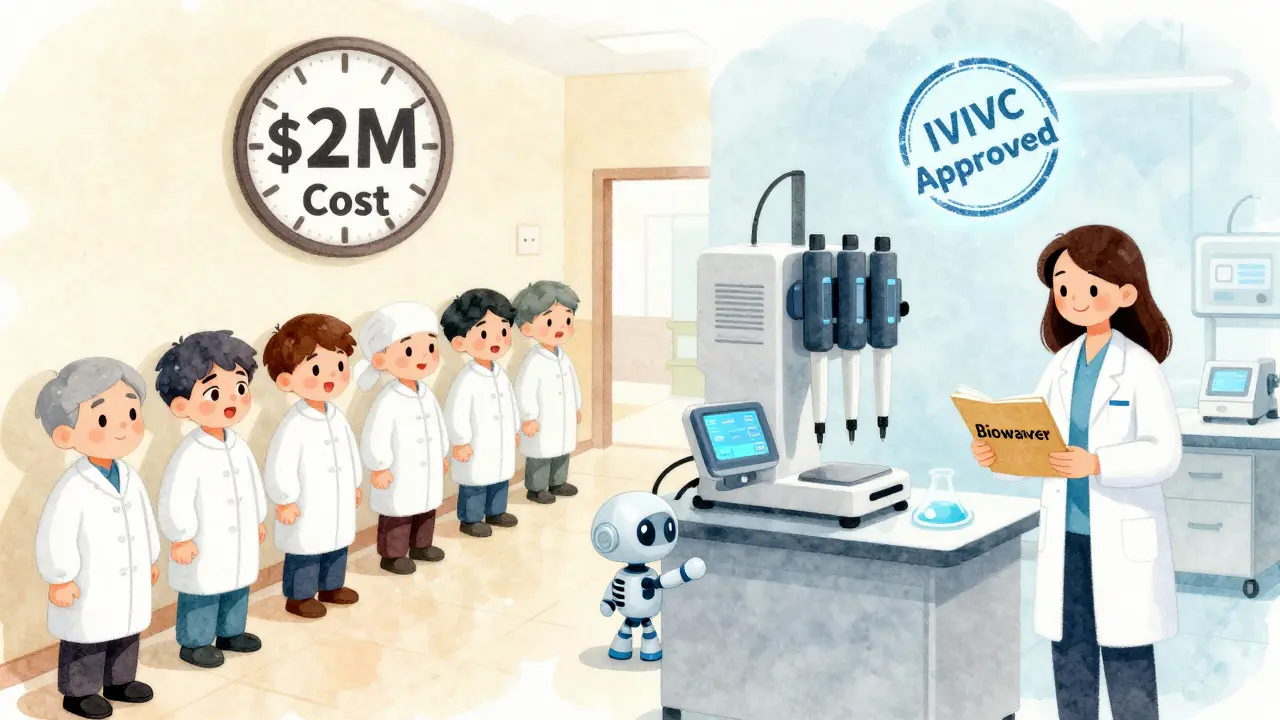
For decades, proving that a generic drug works the same as the brand-name version meant putting healthy volunteers through blood draws, fasting periods, and long clinical trials. Each study cost between $500,000 and $2 million and took months to complete. But now, a smarter approach is changing all that. IVIVC - In Vitro-In Vivo Correlation - is letting regulators approve generic drugs without ever giving them to a human subject. It’s not magic. It’s science. And it’s becoming the new standard for complex medicines.
What Exactly Is IVIVC?
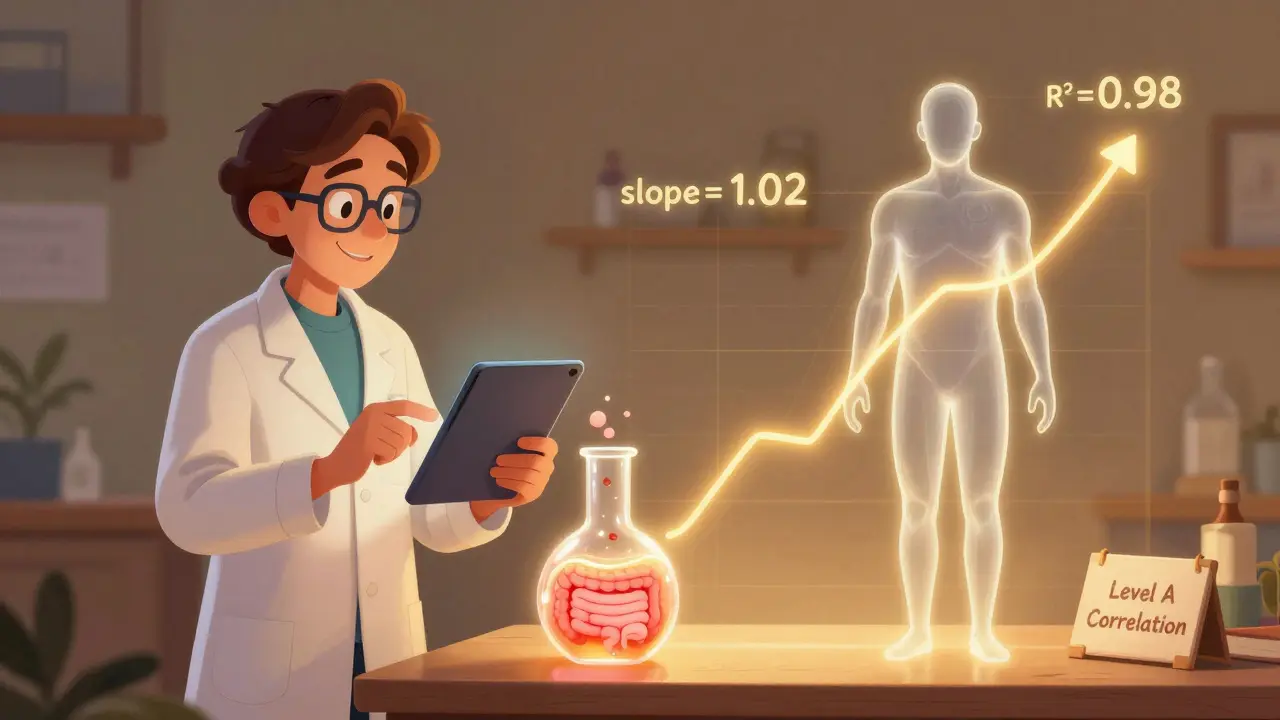
IVIVC stands for In Vitro-In Vivo Correlation. In plain terms, it’s a mathematical model that links how a drug dissolves in a lab test to how it behaves inside the human body. If you can show that a tablet releases its active ingredient at the same rate in a beaker as it does in the gut, you might not need to test it in people at all. This is called a biowaiver.
The FDA first laid out the rules in 1996, but it wasn’t until the 2014 update that IVIVC became a realistic tool for generic drug makers. The idea? Replace expensive, slow, and ethically tricky human trials with precise lab tests. For immediate-release drugs, the Biopharmaceutics Classification System (BCS) often does the job. But for extended-release pills, patches, or other complex forms? IVIVC is often the only way.
The Four Levels of IVIVC - And Why Level A Matters
Not all correlations are created equal. The FDA breaks IVIVC into four levels. Only one really gives you a full biowaiver.
- Level A: This is the gold standard. It matches dissolution at every time point to the drug’s concentration in the blood. Think of it like a perfect mirror - if the tablet dissolves at 20% after 1 hour, the blood level should match exactly. To qualify, the model needs an R² value over 0.95 and a slope near 1.0. Only Level A lets you skip all human testing for post-approval changes.
- Level B: Uses averages. It’s useful, but doesn’t predict individual responses. Not enough for a waiver.
- Level C: Links one dissolution point (like 70% dissolved at 4 hours) to one pharmacokinetic value (like AUC). It’s easier to build but risky. The EMA and FDA warn that Level C can miss real-world variations.
- Multiple Level C: Uses several dissolution points to predict multiple drug parameters. Still not as reliable as Level A, but sometimes accepted with extra data.
For a biowaiver to be approved, the model must predict AUC within ±10% and Cmax within ±15%. That’s strict. And it’s why so many attempts fail.
Why Companies Still Struggle - And Why Some Succeed
It sounds simple: test the drug in a lab, prove it matches the body, and skip the trial. But in practice, it’s a minefield.
Most companies that try IVIVC fail - 71% of submissions in 2022 didn’t make the cut. Why? Three big reasons:
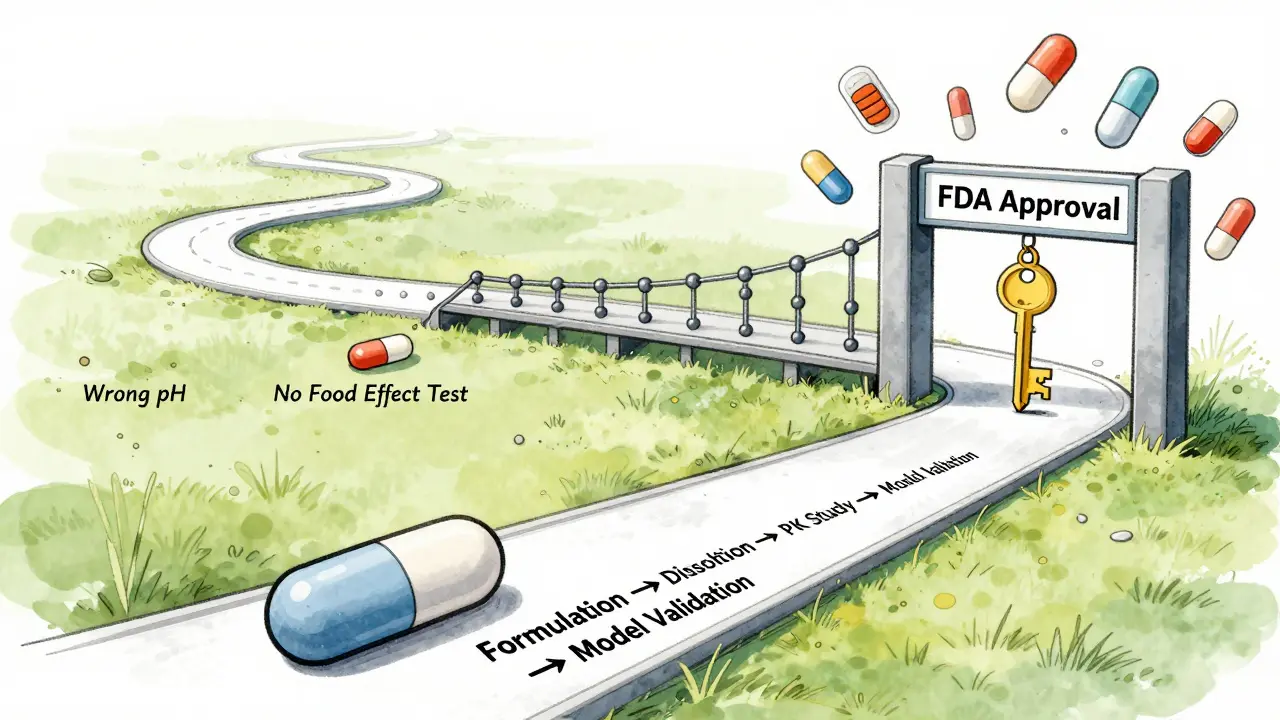
- Wrong dissolution conditions. If your test uses plain water at pH 6.8, you’re not simulating the stomach. Biorelevant media - with bile salts, enzymes, and pH changes that mimic the gut - are now required for complex products. A 2023 FDA review found 64% of failed submissions used outdated methods.
- Not enough formulation variation. You can’t prove a correlation if you only test one version of the drug. You need at least three different formulations with different release rates. Many companies skip this because it’s expensive. But without it, regulators won’t trust the model.
- Poor model validation. A model that fits your data perfectly might fall apart with new data. Validation means testing it on unseen samples, across different labs, and under food-effect conditions. Too many teams skip this step.
But the winners? They plan early. Teva spent 14 months and three formulation tries to nail their extended-release oxycodone IVIVC. They avoided five full bioequivalence studies - saving over $1 million. Contract labs like Alturas Analytics and Pion hit 60-70% success rates by getting involved during Phase 2 development. The key? Don’t treat IVIVC as a last-minute checkbox. Treat it like core R&D.
Where IVIVC Works - And Where It Doesn’t
IVIVC isn’t universal. It’s powerful, but only for specific drugs.
Best for:
- Extended-release oral tablets (e.g., oxycodone, metformin XR)
- Modified-release capsules
- Transdermal patches
- Some complex injectables (with strong supporting data)
Not suitable for:
- Drugs with narrow therapeutic index (like warfarin or digoxin)
- Drugs with nonlinear absorption
- Oral suspensions or powders
- Drugs absorbed in the colon
The FDA’s 2022 approval data shows IVIVC works best for oral extended-release products - 58% success rate. For ophthalmic products? Only 19%. That’s because the eye doesn’t have the same absorption pathways as the gut. The same goes for implants and inserts - new research is underway, but it’s still experimental.
The Real Cost Savings - And the Hidden Price
Every bioequivalence study you skip saves $1-2 million. That’s why big generics like Teva, Sandoz, and Sun Pharma invest in IVIVC teams. But the upfront cost? It’s steep.
Building a Level A IVIVC takes 12-18 months. You need:
- 3-6 months to develop a discriminatory dissolution method
- 6-9 months to run pharmacokinetic studies (minimum 3 studies, 12-24 subjects each)
- 3-6 months to build and validate the model
That’s over $1 million in lab work alone. And you need experts - pharmacokineticists, formulation scientists, statisticians. Only 15% of pharma companies have this in-house. That’s why many hire contract labs.
The payoff? Once approved, you can make minor formulation changes - like swapping a filler or moving production to a new factory - without another human trial. That’s huge for supply chain flexibility.
What’s Changing in 2025 and Beyond
IVIVC is evolving fast. The FDA’s 2023 draft guidance on topical products hints that this method will soon apply to creams and gels. The EMA and FDA held a joint workshop in 2024 on machine learning models for IVIVC. AI isn’t replacing scientists - it’s helping them find patterns in massive datasets.
Biorelevant dissolution testing is becoming standard. By 2025, 75% of new IVIVC submissions will use media that mimics real digestion - not just buffer solutions. The FDA’s GDUFA III funding ($15 million through 2027) is pushing this forward.
By 2027, McKinsey predicts IVIVC-supported waivers will cover 35-40% of all modified-release generic approvals - up from 22% today. The trend is clear: labs are replacing clinics.
Is IVIVC the Future? Yes - But Only If Done Right
IVIVC isn’t a shortcut. It’s a marathon. It demands precision, deep expertise, and patience. But for companies that get it right, it’s the most powerful tool in generic drug development.
It cuts costs. It speeds up approvals. It reduces the burden on volunteers. And it makes sure patients get safe, effective medicines - without unnecessary trials.
The old way - testing in people first - isn’t gone. But for the right products, it’s becoming optional. And that’s a revolution in how we make generic drugs.
What is a biowaiver in the context of IVIVC?
A biowaiver is a regulatory approval that allows a generic drug to be marketed without conducting a full in vivo bioequivalence study in humans. When a strong IVIVC is established - especially a Level A correlation - regulators like the FDA and EMA accept dissolution testing as proof that the generic performs the same as the brand-name drug in the body. This eliminates the need for costly clinical trials involving healthy volunteers.
Why is Level A IVIVC preferred over other levels?
Level A IVIVC provides a point-to-point correlation between in vitro dissolution and in vivo absorption, meaning every dissolution time point directly predicts the corresponding blood concentration. This allows regulators to confidently predict the entire pharmacokinetic profile - including AUC and Cmax - from lab data alone. Other levels (B, C) offer only approximate or partial correlations, which aren’t reliable enough to replace human studies for most regulatory purposes.
Can IVIVC be used for all types of drugs?
No. IVIVC works best for extended-release oral products with predictable absorption, like metformin XR or oxycodone ER. It’s not suitable for drugs with narrow therapeutic indices (e.g., warfarin), nonlinear pharmacokinetics, or complex delivery systems like inhalers or eye drops - unless specific validation exists. For immediate-release drugs, the BCS classification is often simpler and more reliable.
How much does developing an IVIVC model cost?
Developing a Level A IVIVC typically costs between $800,000 and $1.5 million, depending on complexity. This includes formulation development, dissolution method optimization, pharmacokinetic studies (with 36-72 subject exposures), and modeling/validation. While expensive upfront, it can save $1-2 million per avoided bioequivalence study and eliminate future testing needs for post-approval changes.
Why do so many IVIVC submissions get rejected?
The top reasons for rejection are: 1) using non-biorelevant dissolution media (e.g., plain buffer instead of simulated intestinal fluid), 2) insufficient formulation variation (testing too few different versions of the drug), and 3) poor model validation (not testing predictions on new data or under food-effect conditions). The FDA found that 64% of failed submissions in 2023 had inadequate physiological relevance in their dissolution methods.
Companies that succeed with IVIVC don’t treat it as a regulatory trick. They treat it as a scientific discipline. And that’s the real difference.
10 Comments
Morgan Dodgen
So let me get this straight... they're replacing human trials with *lab beakers*? 😏 Sounds like Big Pharma just found a way to skip the whole 'safety' part. I bet the FDA's got a backdoor deal with Teva. You think they're just *hoping* the model works? 🤔 R² > 0.95? Yeah right. I've seen worse correlations in my ex's text messages. #BiowaiverBullshit
Philip Mattawashish
You call this science? This is just corporate laziness dressed up in lab coats. You don't replace human physiology with a beaker full of fake gut juice. That's not innovation - it's surrender. We used to test drugs on people because we respected the complexity of life. Now? We run a script and pray. And when someone dies because their generic didn't dissolve right? Oh wait - it's 'within ±10%' so it's fine. 🤡
Tom Sanders
I mean... if it works, who cares? I've taken generics my whole life and never even noticed. But yeah, sounds like a lot of work for something that might just be... fine?
Jazminn Jones
The assertion that IVIVC represents a paradigm shift in regulatory science is, in fact, substantiated by empirical evidence. However, the operationalization of Level A correlation necessitates rigorous methodological fidelity, particularly with respect to biorelevant dissolution media and model validation across heterogeneous datasets. The failure rate of 71% is not indicative of systemic inadequacy, but rather reflects insufficient adherence to ICH Q1D guidelines. One must not conflate expedience with scientific rigor.
Stephen Rudd
You Americans think you've cracked the code. Let me tell you - in Australia, we still do full bioequivalence studies. Why? Because you can't simulate a human gut with a $500 kit. You're gambling with people's lives because your corporate overlords want to cut costs. And now you're calling it 'science'? Pathetic. This isn't progress - it's corporate colonialism disguised as innovation.
Erica Santos
Oh wow. So we're just going to trust a computer model over actual human biology? Brilliant. Next they'll replace MRI scans with a spreadsheet. I'm sure the 10% margin of error is just fine when someone's heart stops because their generic warfarin didn't dissolve right. Classic. We used to call this 'cutting corners'. Now it's 'regulatory efficiency'. How poetic.
George Vou
they say ivivc is the future but what if the model is wrong? like what if the beaker dissolves the pill at 80% but in the body it's only 65%? then people get underdosed and die? and no one knows why? and the company just says 'it was within 10%'? 🤡
Scott Easterling
Wait... wait... so they're skipping human trials... but they still need 3 different formulations? 36-72 subjects? That's not a waiver - that's just a longer, more expensive way to get the same data. And you call this efficiency? This is just corporate theater. They're not saving money - they're just moving the cost from clinical sites to R&D labs. And then they charge you $20 for a pill that costs $0.10 to make. 🤡
Mantooth Lehto
I work in a lab and I've seen these models fail. Hard. One time we had a perfect Level A correlation... then the batch from the new factory dissolved 20% slower. No one caught it. Patient had a seizure. Now? We do both. IVIVC for speed. And a human trial for peace of mind. Don't let them fool you. This isn't progress. It's a gamble with lives. 💔
Philip Mattawashish
Exactly. And you think the FDA's going to admit they approved a flawed model? Please. They'll bury it under 'statistical noise' and 'batch variation'. This isn't science - it's a legal loophole with a fancy name. We're not advancing medicine. We're optimizing profit margins. And the patients? They're the cost center.