
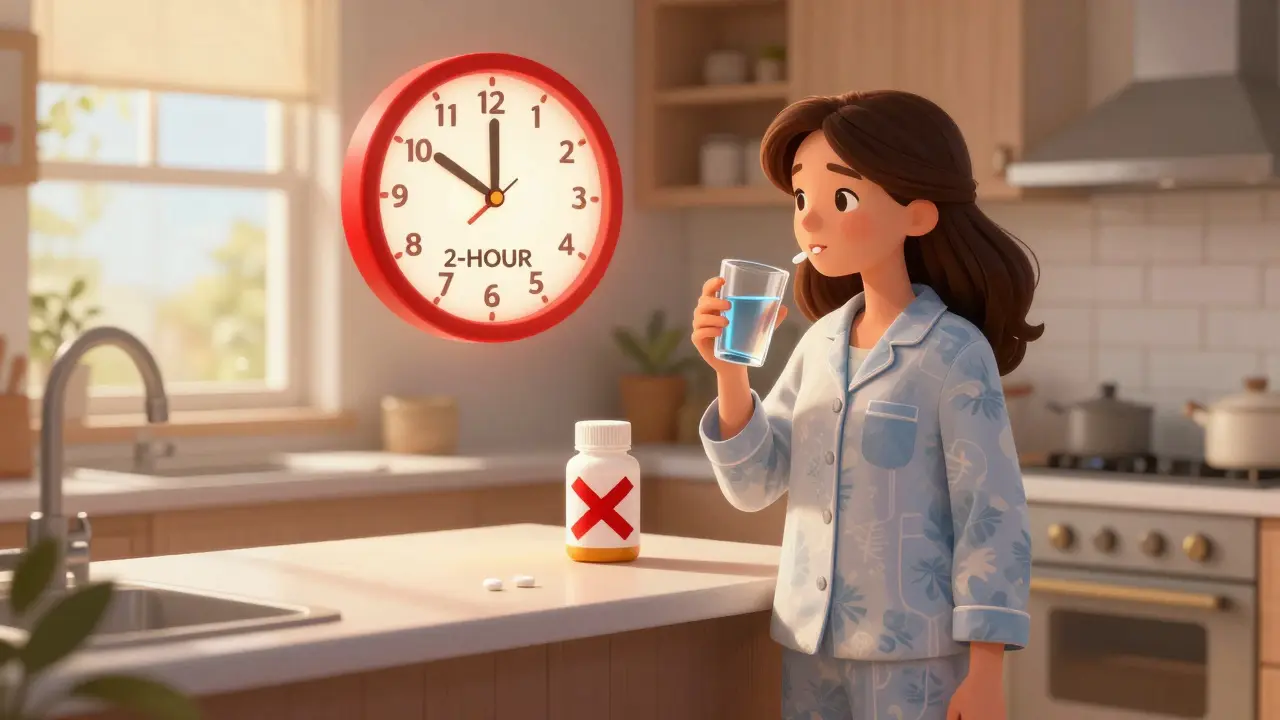
Take your osteoporosis pill at 7 a.m. You grab your magnesium supplement after breakfast at 8:30 a.m. Sounds reasonable, right? It’s not. You might as well have thrown that pill away. Magnesium supplements and oral bisphosphonates - the most common osteoporosis drugs like Fosamax, Actonel, and Boniva - don’t just coexist. They cancel each other out. And if you’re doing this without knowing, you’re risking bone fractures you could have avoided.
Why Magnesium Kills Your Osteoporosis Meds
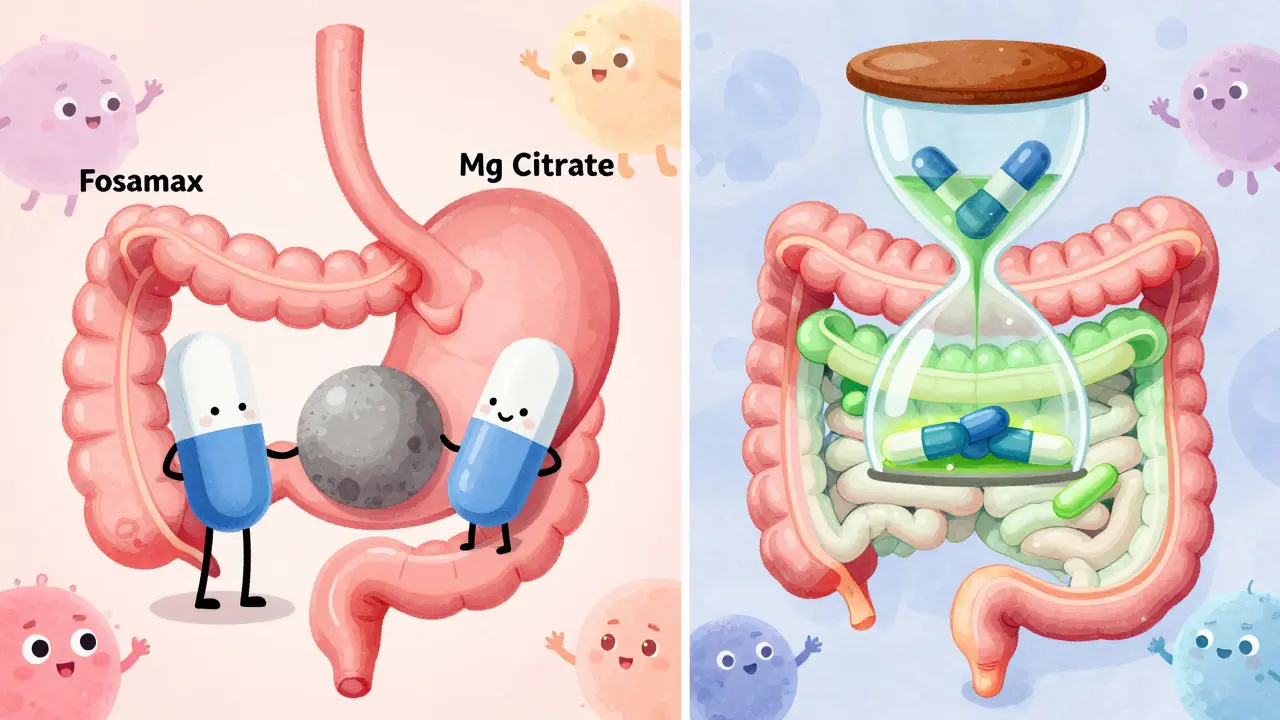
Bisphosphonates are powerful drugs. They work by sticking to your bones and telling bone-eating cells to stand down. But they’re picky eaters. To get into your bloodstream, they need an empty stomach and zero interference. Magnesium, whether from a supplement, antacid, or even some bottled water, acts like a magnet for these drugs. The two bind together in your gut, forming a solid lump your body can’t absorb. That’s not a theory. That’s a chemical fact backed by FDA studies showing up to 60% less absorption when taken together.It’s not just about feeling worse. It’s about your bones getting weaker. A 2021 study from Creighton University found patients who spaced out their magnesium and bisphosphonates improved their spine bone density by 8.2% more over two years than those who didn’t. That’s not a small difference. That’s the gap between avoiding a hip fracture and ending up in a hospital.
What Counts as Magnesium?
Most people think only of those little white pills labeled "Magnesium Citrate" or "Magnesium Glycinate." But magnesium is hiding everywhere. If you take an antacid like Milk of Magnesia, you’re getting 800mg of magnesium in one dose - more than most supplements. Laxatives? Often loaded with magnesium. Even some mineral waters like San Pellegrino contain 51mg per liter. If you’re sipping it all day, that adds up.And here’s the trap: you might not even realize you’re taking it. A 2022 survey by the National Osteoporosis Foundation found 37% of people on bisphosphonates didn’t know magnesium supplements could interfere. And 22% admitted they took them at the same time. That’s not carelessness. That’s a system failure.
The 2-Hour Rule - And How to Actually Follow It
The rule is simple: take your bisphosphonate at least two hours before any magnesium. But "two hours" isn’t a suggestion. It’s a minimum. Here’s how to make it work in real life.- First thing in the morning - right after waking up, take your bisphosphonate with a full glass of water (8 oz). No coffee, no juice, no food.
- Wait 30 minutes - this is required for the drug to start absorbing. You can’t eat or drink anything else.
- Wait another 90 minutes - now you’re at the full two-hour mark. Only then can you eat breakfast, drink your coffee, or take your magnesium.
- Take magnesium after lunch or dinner - this is the easiest window. Most people take their magnesium at night anyway for sleep support. That’s perfect. Just make sure it’s at least two hours after your morning pill.
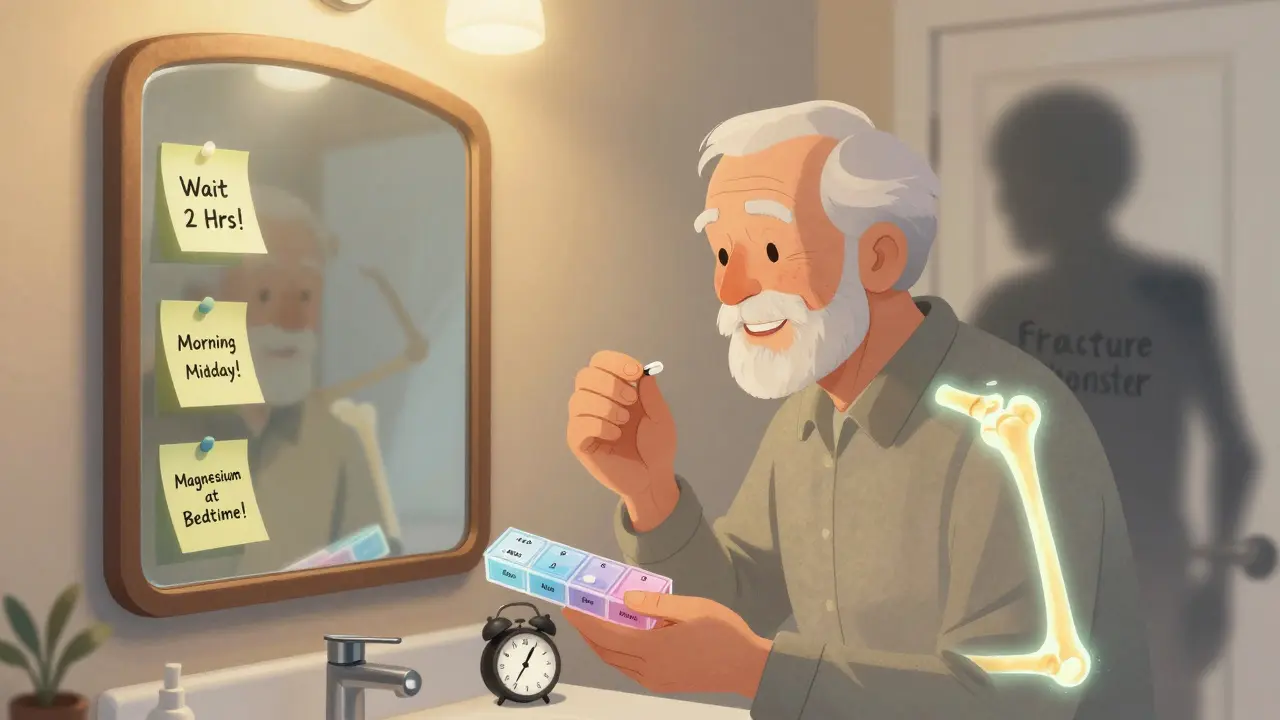
Don’t rely on memory. Use a pill organizer with four compartments - morning, midday, afternoon, evening. Write the times on sticky notes and stick them to your bathroom mirror. Or use a smart pill bottle with Bluetooth reminders - a Mayo Clinic pilot showed 92% adherence with those.
What About IV Osteoporosis Drugs?
If you’re on Reclast or Zometa - the IV versions of bisphosphonates - you’re off the hook. These go straight into your veins. No gut, no magnesium interference. But if you’re on pills, you’re not. Don’t assume. Ask your doctor. If you’re not sure which one you’re taking, check your prescription label. Oral = timing matters. IV = no timing needed.Why Do So Many People Get This Wrong?
Because doctors don’t always explain it. Pharmacists get busy. Patients get overwhelmed. One person on Reddit shared they fractured their wrist after taking Fosamax and magnesium together for six months - their bone scan showed zero improvement. Another user on Drugs.com said they didn’t realize Maalox contained magnesium until their pharmacist pointed it out.It’s not that people are careless. It’s that the system doesn’t make it easy. A 2023 study in the American Journal of Health-System Pharmacy found that patients who got written timing instructions had an 89% adherence rate. Those who only got verbal advice? Just 43%. That’s a huge gap. Clear instructions save bones.
What’s Changing? What’s Coming?
The good news? Things are getting better. The FDA now requires warning labels on both bisphosphonate and magnesium packaging saying "take 2 hours apart." That rollout is still happening - full compliance isn’t until 2025. Electronic health records like Epic and Cerner now block doctors from prescribing both together unless they override a system alert. That cut prescribing errors by 73% in one study.Pharmacies are also stepping up. By January 2025, all U.S. pharmacies will be required to use a standardized counseling script when dispensing bisphosphonates. That means the pharmacist will ask you: "Are you taking any magnesium supplements? Antacids? Laxatives?" And they’ll tell you the timing rule - out loud, in person.
And in the future? Merck is testing a new time-release bisphosphonate that’s less affected by minerals. Early results look promising. But that’s still years away. For now, the 2-hour rule is your only shield.
What If You Already Mixed Them?
If you’ve been taking magnesium and your osteoporosis pill together for months - don’t panic. Don’t stop your meds. Just start spacing them correctly today. Your next bone density scan will show the difference. One study showed bone loss slowed and even reversed within 12 months of proper timing.And if you’re unsure? Ask your pharmacist. Bring in all your bottles - supplements, antacids, even your water. They’ve seen this a hundred times. They’ll help you sort it out. No judgment. Just facts.
Can I take magnesium at night if I take my osteoporosis pill in the morning?
Yes - and that’s actually the best time to take it. If you take your bisphosphonate first thing in the morning with water and wait two full hours before eating or taking anything else, then taking magnesium at bedtime is completely safe. This is the most common and easiest way to follow the rule without disrupting your routine.
Does magnesium from food like spinach or almonds interfere?
No. The problem is with supplements and medications that deliver high, concentrated doses of magnesium all at once. The small amounts in food - even a cup of spinach (150mg) or a handful of almonds (80mg) - don’t form enough of a chemical bond to block bisphosphonate absorption. You don’t need to avoid leafy greens or nuts. Just avoid pills, antacids, and laxatives.
What if I forget and take them together?
Skip the next dose of your bisphosphonate. Don’t double up. If you accidentally took magnesium within two hours of your pill, wait until tomorrow to take your next dose. One slip won’t ruin your treatment - but doing it regularly will. Use this as a reminder to set a phone alarm or write a note.
Are all osteoporosis medications affected by magnesium?
Only oral bisphosphonates: alendronate (Fosamax), risedronate (Actonel), ibandronate (Boniva), and etidronate (Didronel). Drugs like denosumab (Prolia), teriparatide (Forteo), or romosozumab (Evenity) are not affected. IV bisphosphonates like zoledronic acid (Reclast) also bypass the gut and are safe. Always confirm your drug’s name with your pharmacist.
How do I know if my magnesium supplement is working?
You won’t feel it. Magnesium helps with sleep, muscle cramps, or anxiety - but those effects aren’t tied to your bone health. The only way to know if your osteoporosis treatment is working is through a bone density scan (DEXA) every 1-2 years. If your bone density isn’t improving, the timing of your magnesium could be why.
15 Comments
Corey Chrisinger
So basically if I take my Fosamax at 7am, I can’t even have a banana with magnesium in it until 9am? 😅 I thought nutrition was supposed to be intuitive, not a chemistry lab experiment.
Also, why does my pharmacist not tell me this? I’ve been taking magnesium at night for years and my bones are fine... or so I thought.
Maybe I’m just lucky. Or maybe the 60% absorption loss doesn’t matter if you’re already 70 and don’t plan on dancing at your grandkid’s wedding anytime soon. 🤷♂️
Bianca Leonhardt
You people are so naive. You think a two-hour window is enough? Please. Magnesium lingers in your gut for hours. You’re fooling yourself. I’ve seen bone density scans from patients who followed the "rule" and still had zero improvement. The real issue? Doctors prescribe these drugs like candy and never follow up. This isn’t about timing-it’s about a broken healthcare system that profits from your ignorance.
Travis Craw
honestly i had no idea magnesium in water counted. i drink san pellegrino like it’s water and now i’m kinda panicking. i take my pill at 7 and my water at 8. maybe i should just switch to tap. or maybe i’m overthinking it. 🤔
also why does everything have to be so complicated now?
Christina Bilotti
Oh sweet mercy. So the entire population is just stumbling through life taking pills like they’re gummy bears? And now you’re surprised people are breaking bones?
Let me guess-you also think "eating healthy" means buying a $12 kale smoothie and then chugging a soda with your supplement. The fact that you needed a 1,200-word essay to explain this is the real tragedy.
Also, did you know your post has more commas than actual clarity? Just saying.
swarnima singh
we are all just trying to survive in this world and yet here we are… magnesium, bones, time… it’s all connected in ways we don’t understand
maybe the real medicine is not the pill but the peace we find in accepting we can’t control everything
my grandma took her pills whenever she remembered and lived to 94… maybe the universe has its own timing
Isabella Reid
I love how this post breaks it down so clearly. I’m 58 and was taking magnesium at night for sleep, but I didn’t realize it was conflicting with my Fosamax until now. I’ve already switched to taking it after dinner and set a phone alarm. Small change, huge impact.
Also, I told my mom about this-she’s 72 and on Boniva. She said she thought antacids were "just for heartburn." Now she’s going to her pharmacist tomorrow. Thank you for the clarity.
Jody Fahrenkrug
took my pill at 7am, magnesium at 10pm. perfect. no drama. no stress.
also, i use a pill organizer with little stickers that say "MORNING PILL - NO FOOD" and "NIGHT MAG - NO PROBLEMS"
it’s dumb but it works. my bones are happy. my brain is too.
Kasey Summerer
So I’ve been taking my Fosamax at 7am and my magnesium at 9pm… and I’ve been drinking LaCroix all day. 🤔
Is carbonation the real enemy here? Or is this just another way Big Pharma makes us feel guilty for existing?
Also, why does my bottle of magnesium say "for bone health" if it’s supposed to be the villain? 😂
Allen Davidson
You’re not alone. I used to take my magnesium with breakfast because I forgot I was supposed to wait. Then I broke my wrist falling off the porch-no trauma, just my bones giving up.
After switching to the 2-hour rule, my next DEXA scan showed a 5% improvement. Not magic. Just math.
Set a reminder. Write it down. Tell your spouse. This isn’t about being perfect-it’s about being consistent. Your future self will high-five you.
john Mccoskey
Let’s be brutally honest here: this entire post is a band-aid on a hemorrhage. The real problem is that we’ve turned bone health into a pharmaceutical vending machine. Bisphosphonates have a 40% failure rate over five years. They cause jaw necrosis, atypical femur fractures, and GI bleeding. Magnesium isn’t the villain-the drug itself is the flawed solution.
And yet here we are, debating whether to wait 120 minutes or 121 minutes to take a supplement that’s supposed to fix a problem created by a drug designed for short-term profit, not long-term health.
Meanwhile, the real solution-weight-bearing exercise, vitamin D, protein intake, sunlight-isn’t patented. So nobody promotes it.
So yes, follow the two-hour rule. But ask yourself: why are we still playing this game at all?
Corey Sawchuk
took my pill at 7am and magnesium at 11pm. easy. no issues.
also i drink mineral water and eat almonds and spinach every day and i still walk 5 miles a week so i guess my bones are doing ok
maybe the real rule is move your body and stop worrying so much
Rob Deneke
my mom’s on Fosamax and she takes magnesium at night. she’s 78 and still gardens. she doesn’t care about science. she cares about feeling good.
maybe the answer isn’t in the timing but in the intention
she says her bones feel stronger since she started walking every morning
just saying
evelyn wellding
YESSSS this is the kind of post I need in my life 🙌
I was taking my magnesium with my morning coffee and now I feel like a genius for switching to bedtime.
Also I bought one of those smart pill bottles and it beeps at me like a robot mom. I love it. 💪
My bones are going to thank me in 2030 😘
Chelsea Harton
wait so spinach is fine but milk of magnesia isn’t? so i can eat a salad but not use laxatives? weird.
vivek kumar
Interesting. But let’s not ignore the cultural context. In India, many elderly take turmeric with black pepper and warm milk at night. No supplements. No pills. Just food. Bone density is often better than in Western populations. Maybe the real solution is not timing pills but rethinking our entire approach to aging. Western medicine treats symptoms. Traditional systems treat the whole person.