
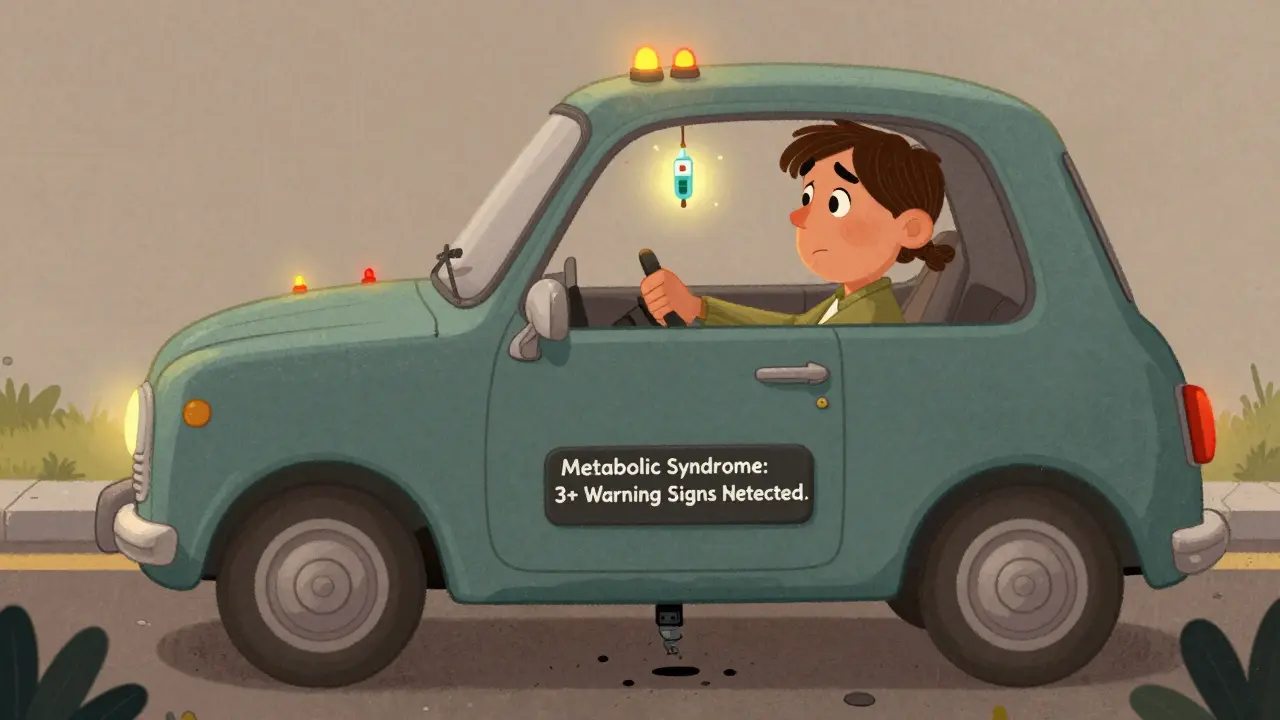
Imagine your body is a car. One warning light might be annoying, but if five lights flash at once - oil pressure, temperature, battery, brake, and engine - you don’t just ignore them. You pull over. That’s what metabolic syndrome is: five warning lights for your heart and metabolism, all flashing together. It’s not a single disease. It’s a cluster of conditions that, when they show up together, nearly double your risk of heart disease and make you five times more likely to develop type 2 diabetes. And here’s the scary part: metabolic syndrome affects nearly one in three American adults. It’s silent, it’s common, and it’s completely reversible - if you catch it early.
What Exactly Is Metabolic Syndrome?
Metabolic syndrome isn’t a diagnosis you get from a single blood test. It’s a pattern. Doctors look for at least three out of five specific warning signs:
- Abdominal obesity: A waist size over 40 inches for men or 35 inches for women (lower for Asian populations). This isn’t just extra weight - it’s fat packed deep around your organs.
- High triglycerides: 150 mg/dL or more. These are fat particles in your blood that clog arteries when they’re too high.
- Low HDL cholesterol: Under 40 mg/dL for men or 50 mg/dL for women. HDL is the "good" cholesterol that cleans out your arteries. When it’s low, gunk builds up.
- High blood pressure: 130/85 mmHg or higher. Even if you only hit one number, it counts.
- Elevated fasting blood sugar: 100 mg/dL or more. This is prediabetes territory.
Having just one of these doesn’t mean much. But three? That’s when your risk for heart attack, stroke, and diabetes jumps sharply. The American Heart Association says this combination is like a perfect storm - each factor makes the others worse.
The Hidden Driver: Insulin Resistance
Why do these five things happen together? The real villain isn’t sugar, or fat, or salt - it’s insulin resistance. Your body’s cells stop responding properly to insulin, the hormone that moves sugar from your blood into your muscles and fat. To compensate, your pancreas pumps out more insulin. High insulin levels trigger fat storage, especially around your belly, raise blood pressure, and mess with your cholesterol. It’s a chain reaction.
Think of it like a clogged drain. You don’t fix it by unclogging just one pipe. You have to clear the whole system. That’s why treating high blood pressure alone, or just lowering cholesterol, doesn’t fix metabolic syndrome. You have to tackle the root: insulin resistance.
Why Most People Miss It
Here’s the frustrating truth: many people with metabolic syndrome never hear the term. They get told they have high blood pressure. Or high cholesterol. Or prediabetes. But no one connects the dots. A 2022 survey of 1,247 people on HealthUnlocked found that 68% had never been told they had metabolic syndrome - even though they met three or more criteria.
Doctors often treat each number separately. A cardiologist handles the blood pressure. An endocrinologist handles the blood sugar. But no one looks at the full picture. Patients end up bouncing between specialists, taking multiple pills, and still not getting better. The real fix? It’s not a pill. It’s lifestyle.
The Only Proven Treatment: Lifestyle Change
There’s no FDA-approved drug for metabolic syndrome as a whole. But there’s something even better: proven, real-world results from lifestyle changes.
The Diabetes Prevention Program (DPP), a landmark U.S. study, showed that people who lost 7% of their body weight - about 15 pounds for someone weighing 200 - and got 150 minutes of walking per week cut their risk of developing type 2 diabetes by 58%. That same intervention reduced metabolic syndrome by 41% over 10 years.
How? Here’s what works:
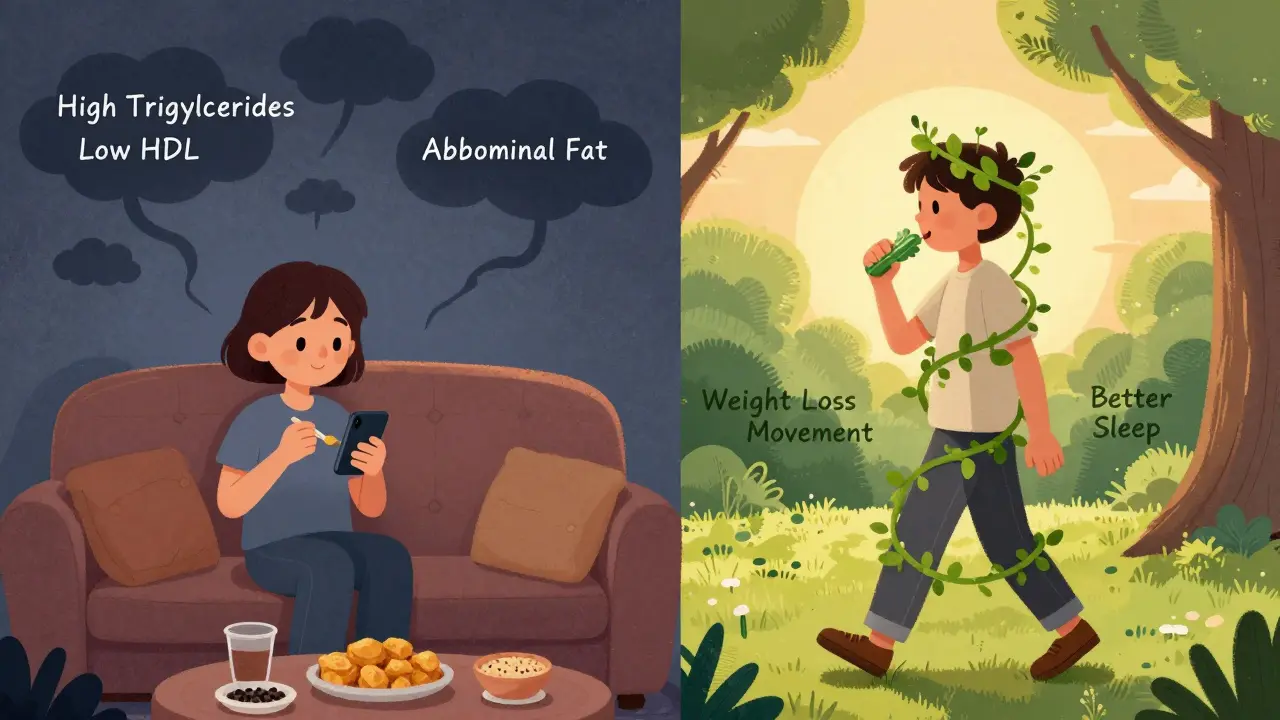
- Weight loss: Losing just 5-7% of body weight reduces belly fat, improves insulin sensitivity, and lowers blood pressure and triglycerides.
- Move daily: 30 minutes of brisk walking five days a week. No gym needed. Just get moving.
- Eat real food: Cut processed carbs, sugary drinks, and fried foods. Focus on vegetables, lean protein, whole grains, nuts, and healthy fats like olive oil.
- Stop late-night eating: Eating after 8 p.m. disrupts your body’s natural insulin rhythm. Try finishing dinner at least three hours before bed.
Reddit users in r/MetabolicSyndrome report that 76% saw at least one risk factor disappear within six months of sticking to this plan. One man lost 22 pounds, dropped his fasting glucose from 118 to 92, and got his triglycerides from 210 down to 120 - all without medication.
Why It’s Worse Than You Think
Metabolic syndrome isn’t just about your heart. It’s linked to fatty liver disease, sleep apnea, kidney damage, and even certain cancers. It’s the hidden reason why some people with "normal" cholesterol still have heart attacks. And it’s growing fast.
In the U.S., prevalence has jumped from 20% in the early 2000s to nearly 35% today. Among people over 60, almost half have it. The economic cost? Over $360 billion a year in medical bills and lost work. And it’s not just an American problem. By 2030, global prevalence is expected to hit 40% - with the fastest growth in South Asia and Latin America.
What Works - and What Doesn’t
Some people try quick fixes: detox teas, keto without exercise, or just popping statins. None of these fix the core problem. Statins lower cholesterol but don’t touch insulin resistance. Weight-loss drugs like semaglutide help, but only if you keep taking them. Stop, and the weight comes back.
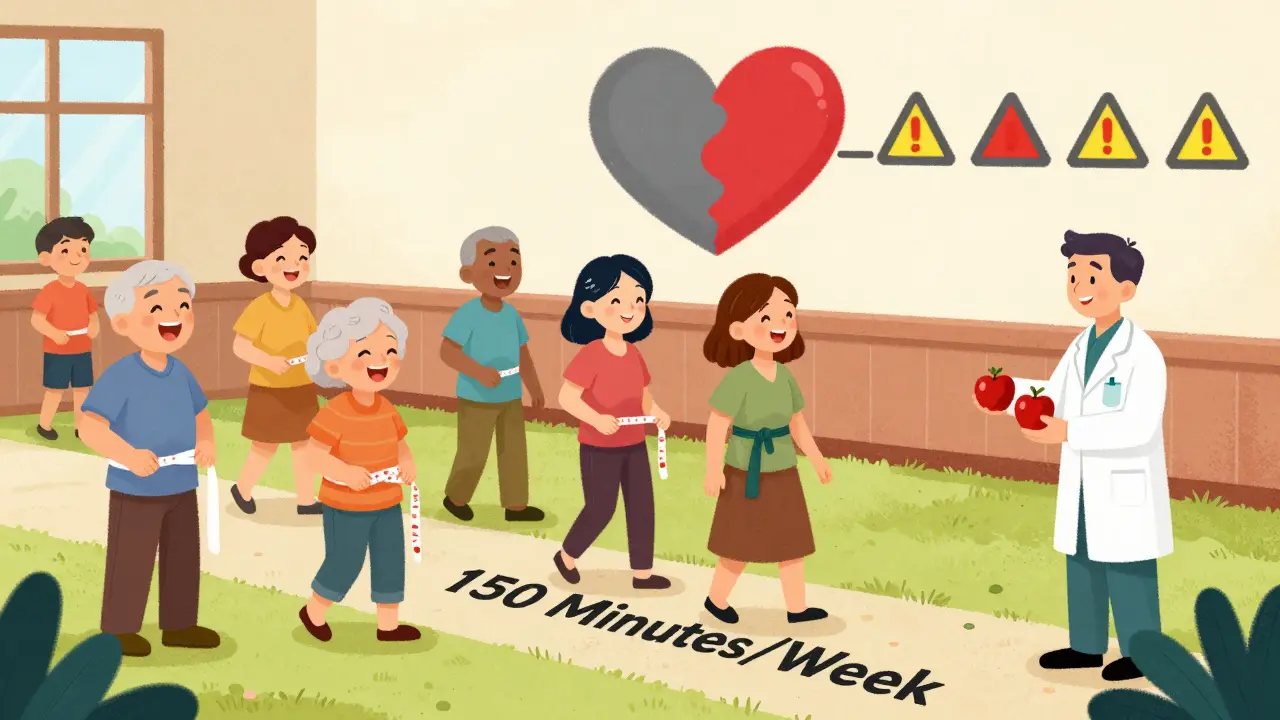
The real success stories? People who joined structured programs. The Mayo Clinic’s Integrated Metabolic Syndrome Program helped 68% of participants reverse the syndrome after 12 months. How? They didn’t just give advice. They provided:
- Personalized meal plans from dietitians
- Supervised exercise sessions
- Weekly coaching on stress and sleep
- Continuous monitoring of waist size and blood sugar
Even more surprising: community health workers - not doctors - achieved better results in underserved populations. In a CDC-backed program, lay educators helped Hispanic participants lose 5.7% of their weight, compared to 4.2% with standard care.
What You Can Do Today
You don’t need a fancy clinic or expensive supplements. Start here:
- Measure your waist. If it’s over 35 inches (women) or 40 inches (men), you’re at risk.
- Ask your doctor for a fasting glucose test and lipid panel. Don’t wait for symptoms.
- Walk for 30 minutes today. No phone. No music. Just movement.
- Swap one sugary drink for water. That’s one less hit of insulin.
- Track your progress: waist size, energy levels, sleep quality. Numbers matter, but how you feel matters more.
The good news? Metabolic syndrome doesn’t have to be permanent. The Diabetes Remission Clinical Trial (DiRECT) showed that people who lost 15 kg or more - about 33 pounds - reversed both metabolic syndrome and type 2 diabetes in nearly half of cases. It’s not about perfection. It’s about progress. One step. One meal. One walk at a time.
Can you have metabolic syndrome and not be overweight?
Yes, but it’s rare. Most people with metabolic syndrome have excess belly fat. However, some thin individuals - especially those with a family history of diabetes or PCOS - can have insulin resistance and elevated blood sugar, triglycerides, or blood pressure. Waist measurement is more important than overall weight. If your waist is large, you could still be at risk even if your BMI is normal.
Is metabolic syndrome the same as prediabetes?
No. Prediabetes is one component of metabolic syndrome - elevated fasting blood sugar. But metabolic syndrome includes at least two other factors: high blood pressure, abnormal cholesterol, or abdominal obesity. You can have prediabetes without metabolic syndrome, and vice versa. But if you have both, your risk of heart disease and diabetes skyrockets.
Can medication cure metabolic syndrome?
No medication cures metabolic syndrome as a whole. Drugs can help manage individual parts - like statins for cholesterol, or metformin for blood sugar - but they don’t fix the underlying insulin resistance. Lifestyle changes are the only proven way to reverse it. Medications may be needed temporarily, but long-term reversal requires diet, movement, and weight loss.
How long does it take to reverse metabolic syndrome?
Many people see improvements in as little as 3-6 months. Losing just 5-7% of body weight can lower blood pressure, improve insulin sensitivity, and reduce triglycerides. The full reversal - meaning no more three or more risk factors - typically takes 6-12 months of consistent effort. The key is not speed, but sustainability. Slow, steady changes last.
Does metabolic syndrome affect women differently?
Yes. Women, especially after menopause, are more likely to gain belly fat due to hormonal shifts. Polycystic ovary syndrome (PCOS) also increases insulin resistance, making metabolic syndrome more common in younger women with PCOS. Women may also find it harder to lose weight due to hormonal fluctuations, but the same lifestyle rules apply: focus on whole foods, regular movement, and stress management. The benefits are just as powerful.
11 Comments
rebecca klady
I never realized how much my waist size mattered until I measured it last year. 38 inches. I thought I was fine because my BMI was normal. Turns out, I had three out of five markers. Started walking daily and cutting soda. Six months later? 32 inches, fasting glucose down to 88. No meds. Just consistency.
Namrata Goyal
lol metabolic syndrome? more like capitalist syndrome. they want you to buy gym memberships and organic kale while ignoring the fact that 70% of us work two jobs and sleep 4 hours. also, who even has time to walk 30 mins? my kid screams 24/7. 🤡
Alex Arcilla
Y’all are overcomplicating this. I’m a 42-year-old mechanic. Didn’t know what insulin resistance was till my doc said ‘you got the whole package.’ So I swapped my 2-liter of Coke for water, started walking after dinner, and stopped eating at 8. Three months later, my BP was normal. Triglycerides cut in half. No magic. Just didn’t treat my body like a trash can anymore. 🙌
Brandon Shatley
so i had no idea i had this until my doc mentioned it. i thought i was just ‘a little chubby’ and had high cholesterol. but when he said ‘you got three out of five’ i was shocked. i started walking with my dog. 20 mins a day. not even 30. and after 4 months my sugar dropped. i didn’t even try. just moved more. weird how simple it is when you stop overthinking it.
Blessing Ogboso
As a Nigerian woman who grew up eating yam and palm oil daily, I can tell you this isn’t just a Western problem. My auntie, 68, has metabolic syndrome but never saw a doctor until her stroke scare. Now she eats more vegetables, walks to market instead of taking a taxi, and drinks herbal tea instead of sugary soda. She’s not ‘perfect,’ but she’s alive. And that’s what matters. In our communities, we don’t need fancy programs-we need neighbors reminding each other: ‘Come eat with us, no fried plantain today.’ Community heals. Not just pills.
Jefferson Moratin
The real tragedy isn’t metabolic syndrome-it’s the medical system’s refusal to treat it as a systemic failure. We’ve reduced human biology to a checklist of numbers, then outsource the solution to individual discipline. But discipline is a luxury when your job pays $12/hour and your neighborhood has no grocery store. The root cause isn’t laziness. It’s structural neglect. If we want to reverse this epidemic, we must first rebuild the social infrastructure that makes health possible-not just prescribe more walks.
Zola Parker
LOL so you think walking fixes insulin resistance? 😏 What about glyphosate? EMFs? The fact that ALL processed food has high-fructose corn syrup? You’re ignoring the real enemy: Big Pharma + Big Ag. I stopped eating ‘real food’ and started eating raw meat and fermented cabbage. My glucose? Down. My aura? Up. 🌿✨
Marissa Staples
I appreciate the advice. Honestly, I’ve been trying to walk more and cut sugar. It’s hard. Some days I fail. But I keep going. I don’t need a 58% statistic to tell me I’m doing better than I was last year. Small steps. That’s all I’ve got. And that’s enough.
Rachele Tycksen
i just ate a donut. i’m gonna die. 😭
Aaron Sims
Wait-so you’re telling me the government doesn’t want us to fix metabolic syndrome? Because if we all got healthy, who’d buy statins? Who’d pay for diabetes care? I’ve been researching… there’s a 2018 memo from the CDC about ‘encouraging lifestyle changes’… but then they funded 14 new drug trials. Coincidence? I think not. 🕵️♂️💊
Caroline Bonner
I just want to say-thank you. I’ve been struggling with this for years. I tried keto, then vegan, then intermittent fasting… and nothing stuck. Then I started doing what you said: walk 30 minutes, swap one drink, measure my waist. Not because I had to. Because I wanted to feel less tired. And now, after 8 months, I can climb stairs without gasping. I’m not ‘reversed’ yet-but I’m not giving up. And I’m not alone. I joined a walking group at my library. We’re 12 women, all different ages, all trying. We don’t judge. We just show up. That’s the real cure: connection. Not calories.