
Metformin B12 Deficiency Risk Calculator
How This Calculator Works
Based on research showing metformin can reduce vitamin B12 absorption. Your risk increases with longer use, higher doses, and certain health factors.
This tool estimates your risk level and provides personalized recommendations based on your situation.
For millions of people with type 2 diabetes, metformin is the first and often only medication they ever need. It’s cheap, effective, and has been used safely for decades. But behind its reputation as a reliable drug lies a quiet, growing problem: metformin can slowly drain your body of vitamin B12 - and many people don’t realize it until damage is already done.
How Metformin Steals Your B12
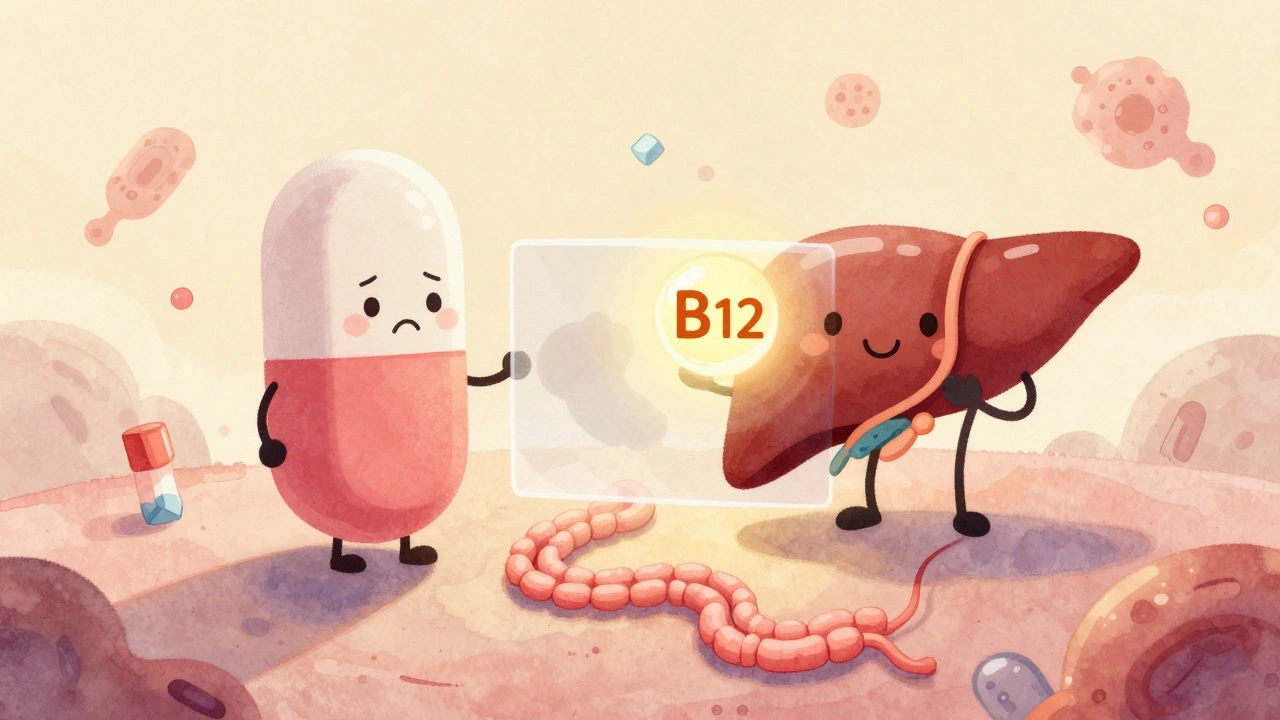
Metformin doesn’t cause B12 deficiency by killing cells or poisoning your gut. It interferes with how your body absorbs the vitamin. Vitamin B12 comes from food, binds to a protein called intrinsic factor, and then needs calcium to latch onto receptors in your small intestine. Metformin disrupts that calcium-dependent step. Without it, up to 30% of the B12 you eat just passes through your body unused.
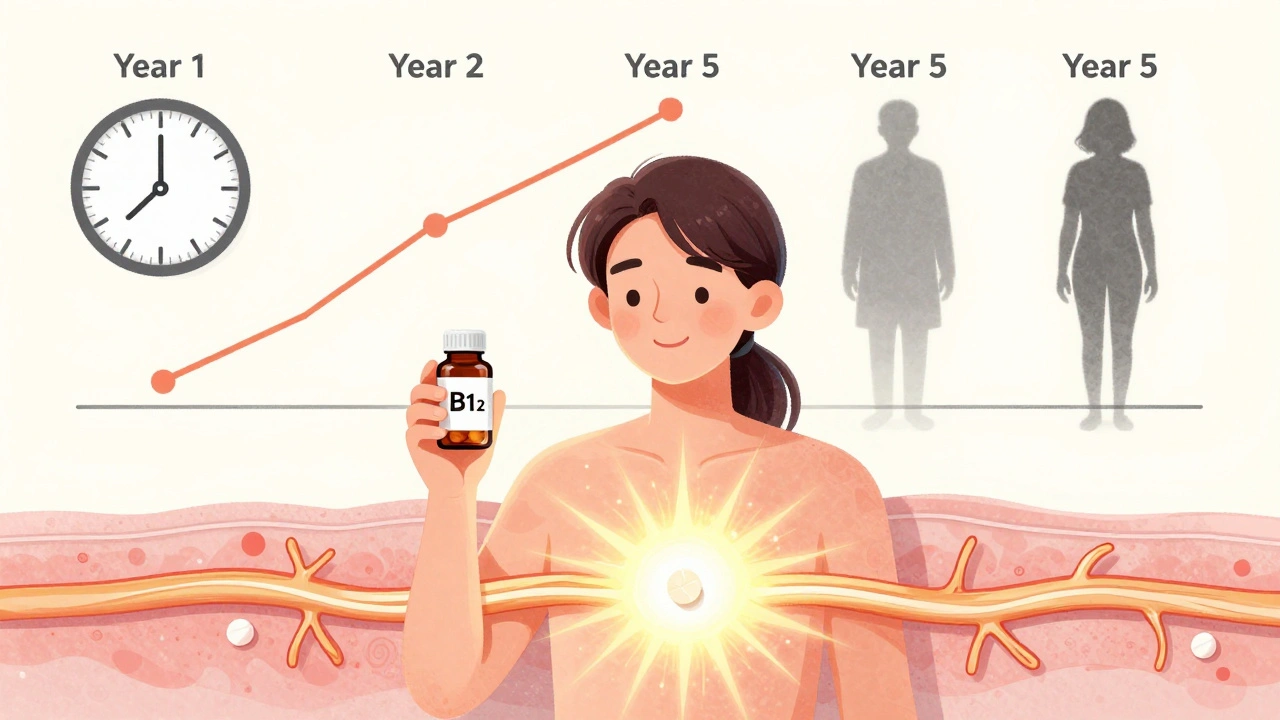
This isn’t a rare side effect. It’s common. Studies show that for every extra gram of metformin you take daily, your risk of B12 deficiency jumps more than double. People on 2,000 mg or more per day - the standard high dose - are at the highest risk. And it doesn’t happen fast. Your liver stores about 2,500 micrograms of B12. You only need 2.4 micrograms a day. So it can take 5 to 10 years of daily metformin before your stores run low enough to cause symptoms.
That’s why so many people miss it. By the time they feel something wrong, they’ve been on the drug for years. And because the symptoms look like diabetes complications, doctors often blame high blood sugar instead of checking B12 levels.
Symptoms No One Tells You About
Vitamin B12 deficiency doesn’t just make you tired. It attacks your nerves. Early signs are easy to ignore: a sore tongue, mouth ulcers, or feeling unusually fatigued. But left unchecked, it can lead to permanent nerve damage.
Here’s what actually happens:
- Peripheral neuropathy - burning, tingling, or numbness in hands and feet. Often mistaken for diabetic neuropathy.
- Muscle weakness - you feel like you’re losing strength, even if you’re exercising.
- Balance problems - you stumble more, feel unsteady, or lose coordination.
- Memory issues or brain fog - confusion, trouble focusing, or mood changes.
- Vision problems - blurred vision or sensitivity to light.
- Pale or yellow skin - a sign your red blood cells are abnormal.
In extreme cases, untreated B12 deficiency causes subacute combined degeneration of the spinal cord - a rare but irreversible condition that damages the spinal cord’s ability to send signals. One Reddit user described a five-year journey of misdiagnoses before finally finding out his numb legs and walking trouble were from B12 deficiency, not worsening diabetes.
And here’s the kicker: you don’t need anemia to be deficient. Many people have low B12 with normal blood counts. That’s why just checking for anemia misses half the cases.
Who’s at Highest Risk?
Not everyone on metformin will develop B12 deficiency - but some groups are far more vulnerable:
- People taking metformin for more than 4-5 years
- Those on doses of 2,000 mg/day or higher
- Vegetarians and vegans - you already get less B12 from food, and metformin cuts absorption even more
- People using proton-pump inhibitors (PPIs) like omeprazole for heartburn - these drugs reduce stomach acid, which is needed to free B12 from food
- Older adults - your body naturally absorbs less B12 as you age
- People with Crohn’s disease, celiac disease, or other gut absorption issues
One study found that among metformin users on PPIs, over 40% developed B12 deficiency. That’s not coincidence - it’s a dangerous combo.

What Doctors Should Be Doing
In 2022, the UK’s Medicines and Healthcare products Regulatory Agency officially declared B12 deficiency a common side effect of metformin. That’s a big deal. It means this isn’t a theoretical risk anymore - it’s standard clinical knowledge.
But not all doctors are on the same page. The American Diabetes Association says to “consider” testing B12 levels in long-term users. The European Association for the Study of Diabetes says to test everyone on metformin every 2-3 years. The UK’s NICE guidelines are clearer: check B12 at least every 2-3 years, and annually if you’re in a high-risk group.
Here’s what good testing looks like:
- Serum B12 level - normal is above 221 pmol/L (some labs say 150, but levels below 221 often show symptoms)
- Methylmalonic acid (MMA) - if B12 is borderline, elevated MMA confirms tissue deficiency
- Homocysteine - also rises when B12 is low, though it can be affected by other factors
Don’t rely on just one number. A B12 level of 180 pmol/L might seem “normal” to some labs, but if you have nerve symptoms, it’s too low.
What to Do If You’re Deficient
Once deficiency is confirmed, treatment works fast - if you act early.
For mild to moderate deficiency, high-dose oral B12 (1,000-2,000 mcg daily) is just as effective as injections for most people. You can buy it over the counter. For severe deficiency or neurological symptoms, doctors often start with weekly injections of 1,000 mcg for 4 weeks, then switch to monthly.
One patient on the NHS forum shared that after 8 years on metformin, her B12 was 128 pmol/L - severely low. She started injections and within six months, her nerve pain improved dramatically. She still takes metformin, but now she takes B12 daily.
And here’s a surprising twist: calcium may help prevent it. A 2021 trial showed that taking 1,200 mg of calcium carbonate daily reduced B12 deficiency by 47% in metformin users. The theory? Calcium helps restore the absorption mechanism that metformin breaks. It’s not a cure, but it’s a simple, cheap way to lower risk.
What’s Changing in 2025?
The tide is turning. By 2025, routine B12 testing is expected to be standard in diabetes clinics worldwide. New guidelines from the American Diabetes Association now explicitly recommend checking B12 in anyone on metformin for more than 4 years.
Researchers are also exploring ways to redesign metformin. A new enteric-coated version is in trials - it releases the drug lower in the gut, where it interferes less with B12 absorption. Early results show 32% less B12 reduction over a year.
And genetics may play a role. Scientists have found people with certain variations in the CUBN gene - which controls the B12 receptor in the gut - are far more likely to develop deficiency on metformin. In the future, a simple genetic test could identify high-risk patients before they even start the drug.
What You Can Do Today
You don’t need to stop metformin. It’s still the best first-line treatment for most people with type 2 diabetes. But you do need to protect yourself.
Here’s your action plan:
- If you’ve been on metformin for 4+ years, ask your doctor for a B12 blood test - don’t wait for symptoms.
- If you’re vegetarian, vegan, or on PPIs, get tested even if you’ve only been on metformin for 2-3 years.
- If your B12 is below 221 pmol/L, start supplementation. Oral 1,000-2,000 mcg daily is safe and effective.
- Consider adding 1,200 mg of calcium carbonate daily - especially if you can’t take B12 supplements.
- Track your symptoms. If you feel more tired, numb, or unsteady, get tested - even if your last B12 was “normal.”
This isn’t about fear. It’s about awareness. Metformin saves lives. But like all medicines, it has hidden costs. B12 deficiency is silent, slow, and reversible - if you catch it early. Waiting until your feet are numb or your memory is failing is too late.
Ask your doctor for a test. Take control. Your nerves - and your future - will thank you.
Can metformin cause nerve damage?
Metformin itself doesn’t directly damage nerves. But long-term use can cause vitamin B12 deficiency, which leads to nerve damage known as peripheral neuropathy. This damage can mimic or worsen diabetic neuropathy, making it hard to tell the difference. If caught early, B12 deficiency-related nerve damage can improve with supplementation. If left untreated, it can become permanent.
How long does it take for metformin to cause B12 deficiency?
It usually takes 4 to 10 years of regular metformin use for B12 levels to drop low enough to cause symptoms. This is because your liver stores a large amount of B12 - enough to last years even with reduced absorption. The risk increases with higher doses and longer use. The Diabetes Prevention Program study found significant deficiency after 13 years of use.
Should I stop taking metformin if I have low B12?
No, you don’t need to stop metformin. Most people can safely continue taking it while correcting their B12 levels with supplements. Stopping metformin without medical advice can lead to uncontrolled blood sugar, which carries its own serious risks. Talk to your doctor about adding B12 supplements - not stopping the diabetes medication.
Can I get enough B12 from food if I’m on metformin?
It’s unlikely. Even if you eat plenty of meat, fish, eggs, or dairy, metformin blocks up to 30% of B12 absorption. People with dietary B12 sources still become deficient on long-term metformin. Supplements - either oral or injectable - are needed to overcome this absorption block. Food alone won’t fix it.
Are B12 injections better than pills?
For severe deficiency or neurological symptoms, injections work faster and ensure full absorption. But for mild to moderate deficiency, high-dose oral B12 (1,000-2,000 mcg daily) is just as effective over time. Most people can manage with pills, especially if they take them consistently. Injections are usually reserved for those who can’t absorb oral B12 or have advanced nerve damage.
Can calcium supplements prevent B12 deficiency on metformin?
Yes. A 2021 clinical trial showed that taking 1,200 mg of calcium carbonate daily reduced the risk of B12 deficiency by 47% in metformin users over two years. Calcium helps restore the absorption mechanism that metformin interferes with. It’s not a replacement for B12 supplements, but it’s a helpful preventive step - especially if you’re at high risk.
How often should I get my B12 levels checked?
If you’ve been on metformin for more than 4 years, get tested every 2-3 years. If you’re vegetarian, vegan, on PPIs, over 60, or have nerve symptoms, get tested annually. Some experts recommend checking at the start of metformin therapy and then every 2 years after that. Don’t wait for symptoms - by then, it may be too late to prevent nerve damage.
12 Comments
Courtney Co
OMG I’ve been on metformin for 7 years and my feet have been tingling for ages I thought it was just diabetes getting worse but my B12 was 140 and now I’m on supplements and my legs feel like they’re not made of concrete anymore thank you for this post
Priyam Tomar
Actually this is all overblown. B12 deficiency is common in older people regardless of metformin. The real issue is lazy doctors not testing. Also, calcium supplements? That’s not a cure, it’s a bandaid. You still need B12. Stop giving people false hope with gimmicks.
Irving Steinberg
Bro i just took a 1000mcg B12 gummy this morning and now i feel like a new man 😎 i’ve been on metformin since 2019 and my brain fog was real like i was forgetting my own name
Lydia Zhang
My doctor never mentioned this. I’m on 2000mg. Should’ve known.
Kay Lam
I’ve been a nurse for 18 years and I’ve seen so many patients come in with numb hands and memory lapses and they’re told it’s just aging or diabetic neuropathy. But when you check the B12 it’s like 120 and they’ve been on metformin for 8 years. It’s heartbreaking. And it’s so easy to fix. Just test. Just give them the supplement. Don’t wait for them to fall. Don’t wait for them to lose their balance. Don’t wait for them to lose their mind. It’s not complicated. It’s not expensive. It’s not rare. It’s just ignored. And that’s the real problem.
Eric Vlach
My mom’s been on metformin for 12 years and she’s vegan. Her B12 was 89. She started injections and now she’s walking without her cane. I’m telling everyone I know. This is life changing stuff. And calcium? Yeah I started giving her 1200mg too. No harm. Might help. Why not?
Souvik Datta
Metformin is a gift. But like any gift, it comes with responsibility. We don’t blame the knife for cutting fingers-we teach people how to hold it. B12 deficiency isn’t a flaw in metformin. It’s a flaw in our complacency. We assume because a drug is cheap and old, it’s harmless. But biology doesn’t care about convenience. Your liver stores B12 like a bank account. Withdraw too long, and one day, you wake up broke. Check your balance. Before it’s too late.
Matt Dean
People are losing their minds over this like it’s a conspiracy. It’s not. It’s science. If you’re on metformin and you’re not getting your B12 checked, you’re being irresponsible. Period. End of story. Stop making excuses.
Bee Floyd
I’ve been on metformin since 2017. My B12 was borderline. I started 1000mcg daily and my brain stopped feeling like it was wrapped in cotton. I still take it. Still feel the burn. But now I feel like myself again. No drama. No panic. Just a simple fix. And yeah, I take calcium too. Why not? It’s a penny. My nerves are priceless.
Jeremy Butler
It is an empirical observation that the pharmacodynamic interference of metformin with the ileal intrinsic factor-cobalamin receptor complex constitutes a well-documented, dose-dependent, and temporally progressive mechanism of nutritional depletion. The clinical implications, while underrecognized, are profound and necessitate a paradigmatic shift in therapeutic monitoring protocols for long-term users.
Shashank Vira
Let me tell you about the day I realized I was dying. Not from diabetes. From silence. From my doctor’s indifference. My hands were numb. My balance was gone. I fell three times in one week. They said it was ‘age.’ I cried in the parking lot. Then I found this. Now I take B12. Now I walk. Now I live. This isn’t a post. It’s a lifeline.
Jack Arscott
Just got my B12 test back - 190. I’m taking 2000mcg daily and 1200mg calcium. No injections needed. Felt better in 3 weeks. 🙌