

Therapeutic Drug Monitoring Calculator
Check if your immunosuppressive drug levels fall within the recommended target range based on current medical guidelines. Enter your measured level and select your medication to see if it's within the safe and effective range.
When you're on immunosuppressive drugs-whether after a kidney transplant, for lupus, or another autoimmune condition-you're walking a tightrope. Too little drug, and your body might attack the transplant or flare up your disease. Too much, and you risk serious infections, kidney damage, diabetes, or even cancer. This isn't guesswork. It's science. And it demands careful, ongoing monitoring through lab tests and imaging.
Why Monitoring Isn't Optional
Immunosuppressants like tacrolimus, cyclosporine, and mycophenolate aren't like regular pills. They have a razor-thin window between working and causing harm. Two people taking the same dose can have completely different blood levels-sometimes up to ten times apart. That’s why fixed doses don’t cut it. You need to know exactly what’s in your bloodstream. Without monitoring, acute rejection rates jump by nearly 40%. Five-year graft survival drops by over 20%. These aren’t theoretical risks. They’re real outcomes backed by decades of data from transplant centers worldwide. Monitoring turns guesswork into precision medicine.Therapeutic Drug Monitoring: The Core of Safety
Therapeutic drug monitoring (TDM) is the backbone of safe immunosuppression. It measures how much drug is in your blood at specific times. Not all drugs need it-but the big ones do. Tacrolimus is the most commonly used drug today. For kidney transplant patients, targets change over time. In the first three months, doctors aim for 5-10 ng/mL. After that, they lower it to 3-7 ng/mL to reduce long-term kidney damage. Levels are checked at trough-right before your next dose-because that’s when the drug is at its lowest and most telling. Cyclosporine is trickier. Some centers still use just the trough level, but the better method is measuring the C2 level-two hours after your dose. Studies show C2 correlates much better with rejection risk than trough alone. A C2 level below 100 ng/mL raises rejection chances. Above 200 ng/mL, kidney toxicity spikes. Sirolimus and everolimus (mTOR inhibitors) are used less often because of side effects. Their target range is 5-10 μg/L, but there’s less consensus here. Some patients do fine outside that range. That’s why guidelines give this a weak recommendation. Mycophenolic acid (MPA) is another challenge. Its levels swing because of how your gut and liver process it. Trough levels don’t tell the full story. The real measure is the area under the curve (AUC)-how much drug circulates over 12 hours. An AUC of 30-60 mg·h/L is linked to an 85% chance of staying rejection-free in the first year. But AUC testing is expensive and complex, so many centers still use troughs as a rough guide. Testing methods matter too. Immunoassays are cheaper-$50 to $100 per test-but they can overestimate levels by 15-20% because they mistake drug metabolites for the real thing. Liquid chromatography-tandem mass spectrometry (LC-MS/MS) is the gold standard. It’s accurate to 95-98%, but costs $150-$250. Many centers are switching to LC-MS/MS because the extra cost pays off by preventing costly rejections.Routine Blood Work: Catching the Hidden Damage
Drug levels alone don’t show the full picture. Your body’s reaction to these drugs shows up in routine blood tests. These aren’t optional extras-they’re essential early warning systems. Every 1-3 months, you should get:- Full blood count (to catch low white cells, anemia, or low platelets)
- Creatinine and electrolytes (to monitor kidney function)
- Liver enzymes (ALT, AST, bilirubin)
- Calcium, magnesium, phosphate (immunosuppressants drain these)
- Fasting glucose (for diabetes risk)
- Lipid panel (every six months-high cholesterol is common with sirolimus)
- Cyclosporine: 40-60% of patients develop low magnesium. Nerve tingling or muscle cramps can be early signs. Kidney function often drops slowly-creatinine rising over 30% from baseline is a major red flag.
- Tacrolimus: More likely than cyclosporine to cause new-onset diabetes. Fasting glucose above 7.0 mmol/L needs attention. Nephrotoxicity is still common.
- Sirolimus: 60-75% of patients get high cholesterol or triglycerides. Some develop lung inflammation (pneumonitis)-a cough or shortness of breath that doesn’t go away needs a chest X-ray.
- Mycophenolate: Causes low white blood cells in 25-30% of people. Diarrhea hits 30-40%. If you’re losing weight or having frequent bowel movements, your dose may need adjustment.

Imaging: Seeing What Blood Tests Can’t
Some damage doesn’t show up in bloodwork. That’s where imaging comes in.- Renal ultrasound: Done annually or if creatinine rises. Checks for blockages, kidney size, and blood flow. A shrinking kidney after transplant often means chronic rejection.
- Chest X-ray: If you develop a persistent cough, fever, or trouble breathing, this is the first step. It catches pneumonitis-especially with sirolimus or everolimus. Sensitivity is 70-85%.
- Bone density scan (DEXA): Steroids like prednisone weaken bones. After one year of steroid use, you need a baseline scan. Then every 1-2 years. Osteoporosis is silent until you break a bone.
- CT or MRI: Reserved for suspected tumors or unusual symptoms. Long-term immunosuppression increases skin, lymph, and liver cancer risk. Any new lump, unexplained weight loss, or night sweats needs imaging.
The Future: TTV as an Immune Meter
The most exciting development isn’t a new drug-it’s a new way to measure your immune system’s activity. Enter Torque Teno Virus (TTV). TTV is a harmless virus that lives in nearly everyone. In healthy people, it’s kept in check by the immune system. In transplant patients, it multiplies freely. The more immunosuppressed you are, the higher your TTV levels climb. Research shows a clear sweet spot: 2.5-3.5 log10 copies/mL in the first year after transplant. Below that? High rejection risk. Above it? High infection risk. In one trial, using TTV to adjust drug doses cut infections by 28% and rejections by 22% compared to standard care. It’s not perfect yet. No one has standardized the test. Labs use different methods. But the TTVguideIT trial-tracking 300 patients across 12 countries-is expected to wrap up in 2026. If results hold, this could become routine.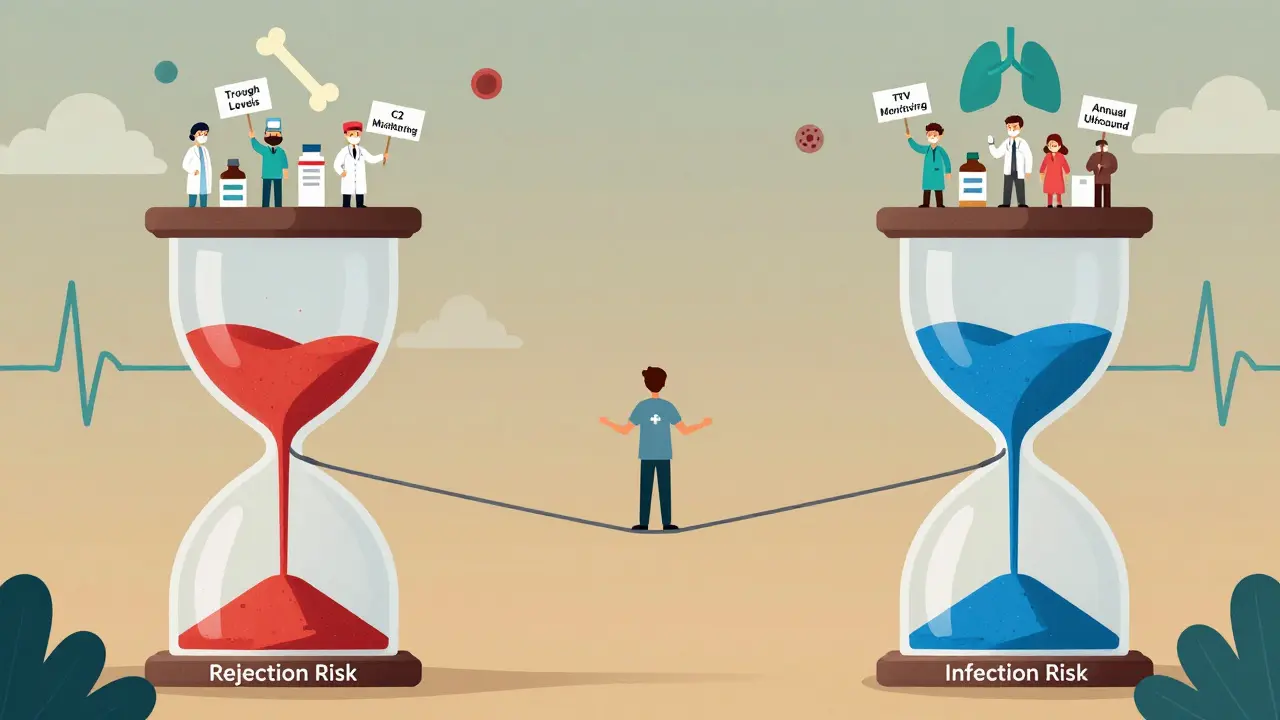
What’s Holding Back Better Monitoring?
You’d think with all this evidence, everyone would be doing it right. But they’re not. A 2022 survey of 150 transplant centers found:- 68% had inconsistent monitoring practices between different teams in the same hospital.
- Only 42% had standardized protocols for mycophenolate monitoring.
- 75% said cost was the biggest barrier.
- 63% said there were no agreed-upon target ranges for some drugs.
Cost vs. Benefit: Is It Worth It?
Yes. A 2022 analysis found comprehensive monitoring adds $2,850 per year to treatment costs. But it saves $8,400 by preventing hospitalizations, rejections, and transplant failures. That’s a nearly 3:1 return on investment. The global market for this monitoring is growing fast-$1.85 billion in 2023 and climbing. LC-MS/MS testing is the fastest-growing segment. Point-of-care devices are in trials and could be available by 2027. Imagine getting your tacrolimus level checked in 15 minutes at your doctor’s office instead of waiting a week.What You Can Do
You’re not just a patient. You’re part of the team.- Keep a log of your meds, doses, and side effects.
- Ask for your latest drug level and what it means.
- Report even small changes: new fatigue, rash, diarrhea, or breathing issues.
- Don’t skip blood tests or imaging appointments. They’re not busywork-they’re lifesavers.
How often do I need blood tests while on immunosuppressants?
In the first 3 months after transplant, you’ll typically have blood tests every 1-2 weeks. After that, it drops to every 2-4 weeks for the next 6 months. By year one, most patients are tested monthly. After the first year, it’s usually every 1-3 months, unless your doctor adjusts your plan. Always follow your transplant team’s schedule-don’t skip tests even if you feel fine.
Can I stop taking my immunosuppressants if I feel fine?
Never stop without talking to your doctor. Feeling fine doesn’t mean your immune system has stopped attacking. Many rejections happen without symptoms. Stopping your meds-even for a few days-can trigger rapid organ rejection. In kidney transplants, this can lead to loss of the graft in under 72 hours. Always consult your transplant team before making any changes.
What’s the difference between tacrolimus and cyclosporine monitoring?
Tacrolimus is monitored at trough levels (just before your next dose), with targets of 5-10 ng/mL early on, then 3-7 ng/mL. Cyclosporine can be monitored at trough, but many centers prefer C2 levels-measured two hours after your dose-because it better predicts rejection. Target C2 levels are 100-200 ng/mL. Tacrolimus is more commonly used now because it’s more effective and has fewer cosmetic side effects like gum overgrowth or excessive hair growth.
Why is TTV monitoring not used everywhere yet?
TTV monitoring is promising but still emerging. There’s no single, FDA-approved test yet. Different labs use different methods, so results can vary. Also, optimal TTV levels may differ between transplant types (kidney vs. liver vs. heart) and patient groups. Until standardized assays and clear guidelines are established, most centers stick with traditional drug level monitoring. The TTVguideIT trial, ending in 2026, could change that.
Do I need imaging every year if I feel fine?
Yes, if your doctor recommends it. Imaging like renal ultrasound and bone density scans are preventive tools. They catch problems before you feel them. A kidney that’s slowly shrinking or bones that are thinning won’t cause pain until it’s too late. Annual scans are low-risk and high-reward. Skipping them increases your chance of late-stage complications.
Are there alternatives to frequent blood tests?
Not yet for most patients. But research is moving fast. Point-of-care devices that give drug levels in minutes are in clinical trials and could be available by 2027. Non-invasive methods like breath analysis for drug metabolites are in early testing. For now, blood tests are still the gold standard. But the future is moving toward fewer, smarter tests-guided by AI and biomarkers like TTV.
13 Comments
Kevin Lopez
TDM for tacrolimus is non-negotiable. Trough-only monitoring is amateur hour. LC-MS/MS isn’t optional-it’s baseline. If your center still uses immunoassays, you’re gambling with graft survival.
And mycophenolate AUC? If you’re not measuring it, you’re just guessing. 30-60 mg·h/L is the sweet spot. Anything else is negligence.
Jim Rice
Everyone’s acting like this is rocket science. It’s not. Just give the standard dose, monitor creatinine, and if the patient gets sick, adjust. Stop overcomplicating everything. The data is noisy, the targets are arbitrary, and you’re scaring patients with numbers they don’t understand.
Henriette Barrows
I just started on tacrolimus after my transplant last month, and honestly, this post made me feel way less alone. I’ve been terrified of every little symptom-fatigue, a weird rash, even diarrhea-and wondering if I’m doing something wrong. Knowing there’s a science behind it, and that my team is tracking these levels… it helps. Thank you for laying it out so clearly.
Also, TTV sounds like sci-fi but I’m holding onto hope.
Alex Ronald
For anyone new to immunosuppressants: don’t panic over every lab result. Fluctuations happen. What matters is the trend. A single elevated creatinine? Could be dehydration. Three in a row? Now we talk.
And yes-keep a log. I started one on my phone. Took me 3 days to remember. Now I can’t imagine not having it. My pharmacist even said it helped her spot a pattern I didn’t even notice.
Teresa Rodriguez leon
They say TDM saves money but what about the emotional toll? 18 blood draws in a year. Every single one feels like a reminder that you’re broken. That you’re not normal. That you’re a lab rat. No one talks about that. The cost isn’t just financial-it’s psychological.
Manan Pandya
Excellent breakdown. I would only add that for patients in resource-limited settings, even basic monitoring-creatinine, CBC, fasting glucose-is a significant improvement over no monitoring at all. Progress, not perfection.
Also, TTV is promising, but standardization across platforms remains the critical bottleneck. Until reference materials are harmonized, clinical adoption will remain fragmented.
Aliza Efraimov
Let me tell you something-my nephrologist switched me from cyclosporine to tacrolimus because my gums looked like I was chewing on a pinecone. I didn’t even know that was a side effect until I read this.
And then she told me to get a DEXA scan because of prednisone. I thought osteoporosis was for grandmas. Turns out, my bones are already thinning. I’m 38. This isn’t just medicine-it’s survival. And it’s brutal.
Nisha Marwaha
TTV monitoring is the future, no doubt. But we need to acknowledge that biomarker-driven dosing isn’t just about the assay-it’s about workflow integration. Labs can generate data, but if the clinician doesn’t have a decision support algorithm built into their EHR, it’s useless.
Also, TTV thresholds may vary by organ. A kidney transplant patient’s optimal level isn’t the same as a liver recipient’s. We need stratified guidelines.
Paige Shipe
Why do we even need all this? Why can’t we just trust the doctor? I mean, look at the data-68% of centers have inconsistent practices. That’s not science, that’s chaos. And now you’re telling me we need TTV and AUC and LC-MS/MS? This is a money grab. They’re inventing tests to keep billing. I’m done.
Tamar Dunlop
While the scientific rigor presented here is commendable, one must not overlook the profound socio-economic disparities that impede equitable access to such advanced monitoring modalities. In many regions, the very concept of LC-MS/MS remains aspirational. The imperative, therefore, is not merely technological advancement, but structural equity in healthcare delivery.
Furthermore, the psychological burden of constant surveillance must be formally integrated into patient-centered care frameworks.
David Chase
AMERICA NEEDS TO STOP BEING SO SOFT!!! 🇺🇸
These drugs are TOUGH. You think you can just chill and sip tea while your body’s being monitored like a lab rat? NOPE. You’re alive because of science-not because you ‘feel fine.’
And TTV? IT’S THE FUTURE. 🚀 If you’re not tracking it, you’re not serious. Stop being lazy. Get your blood drawn. Stop complaining. We’re not in kindergarten. 💪🔥
Emma Duquemin
I used to think monitoring was just a bunch of needles and paperwork. Then I had a rejection scare at 6 months. Turned out my tacrolimus trough was 2.1 ng/mL. I was basically running on fumes.
Now I call my pharmacist every time I feel weird. She’s my superhero. And yes-I track my meds, my mood, my poop, my dreams (okay, maybe not the dreams).
This isn’t just medicine. It’s a daily act of rebellion against my own body trying to kill me. And I’m winning.
Samar Khan
Everyone’s talking about TTV like it’s magic. But have you seen the cost? $200 per test? And you need it monthly? That’s $2,400 a year. My insurance won’t cover it. So what? I’m just supposed to die? 🤡