
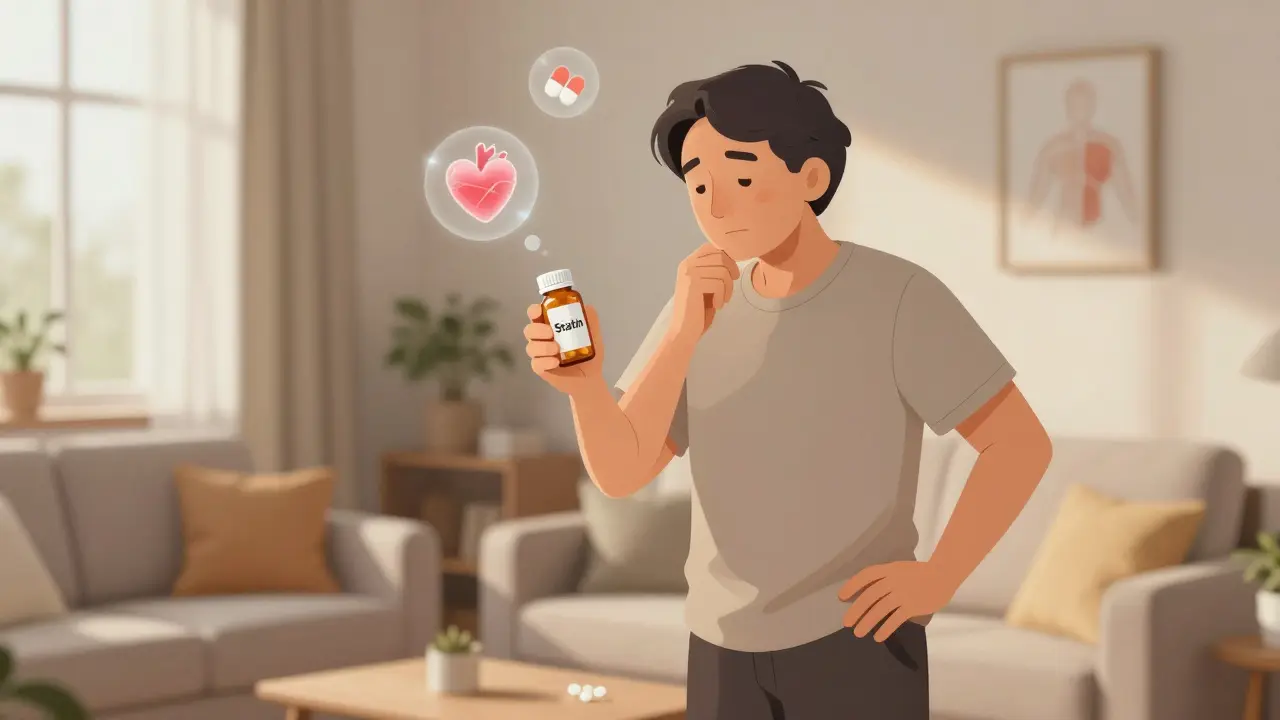
More than 30 million people in the U.S. take statins every year to lower cholesterol and protect their hearts. For many, it works - reducing heart attack risk by up to 35%. But for a lot of them, there’s a catch: muscle aches. You start the pill, and within weeks, your legs feel heavy. Your thighs throb after walking. Your shoulders ache like you’ve been lifting weights all day - even though you haven’t moved a dumbbell. It’s frustrating. And scary. You wonder: is this the drug? Or is it just aging?
Is It Really the Statin?
It’s not always the statin. That’s the first thing you need to know. Studies show that when patients who blame their muscle pain on statins are given a placebo (a sugar pill) without knowing it, about the same number report pain. This isn’t a coincidence. It’s called the nocebo effect - when expecting a side effect makes you feel it, even if the drug isn’t the cause. A 2018 study in Circulation found that only 20-25% of people who think statins hurt their muscles actually get pain when they take the drug again under blind conditions. That means for most, something else is going on. Maybe it’s arthritis. Maybe you’re less active now. Maybe you’re dehydrated. Or maybe you’ve been told so often that statins cause muscle pain that your brain started looking for it. But that doesn’t mean muscle pain from statins isn’t real. It just means it’s not as common as people think. The actual rate of true statin-related muscle symptoms is around 5-10%, not the 30% many assume. Still, even 5% of 30 million people is 1.5 million individuals - and for them, it’s very real.What Does Statin-Related Muscle Pain Feel Like?
It’s not a sharp, sudden pain. It’s not a pulled muscle. It’s a deep, constant soreness - like your muscles are tired all the time. You might feel weakness when climbing stairs, standing up from a chair, or reaching overhead. The pain usually hits both sides of your body equally: both thighs, both shoulders, both calves. It doesn’t come and go like a sprain. It lingers. Symptoms often show up within the first few months of starting the drug, or after a dose increase. High-intensity statins - like atorvastatin 40-80 mg or rosuvastatin 20-40 mg - carry a higher risk than lower doses. Women, especially those over 65, smaller in body size, or with thyroid or kidney issues, are more likely to notice these symptoms.When to Worry: Rhabdomyolysis and Other Serious Risks
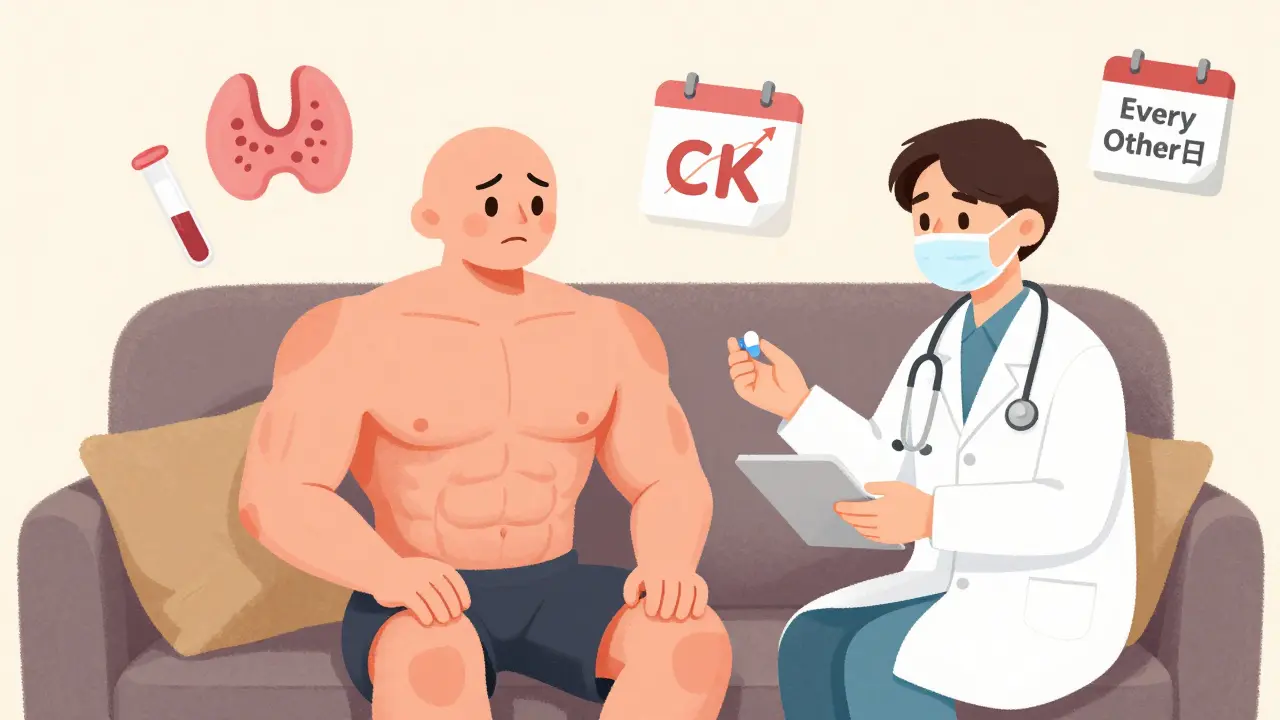
Most muscle pain from statins is mild. But there’s a rare, dangerous condition called rhabdomyolysis - where muscle tissue breaks down and leaks into your bloodstream. This can damage your kidneys and even be life-threatening. The good news? It’s extremely rare. Only 0.1 to 0.5 cases happen per 10,000 people taking statins each year. That’s about 3-5 cases per million prescriptions. You’re far more likely to be hit by lightning than develop this. Still, you need to know the red flags:- Severe muscle pain that doesn’t improve
- Dark, tea-colored urine
- Extreme weakness or fatigue
- Fever or nausea with muscle pain
Why Some People Are More at Risk
Not everyone reacts the same way. Certain factors make muscle pain more likely:- Age 80+ - risk increases by about 30%
- Small body size (under 100 lbs) - especially in women
- Thyroid problems - undiagnosed hypothyroidism raises risk by 35%
- Liver or kidney disease - doubles your chance of side effects
- Taking other meds - like fibrates, cyclosporine, or certain antibiotics (e.g., erythromycin)
- High statin dose - switching from moderate to high intensity raises risk by 15%
What to Do If You Have Muscle Pain
Don’t just quit. Stopping statins without guidance can raise your risk of heart attack or stroke by 25-50% within two years. That’s a big risk for something that might not even be the drug. Here’s what works:- Don’t self-diagnose. Talk to your doctor. Get a blood test for CK levels. This isn’t optional.
- Try a break. If symptoms are mild and CK is normal, your doctor might suggest stopping the statin for 4-6 weeks. If the pain goes away, it’s likely related.
- Switch statins. About 60% of people who have trouble with one statin do fine on another. Pravastatin and fluvastatin are the least likely to cause muscle issues.
- Go lower. Try cutting the dose in half. Many people get the same heart protection from a lower dose - without the pain.
- Check your thyroid. If you haven’t had your thyroid tested in the last year, ask for it. Hypothyroidism is a hidden trigger.
- Consider alternatives. If statins still don’t work, ezetimibe (a pill that blocks cholesterol absorption) or PCSK9 inhibitors (injections) can help lower LDL. But they cost $5,000 a year - versus $4-30 for generic statins.
Coenzyme Q10 - Does It Help?
You’ve probably heard that CoQ10 supplements ease statin muscle pain. The theory? Statins lower CoQ10, which your muscles need for energy. But here’s the truth: studies don’t back it up. A 2015 review in the Journal of the American College of Cardiology found no significant benefit over placebo. A 2018 study showed some improvement - but only in 45% of users, and the results weren’t strong enough to recommend it as standard care. If you want to try it, go ahead. It’s safe. But don’t expect miracles. And never use it as a reason to skip your doctor’s advice.
15 Comments
saurabh singh
Been on statins for 5 years, muscle aches started after I switched to atorvastatin. Thought it was just getting old till I read this. Took a break for 6 weeks like they said - pain vanished. Went back on pravastatin and now I’m fine. No more sore thighs after walking the dog. Seriously, don’t just quit. Try switching first.
Dee Humprey
I’m 68, female, 95 lbs, and I got muscle pain on rosuvastatin. My doctor didn’t believe me at first. Said it was ‘just aging.’ Got a CK test - levels were normal, but the pain was real. Switched to fluvastatin. Zero issues now. Don’t let anyone dismiss your pain just because the numbers look okay.
John Wilmerding
It is imperative to underscore that the nocebo effect is not a trivial psychological phenomenon, but rather a well-documented neurophysiological response that can manifest as verifiable somatic symptoms. The 2018 Circulation study referenced herein provides robust, peer-reviewed evidence that patient expectations significantly modulate perceived adverse drug reactions. This does not invalidate patient experience, but rather recontextualizes it within a biopsychosocial framework.
Peyton Feuer
so i had this weird muscle thing going on and i thought statins were the culprit but then i remembered i started doing yoga and my hamstrings were killing me. also i drink like 1 glass of water a day. maybe its not the pill maybe its me being a lazy potato. also coq10? i tried it. felt like i swallowed a chalk tablet. nope.
Siobhan Goggin
This is such an important post. So many people feel alone in this. I was ready to quit statins until my cardiologist suggested lowering the dose. I’m on 10mg now instead of 40mg. Same protection, way less ache. You can do this. Don’t give up on your heart.
Vikram Sujay
The phenomenon of pharmacologically induced somatic perception, when contextualized within the broader epistemology of modern medical subjectivity, reveals a profound dissonance between institutional diagnostic paradigms and lived bodily experience. One must not conflate statistical prevalence with individual veracity. The 5% who suffer real myopathy are not statistical noise - they are persons whose suffering is rendered invisible by the very metrics meant to protect them.
Jay Tejada
Oh so now it’s all in my head? Cool. I’ve been walking 3 miles a day for 20 years. Then I started statins and suddenly I can’t get up from the couch? Yeah, totally my imagination. Next you’ll say my toothache is just ‘expecting pain.’
josh plum
STATINS ARE A PHARMA SCAM. They don’t lower heart attacks - they lower your CoQ10 and make you weak so you buy more meds. The real cause of heart disease? Sugar. And they don’t want you to know that. Your doctor’s paid by Big Pharma. Get off the pills. Eat butter. Lift weights. You’ll be fine.
John Ross
The pharmacokinetic profile of lipophilic statins (atorvastatin, simvastatin) increases myocyte membrane penetration, thereby elevating mitochondrial dysfunction risk via HMG-CoA reductase inhibition. This mechanism is dose-dependent and modulated by CYP3A4 polymorphisms. For patients with suboptimal hepatic clearance, alternative agents like pravastatin (hydrophilic) or ezetimibe should be prioritized to mitigate myotoxicity.
Clint Moser
did u know the government put something in the water to make ppl need statins? i read it on a forum. also my cousin’s dog got muscle pain after eating kibble with soy. statins are just the tip. they’re turning us into zombies. coq10 is the only thing keeping me alive. i take 1000mg. and no, i don’t trust doctors.
Ashley Viñas
People who blame statins for muscle pain are just lazy. If you can’t handle a little discomfort, maybe you shouldn’t be trying to live past 60. I’ve been on high-dose rosuvastatin for 12 years. Never had an ache. You just need discipline. And maybe a personal trainer.
Mandy Kowitz
Wow. So the whole thing is just ‘nocebo’? Then why do I feel like I’ve been hit by a truck every morning? Oh right - because the drug is literally stealing my muscle energy. I don’t need a study to tell me what my body feels. I need a new prescription.
Charlotte N
So… if the pain goes away after stopping… and comes back when restarting… is that still nocebo? I mean… if it’s not the drug… why does it stop and start? That’s weird. I’m confused now. I took coq10. Didn’t help. But I’m still taking it. Just in case. Also I’m 71. Female. Small. And I think my thyroid might be off. Should I get it checked? I don’t want to bother my doctor.
bob bob
I was ready to quit until I read this. I’m 69, took a break, switched to pravastatin, now I’m hiking again. My wife says I’m back to my old self. You don’t have to suffer. There’s a way. Talk to your doc. Don’t be scared. You got this.
Oluwapelumi Yakubu
My brother in Lagos took statins and started walking like a man possessed by spirits - slow, heavy, like his bones were filled with wet sand. We thought it was juju. Turned out it was the pill. He switched to garlic, ginger, and palm oil. Now he dances at weddings again. Science? Maybe. But sometimes the old ways know what the lab coats don’t.