
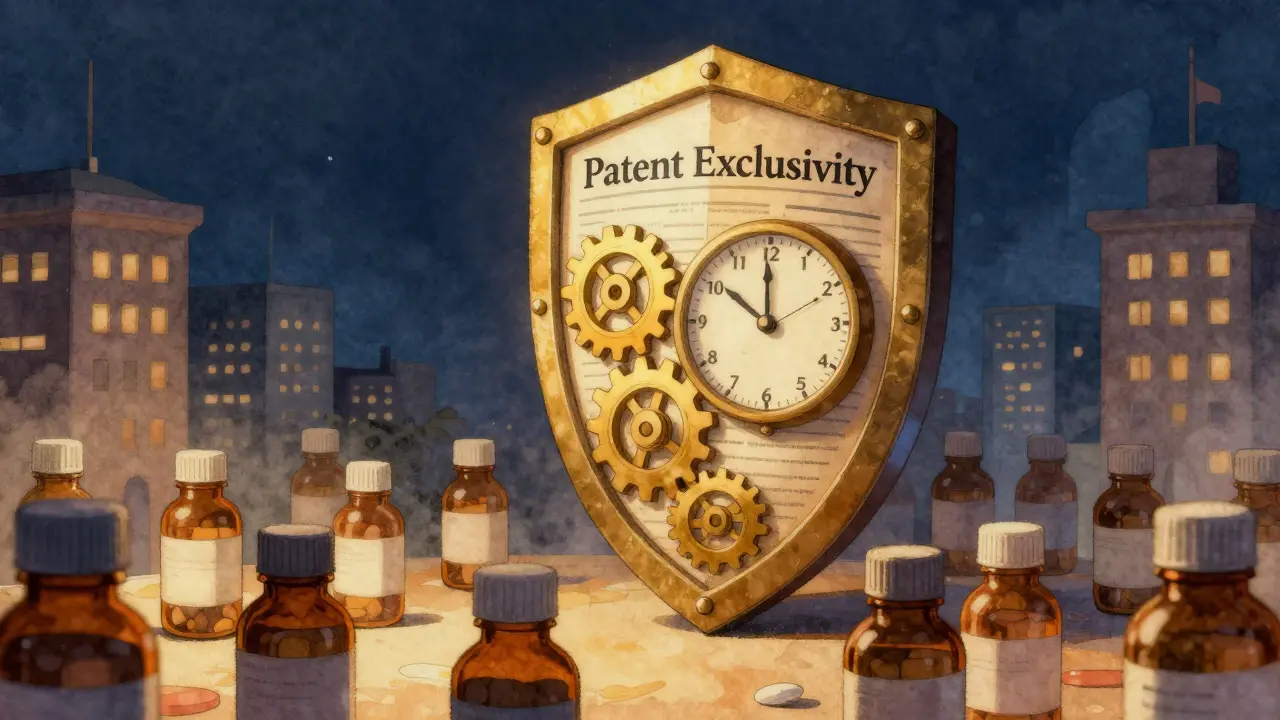
When a new drug hits the market, it doesn’t just come with a price tag-it comes with a legal shield. Two kinds of shields exist: patent exclusivity and market exclusivity. They sound similar, but they’re not the same. And confusing them can cost patients, companies, and even governments billions.
Patent Exclusivity: The Legal Right to Block Copies
A patent gives a company the legal right to stop others from making, selling, or using their invention. In pharmaceuticals, that usually means the exact chemical formula of a drug. The U.S. Patent and Trademark Office (USPTO) grants these patents, and they last 20 years from the day the application is filed.
But here’s the catch: drug development takes a long time. On average, it takes 10 to 15 years just to get a new drug approved by the FDA. That means by the time the drug actually hits shelves, a patent might have only 5 to 10 years of protection left. That’s not enough to recoup the $2.3 billion it typically costs to develop a new drug.
To fix this, the law allows patent extensions. If the FDA’s review process caused delays, the patent can be extended under something called Patent Term Extension (PTE). The maximum extension is 5 years-but the total protected time after approval can’t go beyond 14 years. So if a drug gets approved 12 years after the patent was filed, the company might get 2 extra years of protection.
Not all patents are equal. The strongest one is a composition of matter patent-it covers the actual molecule. But many companies file secondary patents on things like pill coatings, dosing schedules, or new uses for old drugs. These don’t protect the core invention, but they still block generics. In fact, 68% of patents listed in the FDA’s Orange Book are secondary patents.
Market Exclusivity: The FDA’s Secret Weapon
Market exclusivity has nothing to do with patents. It’s granted by the FDA, not the USPTO. And it doesn’t care if the drug is new or old. It only cares about whether the company submitted new clinical data to get approval.
For example, if a company develops a completely new chemical compound-a New Chemical Entity (NCE)-the FDA gives it 5 years of market exclusivity. During that time, the FDA can’t even accept an application from a generic maker trying to copy it. That’s true even if no patent exists.
There are other types too:
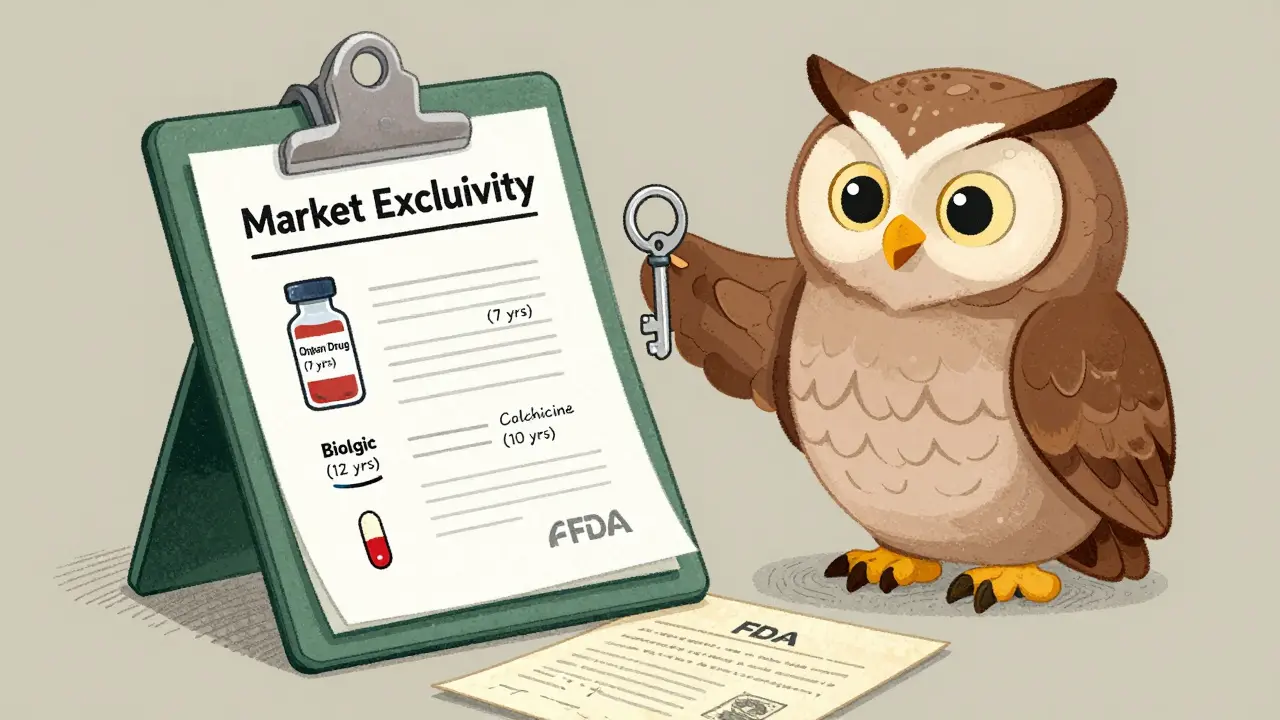
- Orphan drug exclusivity: 7 years for drugs treating rare diseases (under 200,000 patients in the U.S.).
- Pediatric exclusivity: An extra 6 months added to any existing patent or exclusivity period if the company studies the drug in children.
- Biologics exclusivity: 12 years for complex protein-based drugs like Humira or Enbrel.
- First generic exclusivity: 180 days for the first company to successfully challenge a patent and file a generic version.
Here’s where it gets wild: in 2010, a drug called colchicine-a centuries-old treatment for gout-got 10 years of market exclusivity because a company submitted new clinical data. The price jumped from 10 cents to nearly $5 per pill. No patent. Just exclusivity.
How They Work Together (or Don’t)
Think of patents and market exclusivity as two different keys to the same lock. Sometimes you need both. Sometimes you only need one.
According to FDA data from 2021:
- 27.8% of branded drugs had both patent and market exclusivity.
- 38.4% had only patent protection.
- 5.2% had only market exclusivity-no patent at all.
- 28.6% had neither.
That means over 1 in 20 drugs are protected from generics without any patent. And those drugs? They still block competition. The FDA doesn’t approve copies until the exclusivity period ends-even if the patent expired years ago.
Take Trintellix, an antidepressant. Its main patent expired in 2021. But because it had 3 years of market exclusivity, generic versions couldn’t enter until 2024. Teva Pharmaceuticals lost an estimated $320 million in potential sales during that delay.
Why This Matters for Patients and Prices
These protections aren’t just legal technicalities-they directly affect how much you pay for medicine.
Branded drugs make up only 12% of prescriptions in the U.S., but they account for 68% of total spending. Why? Because exclusivity keeps generics off the market. And generics cost 80-90% less.
That 6-month pediatric exclusivity extension? Since 1997, it’s generated about $15 billion in extra revenue for drugmakers. The 180-day first-generic window? It’s worth $100 million to $500 million for the company that wins it.
Small biotech companies rely heavily on market exclusivity. In fact, 73% of them use it as their main protection, especially for reformulated drugs or follow-on biologics. That’s because patents are hard to get for small changes-but the FDA still gives exclusivity if new data is submitted.
What’s Changing in 2024 and Beyond
The system is under pressure. Critics say it encourages “evergreening”-making tiny tweaks to drugs just to reset the clock on exclusivity. The FDA is responding.
Starting January 1, 2024, the FDA requires more detailed justifications for exclusivity claims. Companies can’t just say “we did new studies.” They have to prove the data was essential to approval.
Also, the FDA launched a public Exclusivity Dashboard in September 2023. Now anyone can track when exclusivity periods start and end. Generic makers are using it to plan their entries months in advance.
Meanwhile, Congress is debating the PREVAIL Act, which could cut biologics exclusivity from 12 years to 10. And globally, debates over patent waivers for medicines-like those during the pandemic-could reshape how exclusivity works in the future.
By 2027, analysts predict market exclusivity will account for 52% of total drug protection time, up from 41% in 2020. Patents are getting weaker. Exclusivity is getting stronger.
What Companies Get Wrong
Many drugmakers-especially small ones-assume a patent equals market control. They don’t file for market exclusivity. And they lose out.
Scendea Consulting found that between 2018 and 2022, 22% of innovator companies failed to claim all available exclusivity periods. On average, they left 1.3 years of protection on the table. That’s over $100 million in lost revenue per drug.
And generic companies? They spend an average of $8.3 million to challenge a patent through a Paragraph IV certification. But if they miss the exclusivity window, even a successful challenge won’t help.
Regulatory affairs teams spend 120 to 150 hours just preparing exclusivity claims per drug. It’s not optional. It’s essential.
Bottom Line: Two Systems, One Goal
Patent exclusivity protects inventions. Market exclusivity protects approval data. One comes from a patent office. The other from a health agency. One is about novelty. The other is about proof.
Both delay generics. Both keep prices high. Both are legal-but they’re not interchangeable.
If you’re a patient, understanding this helps you see why some drugs stay expensive long after the patent expires. If you’re in pharma, missing one means leaving money on the table. And if you’re watching policy, this is where the real battle over drug prices is being fought-not in courtrooms, but in FDA offices and regulatory filings.
Exclusivity isn’t just a legal term. It’s a pricing engine. And it’s running longer than ever.
14 Comments
Diana Stoyanova
Okay but let’s be real-this whole system is just pharma’s way of turning medicine into a luxury good. I get that R&D costs a ton, but when a company takes a 70-year-old drug like colchicine and jacks the price from 10 cents to $5 just because they did a tiny new study? That’s not innovation, that’s exploitation. And we’re the ones paying for it in co-pays and skipped doses.
It’s not even about being anti-business-it’s about being pro-human. If your business model depends on keeping people sick and poor to stay profitable, maybe the business model needs to change.
Matthew Maxwell
It is deeply irresponsible to frame market exclusivity as some kind of corporate conspiracy. The FDA grants exclusivity precisely because it requires substantial clinical investment to demonstrate safety and efficacy for new indications or formulations. Without this protection, no rational investor would fund the development of pediatric formulations, orphan drugs, or even improved delivery systems. The system incentivizes real innovation-not just copying.
To suggest that $5-per-pill colchicine is unjust is to misunderstand the cost structure of clinical trials. The company didn’t just print new labels-they ran Phase III trials, monitored adverse events, and submitted a full NDA. That costs millions. And yes, they should profit from it.
Jacob Paterson
Oh wow, so the real villain here is… the FDA? The same agency that approved OxyContin and let Purdue Pharma laugh all the way to the bank? Let me guess-you think this is all perfectly fair because it’s ‘legal.’
Patents are for inventions. Exclusivity is for data. But when you combine them with lobbying power and a regulatory capture economy? You get a system where a $0.10 pill becomes $5 because someone paid a consultant to write a 12-page report. That’s not innovation. That’s rent-seeking dressed up in lab coats.
Jenci Spradlin
just a heads up-most people dont even know what the orange book is. i learned about it from this post and now i get why my insulin is still $300 even though the patent expired 10 years ago. the real scam? the FDA letting companies keep exclusivity for minor tweaks like ‘we changed the color of the pill.’
Darren McGuff
As someone who works in regulatory affairs for a mid-sized biotech, I can confirm: exclusivity claims are a nightmare. We spent 147 hours last year just preparing the pediatric exclusivity submission for one drug. The paperwork is insane. And if you miss a deadline or mislabel a study? You lose a full year of protection. It’s not about greed-it’s about survival. Without exclusivity, we’d be out of business before we even broke even.
But I also agree with the point about evergreening. We’ve seen companies file 3-4 secondary patents on the same molecule just to delay generics. That’s abusive. The FDA’s new dashboard is a step forward, but Congress needs to step in and cap the total protection time-patents + exclusivity combined.
Elisha Muwanga
Let’s not pretend this is about science. This is about American companies exploiting American laws to extract wealth from American patients. Meanwhile, Canada and the UK pay $10 for the same drug. We’re being ripped off-and our government lets it happen because Big Pharma donates to both parties.
If you’re defending this system, you’re not pro-innovation. You’re pro-profit-at-all-costs. And if you think that’s acceptable, you’ve lost touch with reality.
Catherine Scutt
my grandma took colchicine for gout. paid $2 a month. now it’s $150. she stopped taking it. now she’s in the ER every other week. this isn’t a policy debate. it’s a human tragedy.
Aron Veldhuizen
You’re all missing the deeper philosophical point: if a drug’s chemical structure is public knowledge, why should anyone be allowed to monopolize its use? This isn’t about patents or data-it’s about the moral absurdity of owning biology. A molecule isn’t an invention. It’s a discovery. And if we treat nature like property, we’ve already lost the plot.
Exclusivity is capitalism’s final frontier: turning life itself into a commodity. The FDA isn’t a regulator. It’s a gatekeeper for the pharmaceutical priesthood. And we’re all just peasants waiting for our ration of hope.
Micheal Murdoch
For anyone new to this topic-this is one of the most important things you’ll ever learn about healthcare. It’s not about ‘big pharma bad’ or ‘regulation good.’ It’s about incentives. The system rewards the right behaviors… and punishes the wrong ones.
Small biotechs? They can’t afford to patent everything. But if they can get 5 years of market exclusivity for a new formulation? That’s their lifeline. Without it, they die. And then we lose the next breakthrough drug.
But yes-some companies abuse it. The key is to fix the abuse, not throw out the whole system. The FDA’s new dashboard is huge. It’s transparency. And transparency is the first step toward accountability.
Also-pediatric exclusivity? That’s saved thousands of kids. You think a company would spend $50M to study a drug in children if they didn’t get anything back? Nope. So don’t hate the tool. Hate the misuse.
Jeffrey Hu
you guys are overcomplicating this. patent = legal monopoly. market exclusivity = bureaucratic monopoly. both are just ways to delay generics. who cares if it’s ‘data’ or ‘molecule’? the result is the same: people pay more. and the FDA is just another arm of the pharma lobby. end of story.
tali murah
Let’s not pretend this is a neutral regulatory system. It’s a rigged game where the house always wins. The 180-day first-generic window? That’s not a reward-it’s a bribe. The company that wins it gets to be the *only* generic for half a year, charging 90% of the brand price. Meanwhile, every other generic sits idle. That’s not competition. That’s collusion with a stopwatch.
And don’t even get me started on biologics. 12 years? That’s longer than most people’s marriages. And we’re supposed to be grateful? For what? A protein that was sequenced in 1998? The science is ancient. The profit motive? Modern slavery.
The PREVAIL Act is too little, too late. We need a 5-year cap on ALL exclusivity, full transparency of clinical data, and public ownership of any drug developed with federal funding. That’s not radical. That’s restitution.
Heather Wilson
Here’s the cold truth: 73% of small biotechs rely on exclusivity because they can’t afford patents. That’s not a loophole-it’s a necessity. If you want cheaper drugs, fund public R&D. Don’t punish companies that are trying to survive in a broken system.
Also, the $2.3B development cost? That’s inflated. It includes failed drugs, overhead, and marketing. The real cost to develop one successful drug is closer to $600M. And even that’s not justified if the end result is a $50,000-a-year pill for a disease that affects 500 people.
Exclusivity isn’t evil. It’s being weaponized. Fix the weapon, not the tool.
Ashley Kronenwetter
Thank you for this clear, well-researched breakdown. As someone who works in public health policy, I’ve seen firsthand how confusion between patent and market exclusivity leads to poor legislative decisions. This is exactly the kind of clarity we need before drafting reform bills.
The FDA’s new dashboard is a significant step toward accountability. Transparency enables competition-even if indirectly. I hope more stakeholders use it to plan ahead and reduce market disruption.
Phil Kemling
What if the real question isn’t ‘how do we fix exclusivity?’ but ‘why do we let corporations control access to biological knowledge?’
Patents were never meant to be perpetual. Exclusivity was never meant to be indefinite. But when profit becomes the only metric of value, we stop asking whether something is right-and start asking whether it’s legal.
These systems were designed to balance innovation and access. Now they’re designed to maximize shareholder returns. The law didn’t change. Our values did.
Maybe the solution isn’t more regulation. Maybe it’s a moral reckoning.