
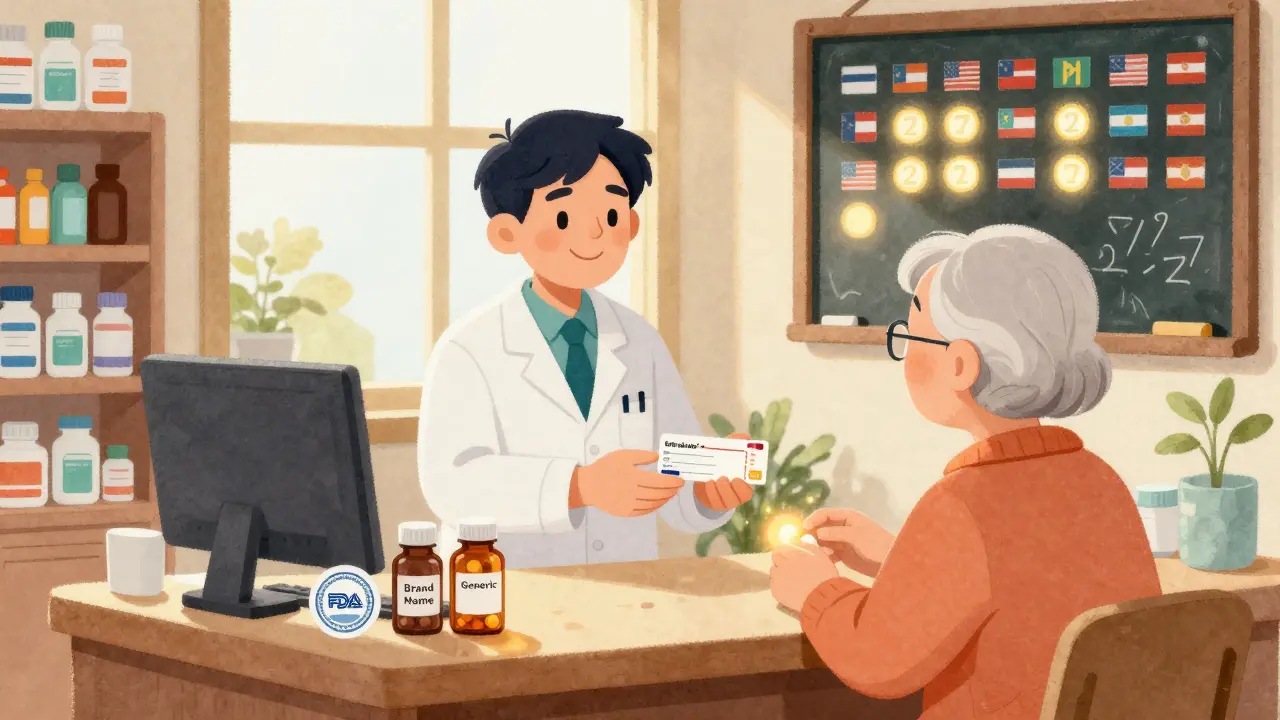
When you pick up a prescription at your local pharmacy, you might not realize that the person behind the counter has more power than you think. In many states, pharmacists can legally swap one medication for another - not just a generic version, but sometimes an entirely different drug from the same class. This isn’t guesswork. It’s a carefully regulated part of pharmacy practice, and the rules vary wildly from one state to the next.
What Exactly Can Pharmacists Substitute?
There are two main types of substitution: generic and therapeutic. Generic substitution means replacing a brand-name drug with a chemically identical, FDA-approved generic. This is allowed in all 50 states and D.C. It’s simple, safe, and saves money - about $197 billion a year, according to the Generic Pharmaceutical Association.
Therapeutic substitution is trickier. It means swapping a drug for another that’s not chemically the same but works similarly - like switching from one blood pressure medication to another in the same class. This isn’t automatic. Only 27 states allow it, and even then, with strict rules. In Colorado, pharmacists must write "Intentional Therapeutic Drug Class Substitution" on the prescription. In California, it’s only allowed for insulin. In Alabama, they can’t do it at all without the doctor’s OK.
The FDA’s 2022 authorization letting pharmacists prescribe Paxlovid for COVID-19 was a turning point. For the first time, federal law overrode state restrictions, giving pharmacists real prescribing power - but only for one drug, under strict conditions: patient must be 12 or older, weigh over 40kg, test positive, and have no kidney or liver issues. This wasn’t substitution - it was direct prescribing. But it opened the door.
State-by-State Rules: A Patchwork of Laws
There’s no national standard. What’s legal in Oregon is illegal in Alabama. And it’s not just about permission - it’s about paperwork.
- Thirty-two states require pharmacists to write a note on the prescription right away.
- Fourteen states give them 72 hours to report the change.
- Nineteen states demand the prescriber be notified within 24 to 48 hours.
Consent is another minefield. Seventeen states require written patient consent - signed on paper. Nine states accept verbal consent. Fourteen states don’t require consent at all, but still demand detailed documentation. That means a pharmacist in New York might need a signature, while one in Texas just needs to log it in the system.
And then there’s training. Pharmacists in states with expanded authority - like Colorado, Oregon, and New Mexico - must complete 10 to 15 extra hours of training. In Colorado, it’s 12.75 hours just for birth control and vaccine protocols. Pharmacists who work across state lines, like those in chain pharmacies, often need 40+ extra hours of training just to stay compliant.
Who’s Leading the Way?
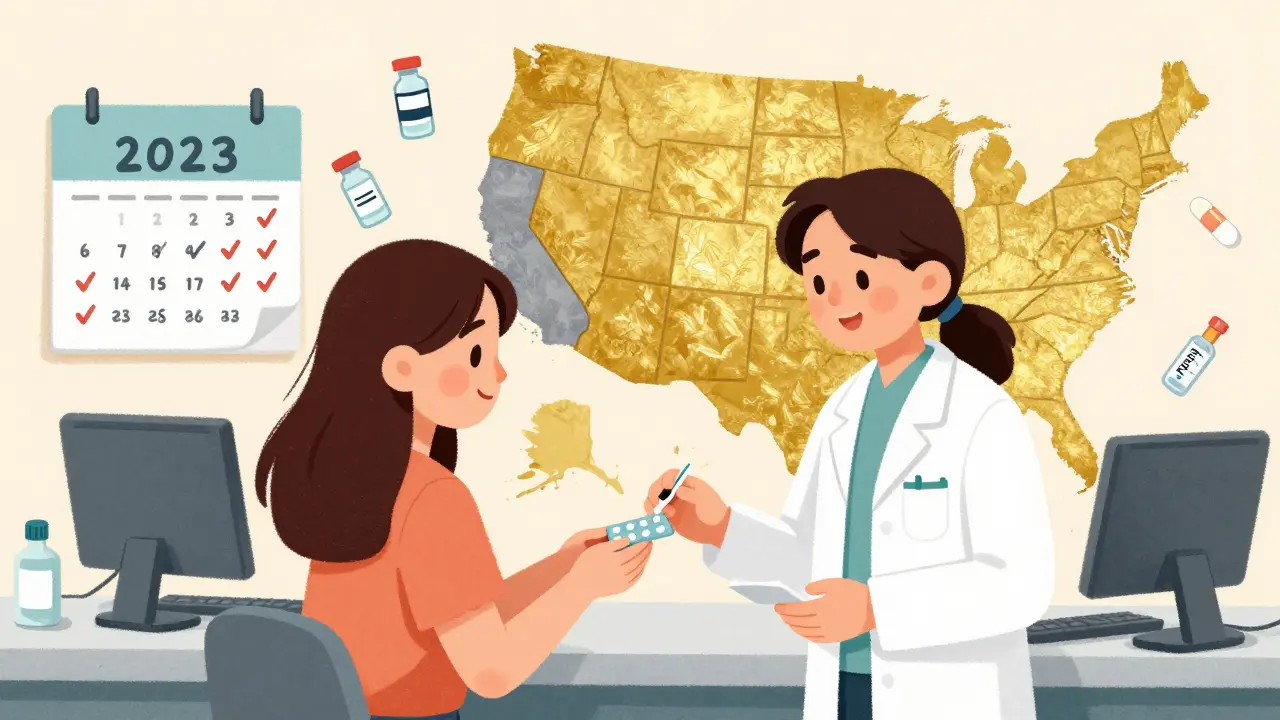
Colorado stands out. Since 2023, pharmacists there can prescribe birth control, manage tobacco cessation, and administer vaccines under statewide protocols - no doctor’s signature needed. That’s not just substitution; it’s independent practice. And it works. One pharmacist in Denver told Reddit she served 47 patients who couldn’t get a doctor’s appointment in 30 days. Each visit took five minutes.
Maryland’s 2023 law lets pharmacists prescribe birth control directly - and Medicaid covers it. Since October 2023, over 12,000 prescriptions have been written this way. In New Mexico, 87% of pharmacies actively use therapeutic substitution. In Alabama? Just 22%.
The difference isn’t just policy - it’s access. Rural areas benefit most. The CDC found therapeutic substitution in rural communities cut medication gaps by 34%, compared to 19% in cities. For someone living hours from a clinic, that’s life-changing.
Why It Matters - And Why It’s Controversial
The savings are real. Generic substitution alone handles 90% of all U.S. prescriptions - 6.34 billion a year. But therapeutic substitution? Experts say it could save $45 billion to $60 billion annually if rolled out nationwide.
But not everyone agrees. The American Medical Association warns that without full access to a patient’s medical records, pharmacists might miss drug interactions or worsening conditions. One doctor wrote in JAMA that unrestricted substitution could fragment care, especially for older patients on five or more medications.
Pharmacists counter with data. The National Community Pharmacists Association says their interventions prevent 12.7 million adverse drug events every year. A 2023 survey of 1,247 pharmacists found 68% in states with strong substitution laws reported better patient outcomes. In restrictive states, 42% said they lost time every day calling doctors just to swap a pill.
What’s Changing Now?
As of March 2024, 19 states are pushing new laws to expand pharmacist authority. Virginia and Illinois are expected to pass major reforms by year-end. The American Pharmacists Association is pushing for four big shifts:
- Standardizing rules across state lines
- Allowing substitution for mental health meds
- Linking substitution to value-based care models
- Creating national training standards
Meanwhile, the FDA’s Orange Book - the official guide to therapeutic equivalence - now lists over 13,700 rated drug pairs. Pharmacists use this daily to decide what’s safe to swap. But if your state doesn’t let you use it? You’re stuck.

Real Problems, Real Solutions
Pharmacists don’t just need legal permission - they need systems. One pharmacist in Texas said therapeutic substitution for insulin added 15-20 minutes per prescription because she had to call the doctor. In Oklahoma? Just document it. That’s 15 minutes saved - 15 minutes that could go to counseling a diabetic patient or checking for interactions.
Electronic records often don’t talk to each other. A pharmacist in a chain pharmacy told a survey: "I can’t tell if the patient’s other doctor approved this substitution because the system doesn’t share it." That’s not a legal problem - it’s a tech problem. Kroger Health fixed this by standardizing forms across states. Their error rate dropped 37%.
Patients are confused, too. Over 78% of pharmacy complaint logs mention patients asking: "Why did you change my pill?" Without clear communication, trust breaks down.
What’s Next?
The future isn’t about taking power away from doctors. It’s about giving pharmacists the tools to act when they’re the most accessible health professional - which they are, for 65% of Americans.
Imagine walking into a pharmacy in a rural town. Your blood pressure meds are too expensive. The pharmacist checks your records, confirms your kidney function, consults the Orange Book, and swaps it for a generic alternative that’s just as effective. No appointment. No wait. Just a quick chat and a new prescription.
That’s not science fiction. It’s happening in Colorado. It’s happening in Maryland. And if 7 more states pass their bills this year, it’ll be happening everywhere.
The law isn’t the barrier anymore. It’s the paperwork, the tech, and the training. Fix those, and pharmacists won’t just fill prescriptions - they’ll keep people healthy.
Can a pharmacist legally swap my brand-name drug for a generic without asking me?
In all 50 states and D.C., pharmacists can substitute a generic version of a brand-name drug without your explicit permission - but they must notify you. This is standard practice and saves money. The only exception is if your doctor wrote "Dispense as Written" or "Do Not Substitute" on the prescription. In that case, the pharmacist must fill it exactly as written.
What’s the difference between generic and therapeutic substitution?
Generic substitution replaces a brand-name drug with a chemically identical generic version - same active ingredient, same dose, same effect. Therapeutic substitution replaces a drug with a different one from the same class - like switching from lisinopril to losartan for high blood pressure. The second drug isn’t identical, but it works similarly. Generic substitution is allowed everywhere. Therapeutic substitution is only allowed in 27 states - and with strict rules.
Why do some states let pharmacists substitute while others don’t?
It’s about history, politics, and healthcare access. States like Colorado and Oregon passed laws to improve rural care and reduce costs. Others, like Alabama, maintain stricter oversight due to concerns about patient safety and physician control. There’s no medical reason for the difference - it’s a legal one. The FDA doesn’t regulate this; state pharmacy boards do.
Do I need to give consent before a pharmacist swaps my medication?
It depends on your state. In 17 states, you must sign a form. In 9, the pharmacist just needs to explain it verbally. In 14, no consent is required - but they still must document the change. If you’re unsure, ask your pharmacist. They’re required to tell you if a substitution is being made, even if they don’t need your permission.
Can my pharmacist prescribe new medications now?
Only in specific cases. Since July 2022, pharmacists nationwide can prescribe Paxlovid for eligible COVID-19 patients. In states like Maryland and Colorado, they can also prescribe birth control, nicotine replacement, and vaccines - but only under state-approved protocols. They still can’t prescribe antibiotics, opioids, or antidepressants without a doctor’s involvement - unless the state explicitly allows it. The rules are narrow, but expanding.
How do I know if my pharmacist made a substitution?
Check the label. If your drug name changed, or if the pill looks different, ask. Pharmacists must document substitutions and notify you - either on the prescription, in writing, or verbally. You can also ask for the reason. If you’re on a fixed medication for a chronic condition, it’s your right to know if something changed.
Are therapeutic substitutions safe?
Yes - when done correctly. The FDA’s Orange Book identifies which drugs are therapeutically equivalent based on clinical studies. Pharmacists are trained to use this guide. Studies show that when substitutions follow protocol, patient outcomes are just as good - sometimes better - because patients are more likely to take cheaper, more accessible meds. The risk comes when documentation is poor or the pharmacist lacks full records. That’s why states with strong systems report fewer errors.
What should I do if I’m unhappy with a substitution?
Ask for the original medication. You have the right to refuse a substitution and request the drug your doctor prescribed - even if it costs more. You can also ask your doctor to write "Do Not Substitute" on future prescriptions. If you believe the substitution caused harm, report it to your state pharmacy board. They investigate complaints and track patterns across pharmacies.
12 Comments
Susan Purney Mark
Just got my birth control script swapped out by my pharmacist last week-no big deal, honestly. She walked me through the options, checked my history, and even gave me a little pamphlet. 🙌 So glad Colorado’s leading the way. I didn’t have to wait 6 weeks for an appointment. That’s healthcare that works.
Tim Hnatko
It’s wild how much variation there is between states. I work for a national chain and have to juggle 12 different protocols. One day I’m documenting a substitution in Texas, the next I’m getting a signed consent form in New York. The tech doesn’t talk to itself, so half my day is phone calls. We need system-wide integration, not just patchwork laws.
Aaron Pace
Pharmacists prescribing birth control? 😏 I mean… cool I guess? But why not just let nurses do it? Or even midwives? Seems like scope creep to me. And what happens when someone’s on 7 meds and the pharmacist doesn’t see the full picture? I’ve seen bad outcomes. Not saying it’s all bad, but… yikes.
Joey Pearson
YES. This is what we’ve been fighting for. 💪 No more waiting. No more cost barriers. Pharmacists are the frontline. They’re the ones who catch the interactions, the ones who remember your name. Let them help. Let them lead. 🌟
Weston Potgieter
So pharmacists are now doctors-lite? Cool story. Where’s the data that proves they don’t mess up 1 in 5 times? I’ve seen people get switched to drugs that didn’t work and then end up in the ER. All because some guy in a white coat thought he knew better than the MD. 🤷♂️
phyllis bourassa
Oh wow, so now we’re trusting people who count pills for a living to make complex clinical decisions? 😅 I mean, I get the savings, but what about the elderly? The ones on 10 meds? You think a pharmacist with 10 minutes between customers can really assess drug interactions? It’s not just paperwork-it’s brainpower. And most aren’t trained for this. Just saying.
Ferdinand Aton
Wait, so you’re saying a pharmacist can swap my blood pressure med without telling me? In 14 states? That’s not freedom, that’s negligence. What if I’m allergic to the inactive ingredient? What if I’ve got kidney disease? You can’t just assume everyone’s got perfect records. This feels like cutting corners.
William Minks
As someone who grew up in rural Alabama, I can’t tell you how much this matters. My grandma had to drive 90 miles to see a doctor just to refill her insulin. Here in Oregon, the pharmacist swapped it out, explained the options, and even called her daughter to update her. That’s not just convenience-it’s dignity. 🙏
Jeff Mirisola
Let’s stop framing this as pharmacists vs. doctors. It’s not a power grab-it’s a team play. Doctors are overloaded. Pharmacists are everywhere. Why not use the whole bench? I’ve seen pharmacists catch a dangerous interaction that the doctor missed because the chart was outdated. This isn’t about replacing MDs-it’s about filling gaps. And the data proves it works.
Ian Kiplagat
Interesting. In the UK, pharmacists can do minor prescribing under protocols too. But we’ve got a national EHR. No one’s calling 12 different systems. Maybe the real issue isn’t the law-it’s the tech.
Roland Silber
I’m a pharmacist in Iowa, and we just passed a law allowing therapeutic substitution for statins and antihypertensives. We had to do 15 hours of training, pass a competency exam, and get certified. It’s not just about authority-it’s about responsibility. And yes, we log everything. We’re not just pill dispensers anymore. We’re care coordinators. The patients notice. They trust us more now.
Patrick Jackson
Imagine this: you’re 72, on 6 meds, and your insulin costs $500. You skip doses because you can’t afford it. Then your pharmacist swaps it for a cheaper, equally effective one. You don’t even know it happened-until your A1C drops. No drama. No paperwork. Just life. That’s not a policy change. That’s a miracle. 🌈 And it’s happening in 27 states. Why are we still arguing?