
When pain becomes a daily companion, pills aren’t always the answer-and sometimes, they’re not even the best one. Many people turn to painkillers because they’re fast, easy, and widely available. But what if you could reduce pain without relying on medication? That’s where physical therapy for pain comes in. It’s not magic. It’s science. And it works.
Think about it: if your back hurts because your core muscles are weak, no pill will fix that. If your knee aches because your hips are tight, a tablet won’t loosen them. Physical therapy doesn’t mask pain. It fixes the broken parts causing it. Through targeted exercise, smart stretching, and movement-based restoration, thousands of people have walked out of chronic pain without ever needing surgery or opioids.
How Movement Actually Stops Pain
Pain isn’t just a signal. It’s a system. When you hurt, your nervous system gets stuck in overdrive. Muscles tense. Joints stiffen. Movement becomes scary. That’s when pain turns from a symptom into a habit.
Physical therapy breaks that cycle. Moving your body releases natural painkillers-endorphins and serotonin. It also calms down overactive nerves. Studies show that just 20 minutes of steady walking at a moderate pace can lower pain ratings by 30% or more. That’s not placebo. That’s biology.
But here’s the catch: it has to be the right kind of movement. Lifting heavy weights when you have a herniated disc? Bad idea. Running on sore knees? That’ll make it worse. The key isn’t pushing through pain. It’s moving within a safe zone.
Most therapists use the 0-10 pain scale to guide this. If your pain stays under 3 out of 10 during exercise and goes back to normal within an hour after, you’re in the sweet spot. If it spikes higher or lingers, you’re pushing too hard. This isn’t about toughness. It’s about precision.
The Three Pillars: Exercise, Stretching, Restoration
Effective physical therapy for pain rests on three simple but powerful pillars: exercise, stretching, and restoration. Each plays a different role-and all are needed.
Exercise: Building Strength Without Breaking Down
Strength training isn’t just for bodybuilders. For pain, it’s medicine. Strong muscles support joints. They take pressure off inflamed tissues. They prevent future injuries.
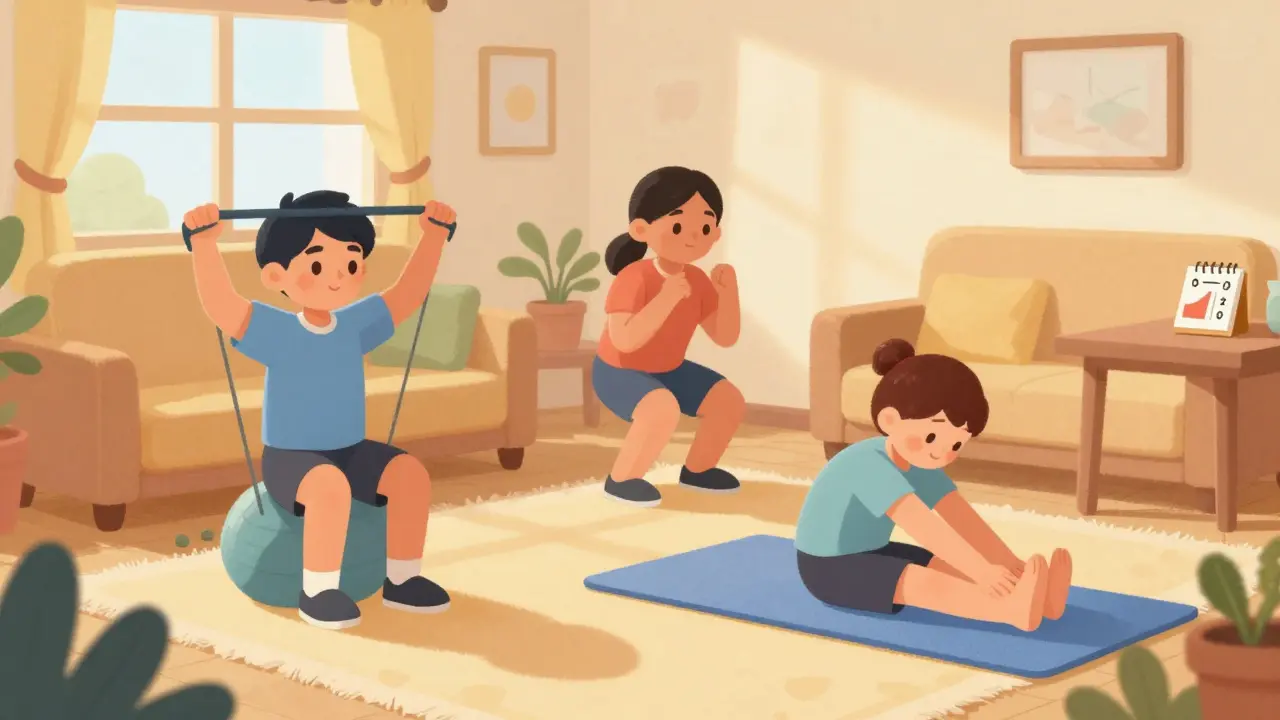
Research shows the best results come from 2-3 sets of 8-15 reps using moderate resistance (60-80% of your one-rep max). You don’t need fancy equipment. Bodyweight squats, wall push-ups, seated rows with resistance bands-all work. The goal isn’t to burn out. It’s to build endurance and stability.
For people with arthritis, low-impact cardio like swimming or cycling reduces joint stress by up to 50% compared to walking on pavement. A 2023 Mayo Clinic study found water-based exercise cut osteoarthritis pain by 35-40% in just six weeks. That’s better than most pain patches.
And you don’t need long sessions. A Duke University study with office workers showed that just two minutes of daily neck and shoulder exercises reduced pain by 31% after four weeks. Tiny efforts. Big results.
Stretching: Loosening What’s Tight
Tight muscles don’t just feel stiff. They pull on joints. They compress nerves. They trigger pain signals.
Static stretching-holding a stretch without bouncing-for 30 to 60 seconds per muscle group, five to seven days a week, increases flexibility by 15-25 degrees in four weeks. That’s measurable. That’s real.
For lower back pain, stretching the hamstrings and hip flexors often makes more difference than any spinal manipulation. For neck pain, releasing the upper trapezius and levator scapulae (those muscles that knot up when you’re stressed) can cut pain in half.
One Reddit user, u/BackPainSufferer, shared that straight leg raises reduced his sciatica pain from 7/10 to 2/10 in three weeks. Not because he did surgery. Not because he took drugs. Because he learned how to gently stretch the nerve pathway.
Important note: Don’t stretch into pain. Stretch into tension. If it hurts, back off. You’re not trying to force your body. You’re inviting it to relax.
Restoration: Getting Back to Life
Pain doesn’t just hurt. It steals your life. You stop walking. Stop lifting. Stop playing with your kids. Stop doing what you love.
Restoration means rebuilding function. It’s not about feeling better today. It’s about being able to tie your shoes, carry groceries, or climb stairs without dread.
Therapists use graded activity to get people there. That means slowly increasing what you can do-10-15% more each week. Walk five minutes today? Try six tomorrow. Do five squats? Do six next week. It’s slow. It’s safe. And it works.
Mayo Clinic’s 15-minute back exercise protocol, released in March 2024, showed 62% pain reduction in six weeks with 92% adherence. Why? Because it was simple. It was doable. It fit into real life.
What Works Best for Different Types of Pain
Not all pain is the same. And not all exercises work for everyone.
For arthritis, water-based movement is king. Swimming, aqua aerobics, and even walking in chest-deep water reduce joint load while keeping muscles active. The Arthritis Foundation’s two-minute exercise routine, updated in January 2024, now covers 12 joint conditions-and has an 87% satisfaction rate among users.
For fibromyalgia, tai chi beats standard aerobic exercise. A 2022 trial with 298 participants found tai chi reduced pain 30% more than walking or cycling. Why? It combines movement, breath, and mindfulness. It teaches the nervous system to calm down.
For chronic back pain, core strengthening and hip mobility are the keys. Dr. James Fricton from UT Health Austin says properly done home exercises have a 70% success rate in reducing long-term back pain. That means no more painkillers, no more missed work, no more fear of bending over.
For neck and shoulder pain from sitting at a desk, micro-exercises work best. Shoulder blade squeezes, chin tucks, and arm circles for just two minutes every hour can prevent pain from ever starting.

Why People Fail (And How to Avoid It)
Physical therapy fails more often because of poor execution than poor science.
Here are the top reasons people don’t see results:
- Doing too much too soon. Pushing past pain leads to flare-ups. 38% of beginners report increased pain at first-not because the therapy is wrong, but because they rushed it.
- Skipping the form. A bad squat can hurt your knees. A twisted stretch can pinch your spine. One bad rep can undo weeks of progress.
- No consistency. Doing exercises once a week won’t change anything. You need 4-5 days a week, even if it’s just 10 minutes.
- No tracking. If you don’t measure pain before and after, you won’t know if it’s working. Use a simple 0-10 scale. Write it down.
The fix? Start small. Do one exercise perfectly. Do it every day. Record how you feel. After two weeks, add another. That’s how real change happens.
What You Need to Get Started
You don’t need a gym membership. You don’t need expensive gear. You need:
- A quiet space
- A chair or wall for support
- A resistance band (under $10)
- A notebook or phone app to track pain levels
- Patience
Most clinics give you written instructions. But video demos are better. A 2023 VAOP Therapy study found that patients who got video instructions were 78% likely to stick with their program-compared to 45% with just paper.
Look for resources from trusted sources: Mayo Clinic, Arthritis Foundation, Physiopedia. Avoid random YouTube videos without clear instructions or professional backing.

When Physical Therapy Isn’t Enough
It’s not a cure-all. Some people need more.
Dr. Jane Smith from Advanced Pain Medical points out that 35% of her patients need a combo approach-physical therapy plus cognitive behavioral therapy, acupuncture, or even medication for short-term relief. That’s not failure. That’s smart care.
If you’ve tried physical therapy for eight weeks and feel no change, it’s time to reassess. Maybe your diagnosis is wrong. Maybe you need imaging. Maybe your pain has a nerve component that needs a different strategy.
But don’t give up on movement. Even if you need other tools, exercise and stretching should still be part of your plan. They’re the foundation.
The Bigger Picture
Physical therapy for pain is growing fast. In 2023, it made up 22% of the $58.3 billion non-opioid pain management market. Medicare covers 80% of approved sessions. More clinics now offer telehealth. Wearable devices track your movement and give feedback.
The future? Personalized routines based on your pain type, age, and goals. NIH just funded $14.7 million in research on ultra-short exercise bursts for chronic pain. That means even busier people will have options.
What’s clear is this: pain doesn’t have to be permanent. You don’t have to live with it. You don’t have to numb it. You can heal it-with your own body, one gentle movement at a time.
Can physical therapy help with chronic pain even if I’ve had it for years?
Yes. Chronic pain doesn’t mean permanent damage. The nervous system can relearn. Studies show people with 10+ years of back or knee pain reduce pain by 50-75% in 6-8 weeks with consistent, properly guided physical therapy. It takes patience, but the body adapts even after decades.
How long until I feel better with physical therapy?
Most people notice small improvements in 2-3 weeks. Meaningful pain reduction usually happens between 4 and 8 weeks. It’s not instant, but it’s lasting. The key is consistency-not intensity. Doing 10 minutes a day, five days a week, beats one long session once a week.
Is it normal for pain to get worse at first?
Mild soreness is normal, especially if you haven’t moved in a while. But sharp, shooting, or increasing pain is not. Use the 2-hour rule: if your pain returns to baseline within two hours after exercise, it’s safe. If it’s still higher after two hours, scale back. This isn’t about pushing through pain-it’s about respecting your body’s limits.
Do I need a referral to see a physical therapist?
In the UK, you can self-refer to NHS physiotherapy services without a doctor’s note. Many private clinics also allow direct bookings. Check your local provider’s policy. If you’re on Medicare or private insurance, check coverage rules-but you don’t always need a referral to start.
Can I do physical therapy at home, or do I need to go to a clinic?
You can start at home with the right guidance. Many successful programs are designed for home use. But if your pain is complex, severe, or worsening, seeing a therapist in person is essential. They can assess your movement, correct your form, and adjust your plan. Think of home exercises as maintenance. In-clinic visits are for diagnosis and fine-tuning.
What if I can’t afford physical therapy?
Free and low-cost options exist. The Arthritis Foundation offers free two-minute exercise videos online. NHS physiotherapy in the UK is free for eligible patients. Many community centers offer low-cost group classes. YouTube channels from certified physiotherapists (like Physiopedia or Mayo Clinic) provide reliable routines. You don’t need to spend hundreds to start healing.
11 Comments
dean du plessis
Been doing this for 18 months now after my knee gave out at the gym. Started with 5 minutes of wall sits and breathing. Now I hike weekends without pain. No pills. No magic. Just slow consistent movement. Body listens if you give it time.
Elizabeth Ganak
i just stretch my hips every morning before coffee. 2 minutes. no equipment. no drama. my lower back hasn’t hurt in 4 months. you don’t need a degree to move better.
Gerald Tardif
Let me be the first to say this: if you’re still believing pain is just a ‘signal’ and not a systemic nervous system malfunction shaped by trauma, stress, and sleep deprivation, you’re missing 70% of the picture. Physical therapy helps-but only if you’re also addressing cortisol levels, emotional repression, and the fact that most people move like robots because they’ve been conditioned to suppress discomfort since childhood. This isn’t about squats. It’s about relearning how to inhabit your body without fear. And yes, that’s harder than lifting weights.
John Barron
As a licensed physical therapist with 17 years in clinical practice, I must emphasize that the 0-10 pain scale is a flawed metric. It lacks psychometric validation for chronic pain populations and is highly susceptible to placebo and contextual bias. The notion that ‘pain under 3 is safe’ is dangerously oversimplified. Pain modulation involves descending inhibitory pathways, central sensitization, and neuroimmune interactions-all of which are ignored by this reductionist approach. If you’re relying on a numerical scale to guide rehabilitation, you’re not practicing evidence-based medicine. You’re practicing guesswork dressed in yoga pants.
Will Neitzer
Thank you for this thoughtful, meticulously researched piece. The integration of biomechanics with neurophysiology is precisely what modern pain management requires. I particularly appreciate the emphasis on graded exposure and the rejection of the ‘no pain, no gain’ myth. The inclusion of peer-reviewed studies from Mayo Clinic, Duke, and the Arthritis Foundation lends immense credibility. For clinicians and patients alike, this is a blueprint for sustainable recovery-not merely symptom suppression. I will be sharing this with my entire rehabilitation team.
Janice Holmes
OMG I’M CRYING. I had 12 years of chronic back pain. I tried everything. Acupuncture. Chiropractors. Ketamine infusions. Then I did 3 minutes of cat-cow every morning. Just 3 minutes. Now I play with my kids without wincing. I’m not even joking. My therapist said it was ‘neuroplasticity’ but I think it was just my spine finally saying ‘thank you.’ 😭🙏
Alex Lopez
Oh wow. So we’re just supposed to believe that a resistance band and a notebook can replace pharmaceutical innovation? That’s adorable. Let me get this straight-you’re telling me the entire $58 billion pain management industry is wrong because someone did 10 squats? I’ll stick with my epidural steroid injections, thank you very much. Also, the Mayo Clinic doesn’t endorse ‘two-minute routines’ for osteoarthritis. That’s a blog post, not a clinical guideline. 🤡
Monika Naumann
In India, we have known for centuries that movement heals. Yoga, Ayurveda, Pranayama-these are not ‘alternative therapies.’ They are science refined by millennia of observation. Why do Westerners need a 2023 Mayo Clinic study to confirm what our grandmothers knew? This article is merely a belated Western acknowledgment of Eastern wisdom. And yet, no credit is given. How convenient.
Kishor Raibole
This is a classic example of medical colonization disguised as wellness. Physical therapy as promoted here is a neoliberal tool to shift healthcare costs onto the individual. The real issue? Corporate workplaces force sedentary lifestyles. Insurance companies deny access to qualified therapists. And now we’re being told to ‘just stretch more’ while the system profits from our suffering. This isn’t healing-it’s victim-blaming wrapped in a resistance band.
Elizabeth Alvarez
Have you ever considered that physical therapy is a front for the pharmaceutical industry? They want you to believe movement cures pain so you stop demanding real answers. But pain is caused by 5G frequencies, chemtrails, and the subtle electromagnetic manipulation of your spinal fluid by shadow governments. The fact that they tell you to use a notebook? That’s to track your ‘compliance’ for the next phase of mind control. They’re not helping you heal-they’re conditioning you to accept your own suffering as normal. The 0-10 scale? That’s a neural implant calibration tool. Wake up.
Miriam Piro
It’s beautiful, isn’t it? The body remembers. Not just the muscles, not just the nerves-but the soul. Pain is the ghost of past trauma, locked in connective tissue, whispering in the language of inflammation. When you stretch, you’re not just moving a tendon-you’re releasing ancestral fear. When you squat, you’re not building strength-you’re reclaiming your right to stand tall in a world that taught you to shrink. This isn’t medicine. It’s alchemy. And the resistance band? It’s the modern-day yoni egg. The notebook? Your personal grimoire. You’re not just healing your back. You’re awakening the divine feminine within. 🌿✨