
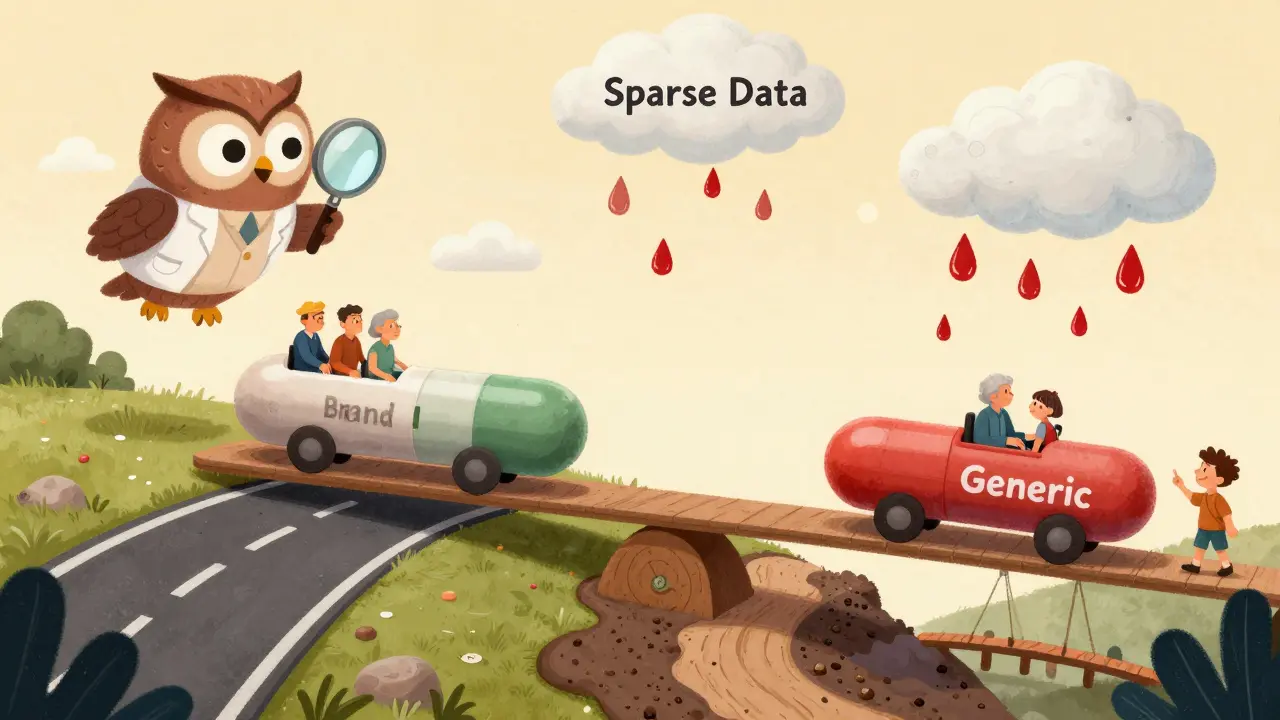
When a generic drug hits the market, how do we know it works just like the brand-name version? It’s not enough to say they look the same or have the same active ingredient. The real question is: does the body absorb and process it the same way? That’s where population pharmacokinetics-PopPK-comes in. It’s not a flashy new tech, but it’s quietly revolutionizing how we prove drug equivalence, especially for patients who were once left out of the equation: kids, the elderly, people with kidney or liver disease, and those on multiple medications.
Why Traditional Bioequivalence Studies Fall Short
For decades, the gold standard for proving two drugs are equivalent was the crossover bioequivalence study. Healthy volunteers, usually 24 to 48 of them, would take one version of the drug, wait a few days, then take the other. Blood samples were taken every 15 to 30 minutes for up to 48 hours. The goal? Compare the average amount of drug in the blood (AUC) and the peak concentration (Cmax). If both were within 80-125% of each other, the drugs were deemed equivalent. But here’s the problem: those volunteers weren’t the people who actually take the drug. They were young, healthy, and had no other conditions. What about someone with kidney failure? Or an 80-year-old on five different pills? Those patients were excluded-not because they didn’t need the drug, but because the study design couldn’t handle them. That’s where PopPK breaks the mold. Instead of forcing everyone into the same box, it uses real-world data from real patients. Think of it like this: instead of testing two cars on a perfect racetrack, you’re watching how they perform on different roads-rainy streets, highways, potholes-with drivers of all ages and experience levels. You’re not just comparing average speed-you’re seeing how each car reacts under pressure, with different loads, in different conditions.How PopPK Works: The Math Behind the Magic
PopPK doesn’t rely on dense, tightly controlled sampling. It uses sparse data-maybe two or three blood draws per patient-collected during routine care. A diabetic patient getting a new insulin prescription? Their doctor checks their blood sugar and takes a blood sample. An elderly patient on blood thinners? Their lab test is part of their monthly checkup. All of that data, scattered and messy, becomes raw material for PopPK. The math behind it is complex, but the idea is simple: build a model that explains how the drug moves through the body, and then figure out what makes it move differently from person to person. Is it weight? Age? Kidney function? Liver enzymes? Drug interactions? PopPK finds those patterns. It uses nonlinear mixed-effects modeling, which sounds intimidating but just means it looks at two layers: the average behavior of the whole group, and how each individual deviates from that average. The model then calculates two key numbers: between-subject variability (BSV) and residual unexplained variability (RUV). BSV tells you how much drug exposure differs between people-say, 30% across a group. If two drug versions have BSVs that overlap within acceptable limits (usually under 40%), you can say they’re equivalent in how they behave across the population.When PopPK Is the Only Practical Choice
There are cases where traditional studies just aren’t possible-or ethical. Take neonates. You can’t draw 10 blood samples from a newborn every hour. You can’t give them multiple doses just to compare two versions of a drug. PopPK lets you use the few samples you can safely get and still make confident decisions. The same goes for patients with severe organ impairment. A study asking someone with end-stage kidney disease to take two versions of a drug just to prove equivalence? That’s not just impractical-it’s dangerous. PopPK lets you analyze data from patients already on the drug in real life, without putting them through extra testing. This is especially critical for drugs with a narrow therapeutic index-where a small change in blood level can mean the difference between effectiveness and toxicity. Think warfarin, digoxin, or certain epilepsy drugs. For these, even a 10% difference in exposure can be dangerous. PopPK doesn’t just tell you the average exposure-it shows you the full range of what patients actually experience.
Regulatory Shifts: From Skepticism to Standard Practice
In the past, regulators were hesitant. PopPK models were seen as too complex, too black-box. But that changed. In February 2022, the U.S. Food and Drug Administration (FDA) released formal guidance saying PopPK data could replace some traditional bioequivalence studies. It wasn’t just a suggestion-it was a roadmap. The FDA now explicitly states that PopPK can help avoid postmarketing requirements if the data are strong enough. The European Medicines Agency (EMA) followed suit with its own guidelines in 2014, emphasizing that PopPK isn’t just about averages-it’s about understanding variability across real patients. Japan’s PMDA adopted similar standards in 2020. This global alignment means companies can design one study and get approval across multiple markets. Today, about 70% of new drug applications submitted to the FDA between 2017 and 2021 included PopPK analyses. That’s not a niche tool anymore-it’s a core part of development.Tools, Training, and the Human Side of PopPK
You can’t run PopPK with Excel. You need specialized software: NONMEM (used in 85% of FDA submissions), Monolix, or Phoenix NLME. These tools are powerful but require deep expertise. Pharmacometricians-the specialists who build these models-typically spend 18 to 24 months training before they’re ready to submit to regulators. But the biggest challenge isn’t the software. It’s the data. Many clinical trials weren’t designed with PopPK in mind. Blood samples are taken at the wrong times, or not at all. If you don’t plan for PopPK early-ideally in Phase 1-you’ll end up with incomplete data, and your model will be weak. A 2023 survey by the International Society of Pharmacometrics found that 65% of professionals listed model validation as their biggest hurdle. What does “valid” even mean? There’s still no universal standard. That’s why the IQ Consortium is working to create one by late 2025.
Where PopPK Is Heading Next
The future of PopPK isn’t just about better models-it’s about smarter ones. A January 2025 study in Nature showed how machine learning can uncover hidden relationships between patient traits and drug behavior. For example, a traditional model might say “weight affects clearance.” But a machine learning model might find that weight only matters if the patient is over 70 and taking a specific diuretic. That’s the kind of insight that changes dosing guidelines. Another big trend: biosimilars. These are complex biologic drugs-like antibodies-that can’t be exactly copied like small-molecule pills. Traditional bioequivalence doesn’t work here. PopPK, combined with other data, is now the primary way to prove they behave the same in patients. And it’s not just for new drugs. Regulators are now exploring PopPK for post-approval monitoring. Imagine a drug that’s been on the market for years. If you start seeing more side effects in older patients, can you use real-world data to prove the generic version is behaving differently? PopPK makes that possible.Why This Matters for Patients
At its core, PopPK isn’t about math or models. It’s about fairness. For too long, drug development treated the “average patient” as the only patient. PopPK flips that. It says: if you’re a child, an elder, or someone with a chronic condition, your experience matters. Your body deserves to be studied-not ignored. When a generic drug is approved using PopPK, it means it’s been shown to work safely across the full spectrum of real patients-not just the healthy ones. That’s not just science. It’s better medicine.Common Misconceptions About PopPK
Some think PopPK replaces all traditional studies. It doesn’t. For simple drugs with wide safety margins, traditional crossover studies are still faster and cheaper. PopPK shines where variability matters most. Others believe it’s too expensive. But companies report saving 25-40% on clinical trials by using PopPK to avoid extra studies. The upfront cost is higher, but the long-term savings are real. And no, you don’t need to be a statistician to understand it. You just need to know this: if a drug has been approved using PopPK, it’s been tested on real people-people like you.What is population pharmacokinetics (PopPK)?
Population pharmacokinetics (PopPK) is a statistical method that analyzes drug concentration data from many individuals to understand how factors like age, weight, kidney function, and other medications affect how the body absorbs, distributes, and eliminates a drug. Unlike traditional studies that rely on healthy volunteers with frequent blood draws, PopPK uses sparse, real-world data from diverse patient groups to model variability and prove drug equivalence across populations.
How is PopPK different from traditional bioequivalence studies?
Traditional bioequivalence studies test two drug versions in 24-48 healthy volunteers using intensive blood sampling over 48 hours. PopPK uses sparse data from hundreds of real patients-including children, elderly, and those with chronic conditions-collected during routine care. Instead of comparing average blood levels, PopPK models how drug exposure varies across individuals and identifies whether differences between formulations are clinically meaningful.
Can PopPK prove equivalence for generic drugs?
Yes. Regulatory agencies like the FDA and EMA now accept PopPK data to support generic drug approvals, especially for drugs with narrow therapeutic windows or when testing in special populations (like renal impairment) is impractical or unethical. PopPK doesn’t just confirm average equivalence-it shows consistent performance across real-world patient groups.
What software is used for PopPK analysis?
The most widely used software in regulatory submissions is NONMEM, used in 85% of FDA-approved PopPK analyses. Other tools include Monolix and Phoenix NLME. These programs handle complex nonlinear mixed-effects modeling and require specialized training-typically 18-24 months-to use effectively for regulatory submissions.
Why is PopPK gaining regulatory acceptance now?
Regulatory agencies have moved from skepticism to support after seeing strong real-world results. The FDA’s 2022 guidance formalized expectations for PopPK data collection and modeling, acknowledging its ability to reduce unnecessary clinical trials and improve dosing for vulnerable populations. With 70% of new drug applications including PopPK between 2017-2021, it’s now a standard tool-not a novelty.
What are the biggest challenges in using PopPK?
The biggest challenges are data quality and model validation. Many clinical trials weren’t designed with PopPK in mind, so blood samples are too sparse or poorly timed. Also, there’s still no universal standard for validating PopPK models, leading to inconsistent regulatory reviews. About 65% of pharmacometricians cite model validation as their top hurdle, and 30% of submissions get additional information requests due to weak model documentation.