
Medication Guide Request Assistant
Your Rights to Medication Guides
Under FDA rules, you are entitled to receive a printed Medication Guide for high-risk prescription drugs. This tool helps you understand when you should receive one and what to do if your pharmacy refuses.
Your Rights Summary
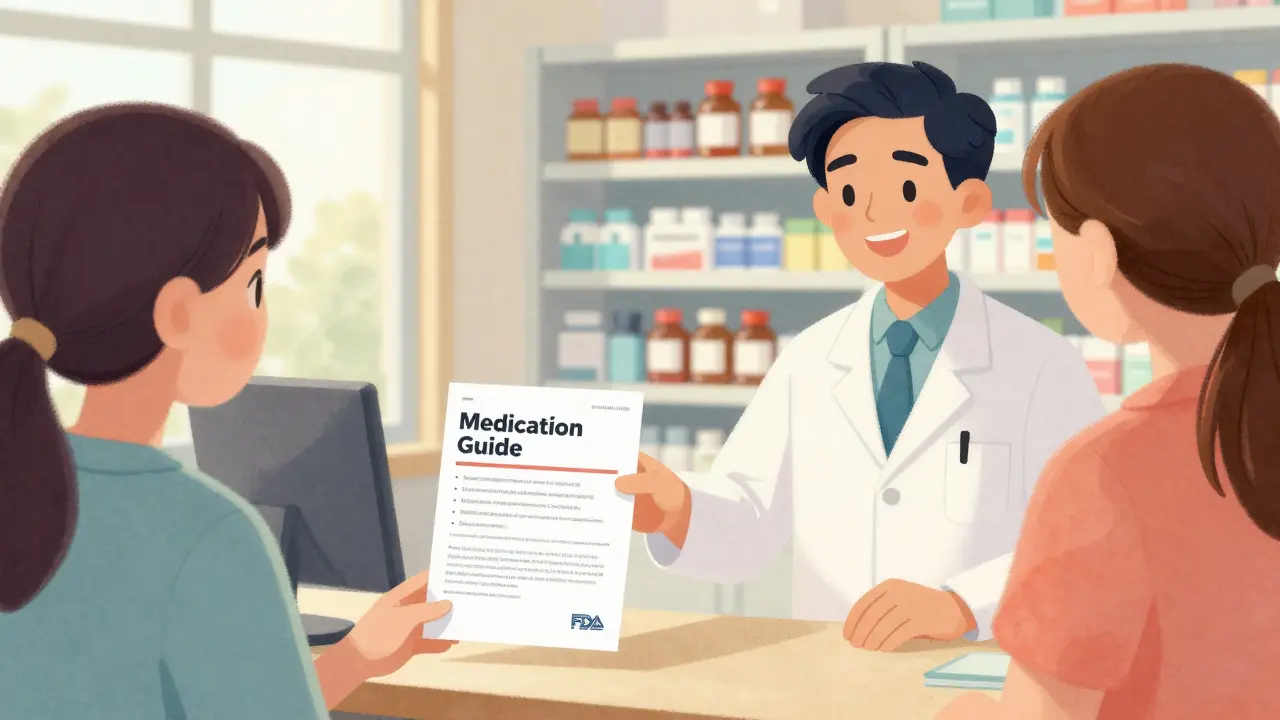
When you pick up a prescription, you might not think twice about the small paper insert that comes with it. But for some medications, that paper isn’t just a suggestion-it’s a legal requirement. These are called Medication Guides, and they’re designed to warn you about serious risks you might not hear from your doctor or see on the prescription label. The FDA mandates them for about 150 prescription drugs that carry high risks, like blood clots, liver damage, or life-threatening interactions. And here’s the thing: you have the right to get a printed copy every time you fill one of these prescriptions. Pharmacies can’t refuse you just because they’re busy, out of stock, or think you already know the risks.
What Exactly Is a Medication Guide?
A Medication Guide isn’t the same as the standard leaflet that comes with most pills. It’s a special FDA-approved document created by the drug manufacturer, reviewed and signed off by the U.S. Food and Drug Administration. These guides exist because some drugs are dangerous enough that patients need clear, direct warnings before they take them. Think drugs like blood thinners, certain antidepressants, or medicines used for autoimmune diseases. The FDA only requires a guide when the risk is serious enough to affect whether someone should even use the drug.
By law, these guides must be written in plain language-no medical jargon. They can’t be promotional. The font must be at least 10-point size, and the words “Medication Guide” must be clearly printed at the top, followed by the drug’s brand and generic name. At the bottom, it must say: “This Medication Guide has been approved by the U.S. Food and Drug Administration.” If you see a guide that looks like an ad, is too small to read, or doesn’t have that line at the bottom, it’s not compliant.
Your Legal Right to a Printed Copy
Under FDA rules (21 CFR §208.24), pharmacies must give you a printed Medication Guide when you pick up the prescription. Not later. Not if you ask for it. Not as an option. It’s required. This applies whether you’re at a big chain like CVS or a small local pharmacy. The pharmacy can’t say, “We don’t have any left,” or “You can read it online.” They’re required to have them on hand-or the ability to print them on the spot.
Manufacturers are legally obligated to supply enough guides to pharmacies. If a pharmacy doesn’t have them, they’re breaking the law. And if you ask for one and they refuse, you’re not being difficult-you’re exercising your right under federal regulation.
There’s one exception: you can ask for an electronic version instead. In May 2023, the FDA officially confirmed that patients can choose to receive the guide via email, text, or a secure patient portal. But here’s the key-the pharmacy can’t force you to take it electronically. If you say you want a paper copy, they must give you one. No arguments, no pushback.
Why Do Pharmacies Sometimes Skip Them?
Despite the clear rules, many patients never get these guides. A 2022 survey by the National Consumers League found that 43% of people who were supposed to receive a Medication Guide never got one. Why? It’s not because pharmacies are trying to hide something. It’s usually because of workflow problems.
Pharmacists are under pressure. They’re juggling prescriptions, insurance issues, counseling patients, and managing inventory. Adding a 15- to 20-second step to verify and hand out a guide for every qualifying prescription adds up. Some pharmacies don’t have systems to track which drugs require guides. Others rely on old paper stock that ran out and haven’t reordered. Independent pharmacies, in particular, often struggle to get timely shipments from manufacturers.
Chain pharmacies like Walgreens and CVS mostly use digital systems that print guides on demand. But even they have gaps. A 2022 audit by the Department of Health and Human Services found that 31% of pharmacy sites had no reliable way to track whether guides were actually handed out. That means even if they had the system, they weren’t using it consistently.

What If You Don’t Get One?
If you’re supposed to get a Medication Guide and don’t, here’s what to do:
- Ask directly: “Is there a Medication Guide for this drug? I’m entitled to a copy by law.”
- If they say they don’t have it, ask if they can print it. Most modern pharmacy systems can do this in under a minute.
- If they still refuse, ask to speak to the pharmacist in charge. Sometimes the tech or cashier doesn’t know the policy.
- If you’re still denied, take a photo of the prescription label and the drug name. Then call the FDA’s MedWatch program at 1-800-FDA-1088 or file a report online. You don’t need to be confrontational-just state the facts: “I was prescribed [drug name], which requires a Medication Guide, and I was not given one.”
Complaints like this matter. The FDA tracks them. And when enough people report the same pharmacy, they get inspected. In 2023, over 1,200 reports were filed about missing Medication Guides-many led to follow-up visits by state pharmacy boards.
Are Medication Guides Actually Helpful?
Some people think they’re just extra paper. A 2022 Pharmacy Times survey found that 28% of patients said the guides were “not helpful at all.” Common complaints? Too much fine print, repetitive info, or content that’s too technical-even though the FDA says they shouldn’t be.
But here’s the flip side. Patients for Safer Drugs collected 347 stories from people who credit Medication Guides with saving their health. Seventeen people said they avoided dangerous drug interactions after reading the guide. One woman with a blood thinner read the guide and realized she couldn’t take ibuprofen with it-something her doctor never mentioned. Another man with a psychiatric medication noticed the warning about suicidal thoughts and told his family before it got worse.
These aren’t rare cases. The FDA estimates these guides prevent thousands of serious adverse events each year. The problem isn’t the guides themselves-it’s how they’re delivered. Many are written at a 12th-grade reading level, even though the FDA recommends no higher than 8th grade. That’s why the agency is replacing them with something new: Patient Medication Information (PMI).

What’s Coming Next: Patient Medication Information (PMI)
The FDA isn’t abandoning patient education-it’s upgrading it. Starting in 2027, the current Medication Guides will be replaced by a new standard called Patient Medication Information, or PMI. This is a single-page, easy-to-read document with a fixed format that will look the same no matter what drug it’s for.
Instead of 150 different layouts, you’ll get one clean template: a bold header, clear sections for “What this medicine is for,” “Important safety information,” “What to avoid,” and “When to call your doctor.” The FDA tested prototypes and found patients understood the new format 37% better than the old guides.
Pharmacies will need to update their systems to print PMI instead. The cost? Between $2,500 and $15,000 per pharmacy. But the goal is clear: make sure patients actually read and understand the warnings. No more burying critical info in tiny font. No more confusing layouts.
What You Can Do Today
You don’t have to wait for 2027 to get better information. Here’s how to make sure you’re protected now:
- Always ask for the Medication Guide when you pick up a new prescription, especially for drugs used for mental health, blood clotting, or chronic conditions.
- If you get it electronically, print it out. Keep it with your other meds. You might need it when you see a new doctor or pharmacist.
- Don’t assume your doctor told you everything. Medication Guides often list side effects and interactions your doctor might not mention during a 10-minute visit.
- Take a minute to read it. Even if it’s long, scan the bolded sections and the “Warnings” box. That’s where the critical info lives.
- If you’re denied a printed copy, document it. Note the date, pharmacy name, drug name, and what they said. You might be helping someone else get their rights next time.
Medication Guides aren’t perfect. But they’re one of the few legal tools patients have to get life-saving information directly from the FDA-not filtered through a doctor’s memory or a pharmacist’s rush. You don’t need to be an expert to use them. You just need to ask for them.
Do I have to pay for a Medication Guide?
No. Medication Guides are required by the FDA and must be provided free of charge. Pharmacies cannot charge you for them, even if they print them on demand. The cost is covered by the drug manufacturer as part of their FDA compliance obligations.
Can I get a Medication Guide before I pick up my prescription?
Yes. You can call the pharmacy ahead of time and ask if they have the guide for your specific medication. Many pharmacies can email or text you a digital copy in advance. But remember, even if you get it early, they still must give you a printed copy when you pick up the prescription-unless you specifically request electronic-only delivery.
What if the Medication Guide is in a language I don’t understand?
By law, Medication Guides must be printed in English. If you need it in another language, the pharmacy isn’t required to provide a translated version. However, you can ask for help from a bilingual staff member, or use a translation app to read it. The FDA is exploring multilingual versions in the future, but as of 2025, English is the only required language.
Are Medication Guides the same as drug package inserts?
No. Package inserts are detailed documents meant for healthcare professionals, written in technical language. Medication Guides are simplified, patient-focused summaries approved by the FDA. You’ll get the Medication Guide at the pharmacy; the package insert stays with the pharmacy’s records or is available online for providers.
Can I request a Medication Guide for an over-the-counter (OTC) drug?
No. Medication Guides only apply to prescription drugs that the FDA has specifically designated as high-risk. OTC medications have different labeling rules, usually on the box or blister pack. If you’re unsure whether a drug requires a guide, check the FDA’s list of approved Medication Guides or ask your pharmacist.
What happens if I lose my Medication Guide?
You can ask for another copy anytime you refill the prescription. Pharmacies are required to provide a new guide each time the drug is dispensed. If you’re concerned about losing it, ask for a digital copy to save on your phone or print a second copy to keep in a safe place.
12 Comments
Danielle Stewart
Just got my new blood thinner prescription yesterday and asked for the guide. The pharmacist looked at me like I was asking for a unicorn. But I stood my ground. They printed it out in 30 seconds. Seriously, if you’re on anything that could kill you if misused, don’t let them gaslight you into thinking it’s optional. It’s not. It’s the law.
Ryan van Leent
why do we even need these things anymore like i get that some drugs are dangerous but if your doctor prescribes it they already explained it right
Chris porto
There’s something quietly powerful about demanding a piece of paper that the government says you’re entitled to. It’s not about being difficult-it’s about refusing to let systems treat you like a number. That guide is the FDA’s way of saying: ‘You deserve to know, even if no one else bothered to tell you.’
Isabel Rábago
People complain about the guides being too long or too technical but half the time they don’t even read them. I’ve seen folks grab the paper, shove it in their bag, and walk out like it’s a receipt for laundry detergent. If you don’t read it, don’t blame the format. Blame yourself.
jessica .
they want you to read these guides so they can track you. every time you pick up a med they log it. next thing you know your insurance rates go up or the gov starts flagging you for 'high risk behavior'. its all connected. the fda isnt protecting you. theyre profiling you.
Sajith Shams
in india we dont have such things but we have better systems. doctors explain everything face to face and pharmacists are trained to warn you. why does america need a 20 page booklet for a pill? its bureaucracy run wild. you dont need paper when you have human beings
Glen Arreglo
I get where you’re coming from, but let’s not forget that in the U.S., not everyone has access to a doctor who spends more than 7 minutes with them. For people in rural areas, for the elderly, for those without good health literacy-this guide might be the only clear warning they ever get. It’s not perfect, but it’s a lifeline.
benchidelle rivera
My mother had a stroke last year from mixing her blood thinner with an OTC painkiller she thought was 'safe.' She never saw the guide because the pharmacy said they were 'out.' She’s fine now, but barely. If you’re reading this and you’re on any high-risk med-ask. Always ask. Don’t wait for a near-death experience to learn the hard way.
Danielle Stewart
Just saw Ryan’s comment. No, your doctor didn’t explain it. Not really. They told you the name, the dose, and maybe one side effect. The guide tells you what happens if you drink grapefruit juice, take ibuprofen, or skip a dose for two days. That’s not fluff. That’s survival info.
Anna Sedervay
The entire Medication Guide system is a performative gesture by a regulatory body that has lost its moral authority. The FDA approves these documents, yet allows them to be printed in 10-point font with no regard for accessibility. The upcoming PMI is a band-aid on a hemorrhage. We need mandatory audio versions, braille, and real-time AI summaries-not more paper.
bhushan telavane
in my village we just ask the pharmacist and he tells us what to avoid. no paper needed. but i get it, america needs everything written down. even the air you breathe needs a disclaimer now
shivam seo
the FDA is just trying to cover their own ass. if you die from a drug they can say 'well we gave them a guide' and that's enough for them. it's not about safety-it's about liability. they don't care if you read it. they just want the paperwork done.