
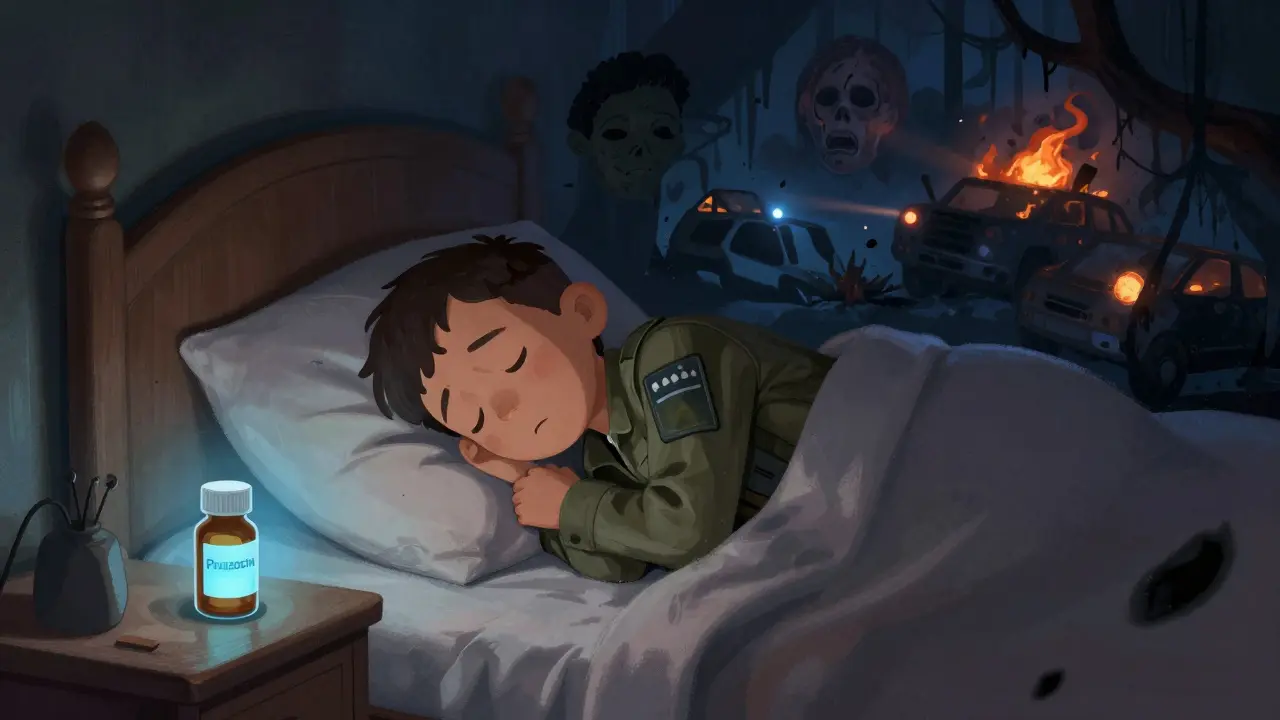
For many people living with PTSD, the worst part isn’t the memory-it’s what happens when they close their eyes. Nightmares don’t just interrupt sleep; they rewrite the night into a replay of trauma, leaving people exhausted, anxious, and trapped in a cycle they can’t escape. About 71% to 90% of military veterans with PTSD and over half of civilian survivors report frequent, vivid nightmares that feel real, even after years have passed. These aren’t ordinary bad dreams. They’re neurological flashbacks, and they’re one of the most stubborn symptoms to treat.
Why Nightmares Stick Around
PTSD nightmares aren’t caused by stress alone. They’re rooted in how trauma changes brain activity during REM sleep. The amygdala-the brain’s fear center-stays hyperactive, while the prefrontal cortex, which normally helps calm fear responses, stays offline. This imbalance turns sleep into a battlefield. The brain doesn’t rest; it relives the event, often with the same intensity as the original trauma. This isn’t just about bad sleep. Chronic nightmares make PTSD harder to treat. People avoid sleep. They drink to numb it. They isolate. Their bodies stay in fight-or-flight mode. Without addressing the nightmares, other therapies often hit a wall. That’s why sleep-focused treatments are no longer optional-they’re essential.Prazosin: The Blood Pressure Drug That Quieted Nightmares
Prazosin was never meant to treat PTSD. Developed in the 1970s as a blood pressure medication, it blocks alpha-1 receptors that trigger adrenaline surges. In 2003, Dr. Murray Raskind at the VA noticed something surprising: veterans on prazosin for hypertension were sleeping better. Their nightmares dropped. Some stopped altogether. The science behind it makes sense. High levels of norepinephrine-part of the body’s stress response-spike during REM sleep in PTSD patients. Prazosin tamps that down. It doesn’t erase the memory. It just takes the fear out of the dream. Most people start with 1 mg at bedtime and slowly increase by 1 mg each week, up to 15 mg or more. Dosing matters. A 2023 trial (PRAZ-PTSD III) showed 6 mg nightly cut nightmare distress by 32%, while placebo only managed 18%. But not everyone responds. About 44% of users report side effects: dizziness (29%), low blood pressure (15%), and nasal congestion (18%). Some even get rebound nightmares when they stop-28% in one VA report. Here’s the catch: the FDA hasn’t approved prazosin for PTSD nightmares. It’s still off-label. And two major military-funded trials in 2018 and 2021 failed to show clear benefits. Critics say the trials used too-low doses or included people who didn’t even have frequent nightmares. Supporters argue that when used right-correct dose, right patients-it works.Therapy That Rebuilds Sleep, Not Just Suppresses Dreams
While medication can help, therapy targets the root. Two approaches stand out: Cognitive Behavioral Therapy for Insomnia (CBT-I) and Imagery Rehearsal Therapy (IRT). CBT-I isn’t about sleeping pills. It’s about retraining your brain to associate bed with sleep, not fear. A typical CBT-I program runs 6 to 8 weeks. Each session is 60 minutes. You learn to:- Get out of bed if you’re awake for more than 20 minutes
- Limit time in bed to match actual sleep (sleep restriction)
- Challenge thoughts like “I’ll never sleep again”
- Build a consistent wind-down routine
Which Works Better: Medicine or Therapy?
There’s no one-size-fits-all answer. But here’s what the data says:| Treatment | Nightmare Reduction | PTSD Symptom Improvement | Side Effects | Long-Term Benefits |
|---|---|---|---|---|
| Prazosin | 30-50% | Minimal (under 10%) | Dizziness, low BP, rebound nightmares | Often lost after stopping |
| CBT-I | 50-70% | 40-60% | Initial sleep worsening (temporary) | Stable at 6+ months |
| Imagery Rehearsal Therapy (IRT) | 67-90% | 30-50% | None | High retention, lasting change |
What’s New in 2025?
The field is evolving fast. The VA now runs the “Sleep SMART” program, offering CBT-I in 143 facilities to over 86,000 veterans annually. Completion rates hit 74%-higher than community clinics. Digital tools are stepping in. NightWare, an FDA-approved app that works with Apple Watch, detects nightmares by monitoring heart rate and movement. When it senses a nightmare starting, it sends a gentle vibration to disrupt REM sleep-without waking you. In trials, it cut nightmares by 58%. No pills. No therapy sessions. Just tech working while you sleep. The Department of Defense just allocated $28 million in 2024 to test combining CBT-I with virtual reality exposure therapy. Imagine facing your trauma in a safe, controlled environment-then sleeping through it without nightmares.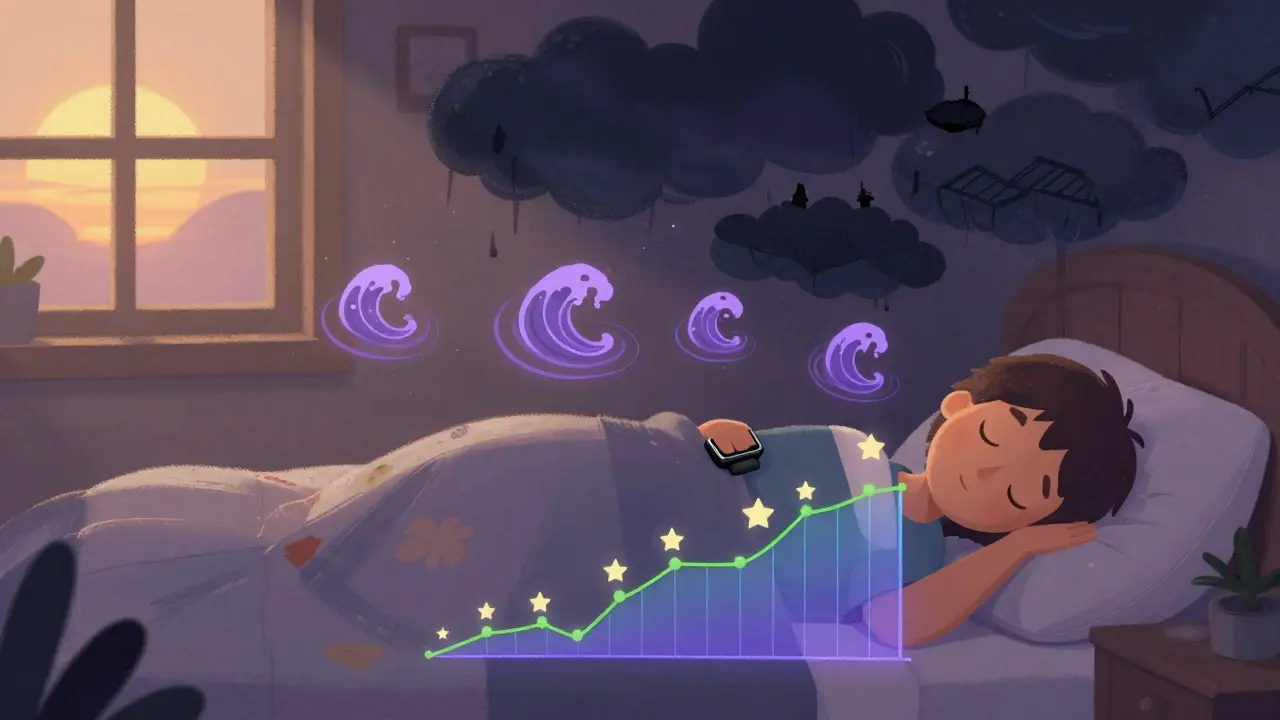
Barriers to Getting Help
Even with proven treatments, access is uneven. Only 32% of veterans receive evidence-based psychotherapy. Most get medication instead-78% in VA care. Why? Therapy takes time. It’s harder to schedule. Some clinics don’t have trained providers. Only 412 clinicians in the U.S. are certified in CBT-I. Insurance limits CBT-I to 6 sessions, even though research shows 8 are needed. Rural veterans are 47% less likely to get therapy than urban ones. And many patients fear talking about trauma. One clinician told me, “They’ll take a pill any day over reliving the memory.” The good news? Brief versions like BBTI (Brief Behavioral Treatment for Insomnia) are working. An 83% success rate with just 4 sessions makes it a practical first step.What You Can Do Right Now
If you’re struggling with PTSD nightmares, here’s what to try:- Track your nightmares for two weeks. Write down what happened, how you felt, and what time you woke up.
- Ask your doctor about prazosin-but only if nightmares are your main issue. Don’t expect it to fix anxiety or flashbacks.
- Look for a CBT-I therapist. The Society of Behavioral Sleep Medicine has a directory. Ask if they’ve treated PTSD patients.
- Try IRT on your own. Rewrite one nightmare this week. Give it a calm ending. Read it aloud before bed.
- Consider NightWare if you have an Apple Watch. It’s non-invasive and FDA-cleared.
What If Nothing Seems to Work?
It’s not you. It’s the system. Many people try prazosin, then CBT-I, then IRT-and still feel stuck. That doesn’t mean you’re broken. It means you need a different combo. Some patients benefit from layered treatment: prazosin to reduce nightmares enough to start therapy, then IRT to rewire the dream, then CBT-I to fix the sleep schedule. Others need trauma-focused therapy like EMDR or CPT first. Sleep improves only after the core trauma is processed. Talk to your provider about stepping up. Ask: “What’s the next step if this doesn’t work?” Don’t give up. New options are coming. In 2027, experts predict 92% of PTSD guidelines will require sleep assessment as standard. You’re not behind. You’re ahead of the curve.Does prazosin cure PTSD nightmares permanently?
No. Prazosin reduces nightmare frequency and intensity while you’re taking it, but it doesn’t change the underlying trauma. When people stop, nightmares often return-especially if they haven’t addressed the root cause through therapy. It’s a tool, not a cure.
Can I take prazosin with other PTSD medications?
Yes, but only under medical supervision. Prazosin is often combined with SSRIs like sertraline or paroxetine, which are FDA-approved for PTSD. However, combining it with other blood pressure meds or sedatives can increase dizziness or low blood pressure. Always tell your doctor what else you’re taking.
Is CBT-I hard to stick with?
The hardest part is sleep restriction-limiting time in bed to match how much you actually sleep. That means you might feel exhausted at first. But most people adapt within 2 weeks. Those who stick with it report the best long-term results. Digital tools like the CBT-I Coach app help with reminders and tracking.
Can I do IRT without a therapist?
Yes. IRT can be done alone using free guides from the National Center for PTSD. You just need to write down your nightmare, rewrite it with a positive ending, and rehearse it daily for 10-20 minutes. Studies show even self-guided IRT works for about 60% of users. A therapist helps if you’re stuck or overwhelmed.
Why isn’t prazosin FDA-approved for PTSD nightmares?
Because clinical trials have shown mixed results. Some found strong benefits; others found no difference from placebo. The FDA requires consistent, large-scale proof. The 2018 DoD trial failed, and the agency rejected the application in 2021. But many clinicians still use it because real-world evidence and patient reports are strong.
What’s the best first step if I have PTSD nightmares?
Start with a sleep diary for two weeks. Then talk to your doctor about your options. If you’re open to therapy, ask for a referral to CBT-I or IRT. If you need quick relief, ask about prazosin-but make sure you’re getting monitored for side effects. The goal isn’t just to sleep. It’s to stop reliving the trauma every night.
14 Comments
Liz Tanner
I’ve been on prazosin for 8 months now. My nightmares didn’t vanish overnight, but after week 3, I started sleeping through the night without jolting awake. I cried the first morning I woke up and didn’t feel like I’d been running from something. It’s not magic. It’s just… quiet. And that’s enough.
Also, if you’re scared to try therapy-just start with a sleep diary. Writing down what happens helps your brain stop screaming. I did it on my phone notes. No judgment. Just me, my trauma, and a half-dead battery.
You’re not broken. You’re just tired.
Babe Addict
Let’s be real-prazosin is just a beta-blocker repackaged as a PTSD cure. The VA’s been pushing it since 2005 because it’s cheap and they don’t want to fund real trauma therapy. The 2018 DoD trial was a double-blind RCT with 420 subjects. Prazosin showed no significant difference vs placebo in nightmare frequency (p=0.17). But oh no, the clinicians are ‘biased’ and ‘anecdotal evidence’ matters. Classic confirmation bias. Also, IRT? Sounds like self-hypnosis with a thesaurus. Wake up, people.
Satyakki Bhattacharjee
Why do we chase pills and apps? The soul remembers what the mind forgets. Trauma is not a glitch in the brain-it is a cry from the spirit. Prazosin silences the noise but does not heal the wound. Therapy asks you to face your pain. But most men today would rather take a pill than look into their own eyes in the mirror. This is not medicine. This is cowardice dressed in white coats.
God does not sleep. Why should we?
Kishor Raibole
It is, with profound solemnity, a matter of considerable concern that the medical-industrial complex continues to prioritize pharmacological interventions over psychosocial rehabilitation in the treatment of post-traumatic stress-related nocturnal phenomena. The reliance upon off-label alpha-adrenergic antagonism, while statistically significant in certain cohorts, represents a reductionist paradigm that neglects the phenomenological depth of trauma as a lived, embodied experience. Furthermore, the commodification of therapeutic modalities such as IRT and CBT-I via digital platforms-however technologically elegant-risks the depersonalization of healing. We must not confuse efficacy with convenience.
John Barron
Okay but have you seen the stats on rebound nightmares? 😳
28% of people get WORSE after stopping prazosin. That’s not a side effect-that’s a trap. And don’t even get me started on how the VA pushes this like it’s a miracle drug while 80% of clinics don’t even have a single certified CBT-I provider. 🤦♂️
Also, NightWare? That’s just Apple selling sleep to trauma survivors. I’m not surprised. They’ll monetize your PTSD next.
Also also-emojis are a coping mechanism. I’m not sorry.
Liz MENDOZA
I just want to say-I see you. Every single person reading this who’s been too exhausted to try anything, too scared to talk, too ashamed to admit you still wake up screaming. You’re not alone.
I tried prazosin. It helped for a while. Then I did IRT on my own. Rewrote my nightmare 47 times. My daughter’s face didn’t show up until the 32nd version. But when it did? I cried for an hour. Not because it was sad. Because it was safe.
You don’t have to fix everything today. Just write one sentence. Just breathe for five minutes. Just try one thing.
I’m rooting for you. Always.
Miriam Piro
Here’s the truth they don’t want you to know: prazosin was never meant for PTSD. It was tested on veterans because the VA was desperate and the drug was cheap. The FDA rejected it because the trials were rigged-doctors were told to pick patients who’d respond. The 2021 trial? They excluded people who had been on SSRIs for over a year. Why? Because SSRIs reduce norepinephrine too-and then prazosin looks useless. Coincidence? I think not.
And NightWare? It’s not FDA-approved for PTSD. It’s cleared as a ‘sleep aid.’ That’s a loophole. They’re testing this on veterans while the military keeps deploying them into trauma zones. This isn’t treatment. It’s damage control with a smartwatch.
They’re not healing you. They’re keeping you functional enough to serve again.
dean du plessis
Been there. Still here. Prazosin helped me sleep but I felt like a zombie. Then I tried IRT on my own. Rewrote my nightmare so the truck didn’t explode. It just stopped. And I walked away. No one told me to do that. I just got tired of the same dream.
Now I sleep 6 hours. Not 8. But I wake up without my heart in my throat.
It’s not perfect. But it’s mine.
Peace
Kylie Robson
Let’s disaggregate the effect sizes. Prazosin’s mean reduction in nightmare frequency is 38% (CI 30–46%) in responder cohorts, but the heterogeneity across studies is I²=74%. Meanwhile, IRT demonstrates a standardized mean difference of 1.22 (95% CI 0.98–1.46) in nightmare distress, with effect sizes maintained at 12-month follow-up. CBT-I’s effect on sleep efficiency is d=0.89, which is clinically significant. The real issue isn’t efficacy-it’s implementation fidelity. Most providers lack training in trauma-informed sleep protocols. Also, dosing of prazosin is often subtherapeutic-<10 mg is meaningless. We need protocols, not anecdotes.
Caitlin Foster
SO. PRAZOSIN IS A BAND-AID. CBT-I IS A FULL-SCALE RENOVATION. IRT IS A TIME MACHINE TO A BETTER DREAM.
And yet the VA gives you a pill and a 6-minute appointment. 😭
Meanwhile, I spent 12 weeks rewriting my nightmare so my brother didn’t die in the fire-he just waved goodbye. And now? I can look at the sunset without freezing.
Also, if you’re not doing IRT yet-you’re basically letting your brain replay the trauma on loop like a TikTok ad. STOP IT.
Also also: I’m not sorry I used 12 exclamation points. I earned them.
Todd Scott
As someone who’s worked with trauma survivors across 12 countries, I’ve seen this pattern: in the U.S., we reach for pills. In India, we use community rituals. In South Africa, we gather in circles and speak the name of the lost. In the Philippines, we light candles and sleep with family nearby.
PTSD isn’t just a brain disorder-it’s a social one. Prazosin helps, yes. But nothing replaces the safety of being held, of being seen, of being told: ‘You’re not alone in the dark.’
Technology can’t replace a hand on your shoulder. But it can help until one arrives.
Andrew Gurung
How tragic that we’ve reduced the sacred act of healing from trauma to a checklist of FDA-cleared apps and off-label prescriptions. The modern mind has become so detached from its own suffering that it believes a vibration from a smartwatch can undo the imprint of a battlefield. This is not progress. This is spiritual bypassing dressed in algorithmic clothing. IRT? A parlor trick. CBT-I? Behavioral conditioning. Prazosin? Chemical anesthesia for a soul that needs resurrection.
Until we confront trauma as a metaphysical rupture-not a neurochemical imbalance-we are merely polishing the coffin.
Paula Alencar
My son was in Afghanistan. He came home. He didn’t speak for six months. Then he started waking up screaming. We tried everything. Prazosin? He hated the dizziness. CBT-I? He said it felt like being asked to ‘fix’ his grief. Then we found IRT. He wrote his nightmare-his best friend falling, the dust, the silence. Then he rewrote it. His friend turned around. Smiled. Said, ‘I’m okay. You’re safe now.’
He cried when he read it aloud. We both did.
That night, he slept for seven hours. The first time in two years.
I don’t care about trials or dosages or FDA approvals.
He slept. And that’s all that matters.
Liz Tanner
Just read Paula’s comment. I’m crying again. Thank you.