
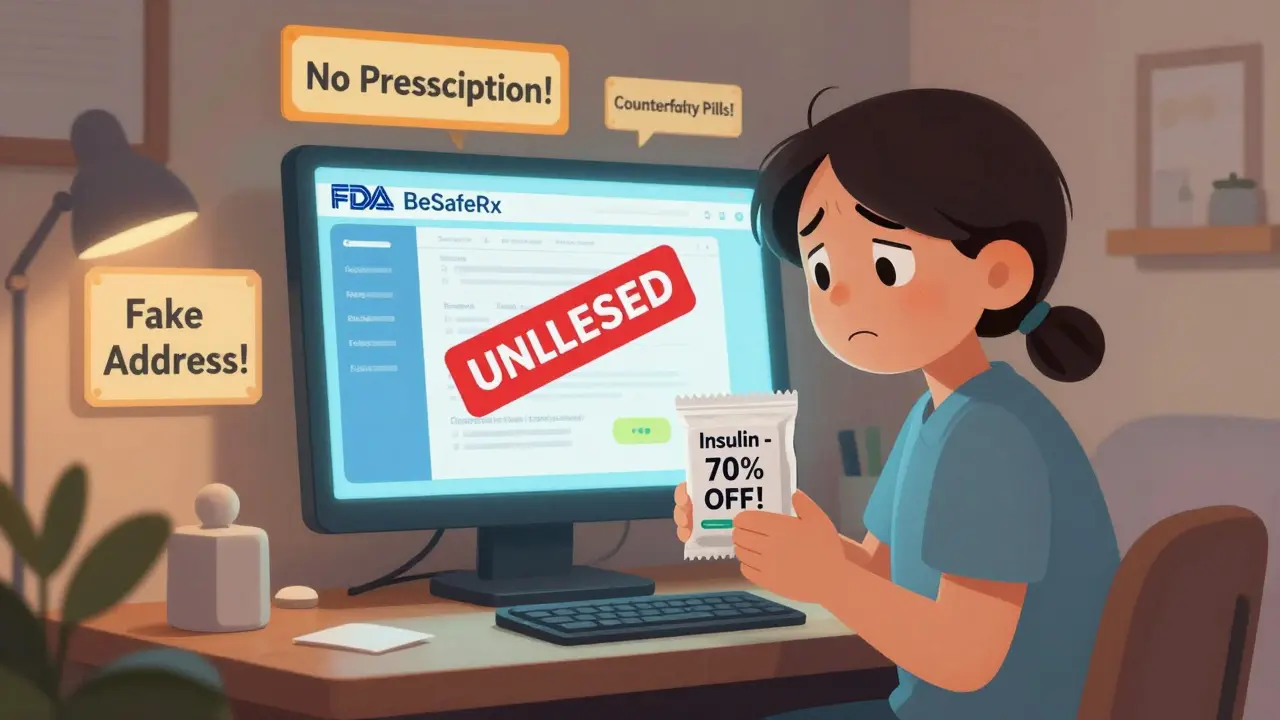
Buying medicine online sounds simple-click, pay, wait for delivery. But behind that ease is a web of rules designed to keep you safe. In 2025, the U.S. regulatory system for online pharmacies is more complex than ever. The FDA and state pharmacy boards work side by side, sometimes in sync, sometimes in tension, to stop dangerous drugs from reaching your door. This isn’t about bureaucracy-it’s about preventing poisoned pills, fake prescriptions, and hidden side effects that could land you in the hospital.
What the FDA Actually Does
The FDA doesn’t license online pharmacies. That’s not its job. Instead, it watches what’s being sold and how it’s advertised. If a website offers pills without a prescription, sells drugs not approved for use in the U.S., or hides serious side effects in fine print, the FDA steps in. In the first nine months of 2025 alone, the FDA issued 147 warning letters to illegal online pharmacies-a 32% jump from 2024.
They also track advertising. Direct-to-consumer ads for prescription drugs have to list risks. But many online pharmacies skip this. In September 2025, the FDA and HHS announced new rules to crack down on misleading ads, especially on Instagram, TikTok, and YouTube. Influencers pushing weight-loss drugs like Semaglutide without mentioning nausea, pancreatitis, or thyroid cancer risks? That’s now a top enforcement target.
The FDA’s BeSafeRx tool lets you check if a pharmacy is legitimate. You enter the website, and it tells you whether the pharmacy is licensed in its home state. If it’s not listed, walk away. In Q3 2025, over 1.2 million people used the tool-up 40% from the year before. That’s not just curiosity. It’s people learning the hard way that a 70% discount on insulin usually means counterfeit.
State Boards: The Real Gatekeepers
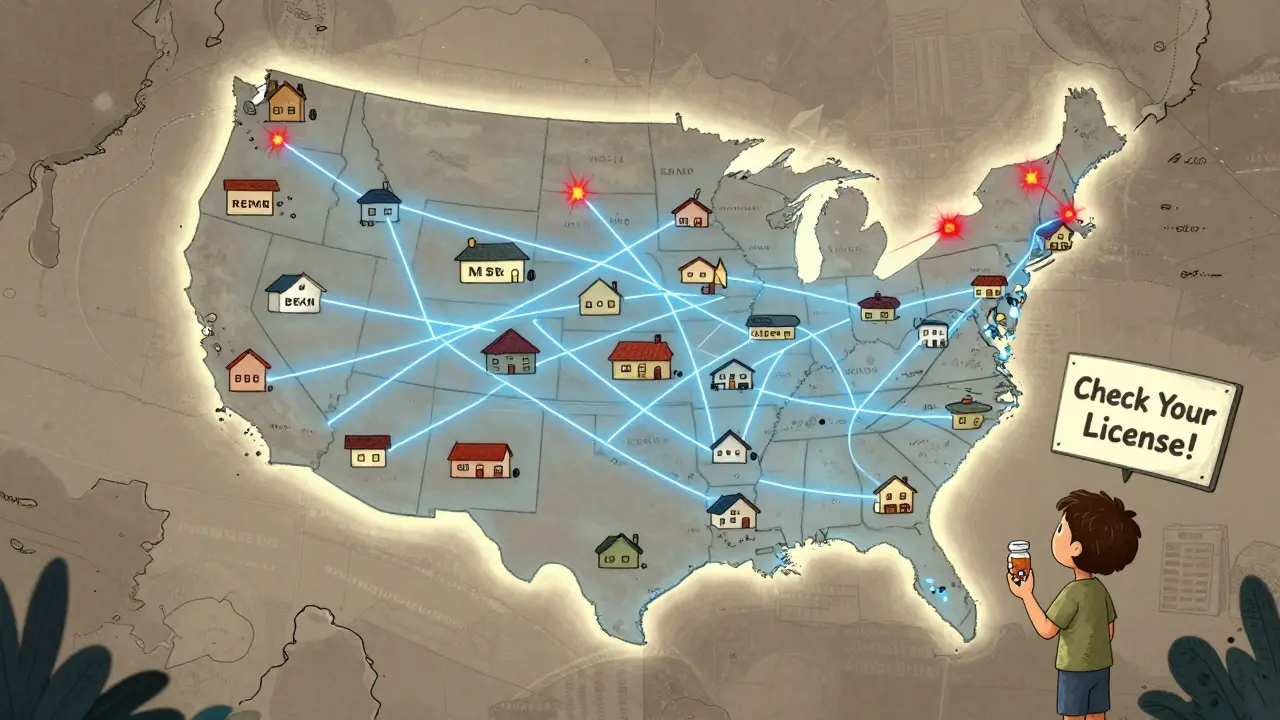
Here’s the truth: the FDA can’t shut down a pharmacy. Only a state board of pharmacy can revoke a license. That’s why 48 out of 50 states maintain public databases where you can search for licensed pharmacies. California, Texas, and Florida saw the most complaints in 2024-2,845 total-because those are the states with the biggest populations and the most online pharmacy traffic.
Each state sets its own rules for how pharmacies operate. Some require pharmacists to call patients before filling a new prescription. Others demand that telemedicine prescriptions be verified against a state prescription monitoring program (PDMP). Twenty-seven states have rules stricter than federal law. That means a pharmacy might be legal in Nevada but illegal in New York, even if they’re the same company.
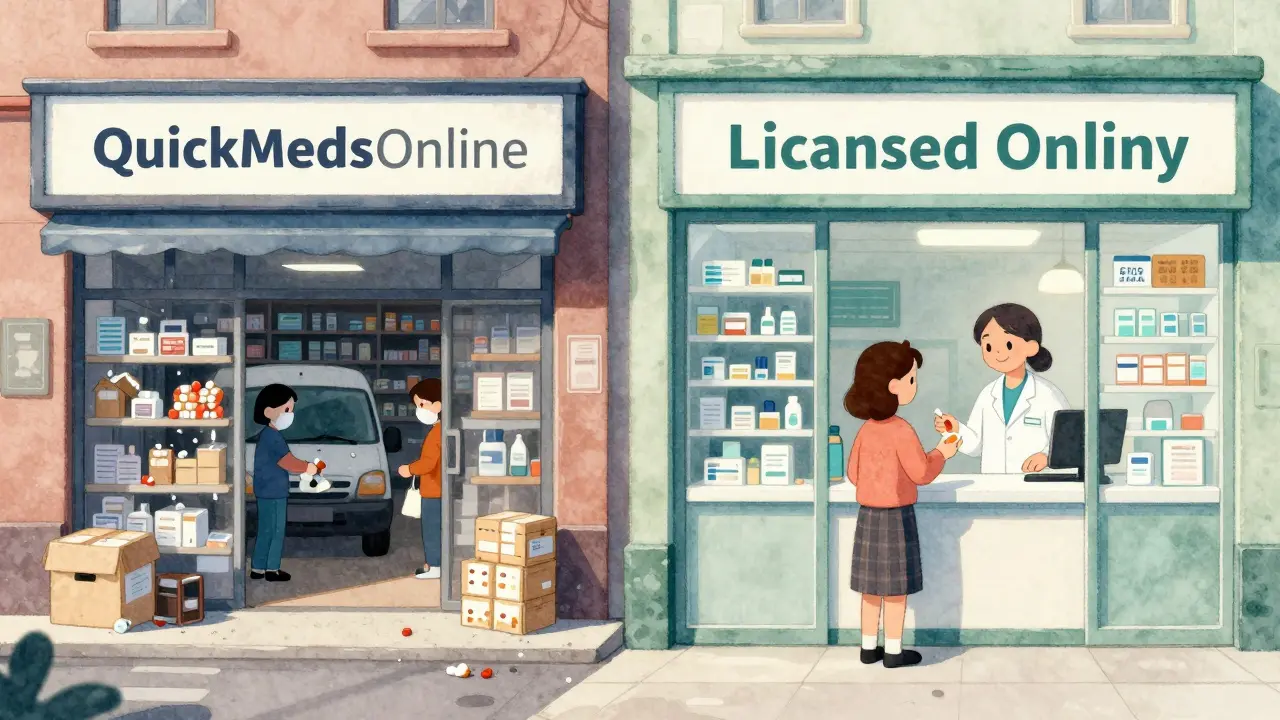
And they’re not passive. State boards investigate complaints, audit records, and shut down operations. In August 2025, QuickMedsOnline.com was hit with a $500,000 fine for repeatedly ignoring the Ryan Haight Act-selling controlled substances without a valid prescription. The pharmacy had no licensed pharmacist on staff. No physical address. Just a website and a bank account.
The DEA’s New Telemedicine Rules
Before 2025, the Ryan Haight Act required an in-person visit before a doctor could prescribe controlled substances like Adderall or oxycodone online. That rule stayed mostly unchanged for 17 years-until January 2025.
The DEA introduced three new Special Registrations for telemedicine providers:
- Standard Registration: Allows prescribing Schedule III-V drugs (like hydrocodone or tramadol) without an in-person visit, but only if the provider checks the patient’s state PDMP first.
- Advanced Registration: For psychiatrists, pediatricians, hospice, and long-term care doctors who want to prescribe Schedule II drugs (like fentanyl or oxycodone) remotely. Requires board certification and extra training.
- Limited State Registration: For providers in states that allow telemedicine prescribing under their own rules.
This isn’t a free-for-all. The DEA is building a nationwide PDMP system to replace the current patchwork of 50 different state databases. By Q3 2026, doctors will see a patient’s full prescription history in one place. That’s a big deal. Right now, a doctor in Ohio might not know a patient got 100 oxycodone pills from a pharmacy in Arizona. With the new system, they’ll see it all.
Compounded Drugs: The Gray Zone
When Semaglutide and Tirzepatide went on shortage in 2024, demand exploded. Legitimate pharmacies couldn’t keep up. So compounding pharmacies stepped in. These are labs that mix custom doses of drugs-not FDA-approved, not mass-produced, but legal under Section 503A if they follow state rules and have a valid patient prescription.
But here’s the catch: the FDA doesn’t test compounded drugs. They don’t check purity, potency, or safety before they’re sold. That responsibility falls entirely to state boards. In 2025, the FDA issued multiple warnings to compounding pharmacies selling GLP-1 drugs with inconsistent dosing. One patient in Florida reported severe dizziness after taking a compounded Semaglutide that contained 20% more active ingredient than labeled.
There’s a reason why only 187 online pharmacies have VIPPS accreditation from the National Association of Boards of Pharmacy. That seal means they’ve passed strict audits on licensing, pharmacist availability, record-keeping, and security. If a pharmacy doesn’t have it, assume it’s not vetted.
What You Can Do to Stay Safe
You don’t need a law degree to avoid dangerous online pharmacies. Here’s what works:
- Only buy from sites that require a prescription. No prescription? No sale. Period.
- Check the pharmacy’s license. Go to the FDA’s BeSafeRx site. Find the state where the pharmacy claims to be based. Then go to that state’s board of pharmacy website and search for the pharmacy name.
- Look for a physical address and phone number. Legitimate pharmacies list both. If you can’t call them, don’t buy from them.
- Watch for red flags. Prices that seem too good to be true? No privacy policy? No licensed pharmacist available to answer questions? Run.
- Stick with big names. CVS, Walgreens, and Kaiser Permanente’s online pharmacies have 4.6/5 ratings on Trustpilot. Unverified sites average 1.8/5.
And if you’ve received a suspicious pill? Report it. The FDA’s MedWatch program lets you file a report online. In 2025, over 3,000 reports came from patients who thought their medication didn’t work-or made them worse.
Why This System Still Has Gaps
There are 1,243 websites selling controlled substances illegally, and 68% of them are based outside the U.S. The FDA can’t shut down servers in Russia or China. State boards can’t touch foreign websites. That’s why the DEA is working with international partners to track domain registrations and payment processors.
Another problem: many patients don’t know the difference between a licensed pharmacy and a scam. A 2025 KFF poll found that 37% of U.S. adults used online pharmacies-but only 22% checked if they were licensed. People choose cheap over safe. And that’s exactly what the bad actors count on.
There’s also a lack of coordination. A doctor might be licensed in New Jersey but prescribe to a patient in Georgia. Which state’s rules apply? Who investigates if something goes wrong? The system isn’t broken-it’s just old. And it’s playing catch-up to a digital world that moves faster than bureaucracy.
The Future Is Integrated
By the end of 2026, the DEA’s nationwide PDMP will be live. The FDA plans to add real-time prescription verification to BeSafeRx. State boards are starting to share data more openly. The goal isn’t to stop telemedicine-it’s to make it safe.
Legitimate online pharmacies are growing. So are the scams. The difference? One follows the rules. The other hides behind fake addresses, fake licenses, and fake promises. You don’t need to be an expert to tell them apart. You just need to know where to look.
How do I know if an online pharmacy is real?
Use the FDA’s BeSafeRx tool to check if the pharmacy is licensed in its home state. Then go to that state’s board of pharmacy website and search for the pharmacy’s name. Legitimate pharmacies will always require a prescription, list a U.S. physical address and phone number, and have a licensed pharmacist on staff. If any of those are missing, it’s not safe.
Can I buy controlled substances like Adderall or oxycodone online legally?
Yes-but only through DEA-registered telemedicine providers who follow strict rules. As of January 2025, providers must have a Special Registration and check the patient’s state PDMP before prescribing. You still need a valid prescription. No online pharmacy can legally sell these drugs without one. Avoid any site that offers them without a consultation.
Are compounded drugs like Semaglutide safe to buy online?
They can be-but only if they come from a state-licensed 503A compounding pharmacy with a valid patient-specific prescription. The FDA doesn’t approve compounded drugs, so safety depends entirely on the pharmacy’s practices. Check the pharmacy’s license with your state board. Avoid bulk orders or websites that sell them without a prescription. Reports of incorrect dosing have increased since 2024.
What should I do if I received a fake or dangerous medication?
Stop taking it immediately. Contact your doctor and report the pharmacy to the FDA through MedWatch (medwatch.fda.gov). Save the packaging, pills, and any emails or receipts. State pharmacy boards also accept complaints. The more reports filed, the faster regulators can shut down dangerous sites.
Why do some online pharmacies look so professional?
Scammers invest in professional websites because they work. Fake licenses, stock photos of pharmacists, and fake testimonials are common. Don’t be fooled by design. Always verify the license through your state’s pharmacy board website. A polished site doesn’t mean it’s legal.
15 Comments
Ryan van Leent
So basically we’re trusting the government to keep us from buying cheap meds but they can’t even shut down a single website based in Russia
Meenakshi Jaiswal
My grandma used BeSafeRx last month after she bought insulin from a site that said ‘90% off’ - turned out it was fake. She’s fine now but scared to death. This post saved her life. Thank you.
Kathryn Featherstone
Just want to say I’ve been working in rural pharmacy for 18 years. People don’t choose scams because they’re dumb - they choose them because they can’t afford the real stuff. The system’s broken, not the patients.
pascal pantel
Let’s be real - the FDA’s 147 warning letters are performative theater. They don’t have the bandwidth to enforce anything meaningful. Meanwhile, the DEA’s new registrations are just bureaucratic theater wrapped in acronyms. PDMP? More like ‘Patchwork Disaster Monitoring Protocol.’
Kevin Motta Top
India has a similar problem. People order from US sites thinking they’re getting brand-name drugs. They get powdered chalk in capsules. We need global awareness campaigns.
Moses Odumbe
Just checked BeSafeRx on my phone - found 3 sites I’ve used. All flagged. 😳 I’m never buying meds online again. Also, why does no one talk about how TikTok influencers are literally selling death in DMs? 🚨
James Stearns
It is imperative to underscore the fact that the regulatory architecture underpinning pharmaceutical commerce in the digital sphere remains fundamentally inadequate. The absence of harmonized international standards renders the current framework not merely inefficient, but perilously anachronistic.
Anna Sedervay
Did you know the FDA gets funding from Big Pharma? Of course they’re not shutting down the shady sites - they’re in bed with them. The ‘BeSafeRx’ tool? A placebo. The real pharmacies are owned by the same corporations that lobby Congress. Wake up.
Dominic Suyo
Let me just say - if you’re buying insulin from a site that doesn’t have a pharmacist on call, you’re not a customer, you’re a lab rat. And the fact that 37% of Americans don’t check licenses? That’s not ignorance - it’s surrender.
Dikshita Mehta
Compounded drugs are tricky. I work with a compounding pharmacy in Bangalore - they follow all state rules, test every batch, and send lab reports. But most people don’t know how to ask for them. Maybe we need a simple checklist for patients?
Dev Sawner
The entire system is a paradox. The DEA requires PDMP checks for telemedicine, yet 12 states still don’t share data with each other. This isn’t innovation - it’s fragmentation dressed as reform. The solution requires federal standardization, not more registrations.
Alisa Silvia Bila
I used to buy from those sketchy sites until my sister had a bad reaction. Now I only use CVS or Walgreens online. It’s more expensive, but I sleep better. Small price to pay.
Carolyn Benson
Are we really supposed to believe that bureaucracy can outpace the digital underworld? The FDA’s tools were designed for a world where medicine came in brown paper bags - not encrypted crypto-payments routed through offshore shell companies. We’re applying analog solutions to a post-digital crisis.
Marsha Jentzsch
Did you know that 78% of fake pharmacies use the same stock photo of a ‘pharmacist’?!! It’s the same guy in every single site!! And they all say ‘licensed in Nevada’ but have no address??!! I reported 12 of them!! And NO ONE CARES!!
Henry Marcus
They’re lying. The ‘national PDMP’? It’s already been sold to a private data broker. You think the DEA wants to stop fraud? No - they want to track you. Every pill you buy, every doctor you see - it’s all in a database owned by a contractor who sells it to insurers. You’re not safe. You’re being mined.