
SGLT2 Inhibitor Fracture Risk Checker
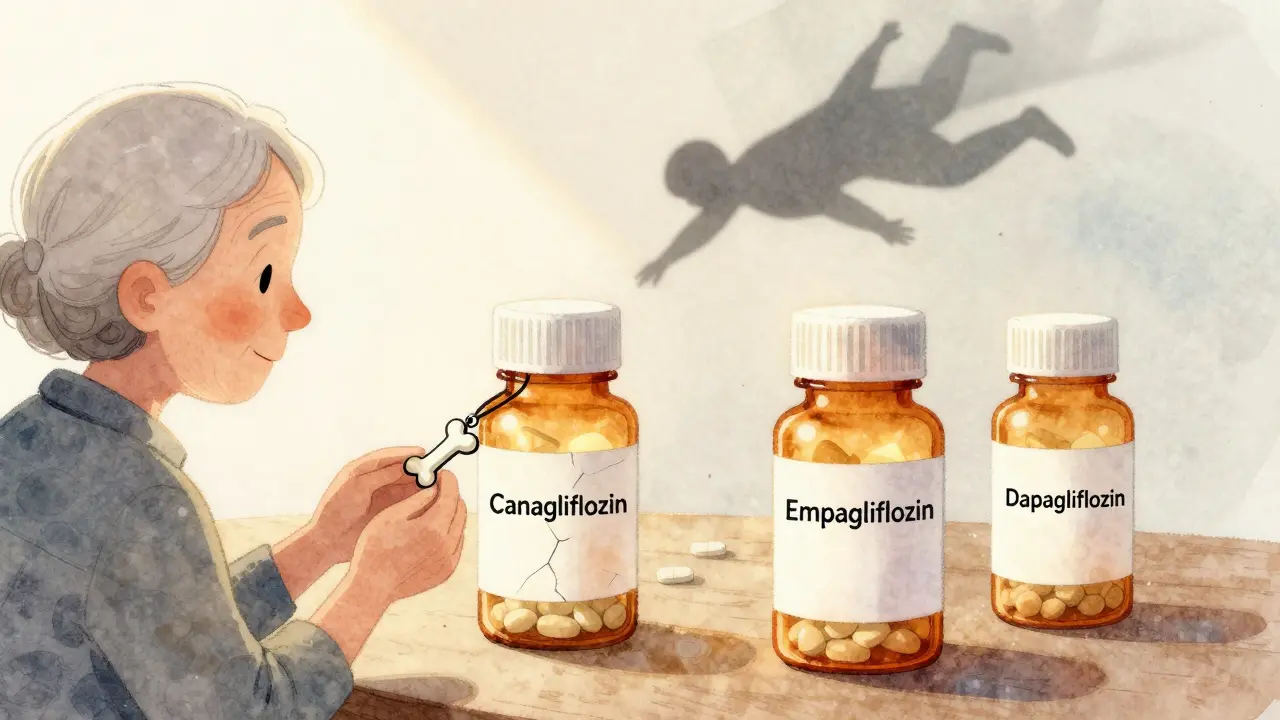
This tool helps you understand your fracture risk based on your diabetes medication and personal health factors. Remember: Canagliflozin has a known fracture risk, while empagliflozin and dapagliflozin do not.
When you’re managing type 2 diabetes, the goal isn’t just to lower blood sugar-it’s to protect your heart, kidneys, and overall long-term health. That’s why SGLT2 inhibitors like canagliflozin, empagliflozin, and dapagliflozin became so popular. They help you lose weight, reduce heart failure hospitalizations, and slow kidney damage. But for some patients, especially older adults or those with weak bones, a quiet concern has lingered: do these drugs increase fracture risk?
Not All SGLT2 Inhibitors Are the Same
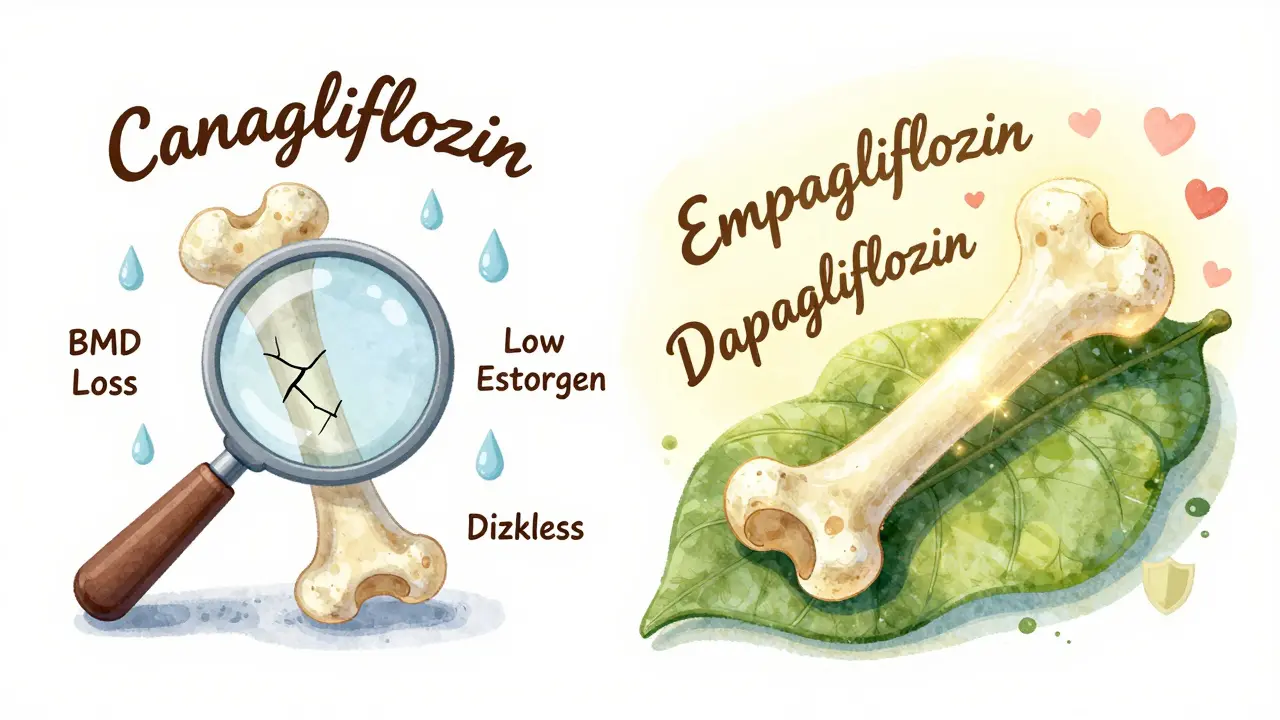
It’s easy to think of SGLT2 inhibitors as one group. They all work the same way-blocking glucose reabsorption in the kidneys so excess sugar leaves through urine. But when it comes to bone health, they’re not interchangeable. The data shows clear differences.Canagliflozin (Invokana) is the only one with a consistent signal of increased fracture risk. In the CANVAS trial, people taking 300 mg of canagliflozin had about 26% more fractures than those on placebo. Most of these were minor fractures-ankles, wrists, feet-that happened after a fall from standing height. The risk showed up as early as 12 weeks into treatment. That’s why the FDA added a boxed warning in 2016.
But here’s the twist: empagliflozin (Jardiance) and dapagliflozin (Farxiga) don’t show the same pattern. Large trials like EMPA-REG OUTCOME and DECLARE-TIMI 58 found no increase in fractures. A 2023 meta-analysis of 27 studies involving over 20,000 patients found the overall fracture risk with SGLT2 inhibitors was almost exactly the same as placebo-1.02 times higher, with no statistical significance. The only outlier? Canagliflozin.
Why Does Canagliflozin Affect Bones More?
The science behind this isn’t simple, but it’s not magic either. Several factors line up in canagliflozin’s case.First, it causes more bone mineral density (BMD) loss than the others. In a two-year FDA-mandated study, patients on canagliflozin lost 0.92% of hip BMD and 1.04% from the spine. Placebo users lost less than half that. That’s not huge-but in someone with osteoporosis, even small losses matter.
Second, canagliflozin may lower estrogen levels. One study found women on the 300 mg dose had a 9.2% drop in estradiol. Since estrogen protects bone, this could make bones more fragile over time.
Third, it can cause dizziness or low blood pressure when standing up. About 1 in 100 people on canagliflozin report this. That increases fall risk-and falls are what cause fractures. Empagliflozin and dapagliflozin have lower rates of this side effect.
Weight loss, which everyone experiences on these drugs, was also suspected. But research shows weight loss only explains about 3% of the bone density changes. So it’s not the main driver.
Who Should Be Worried?
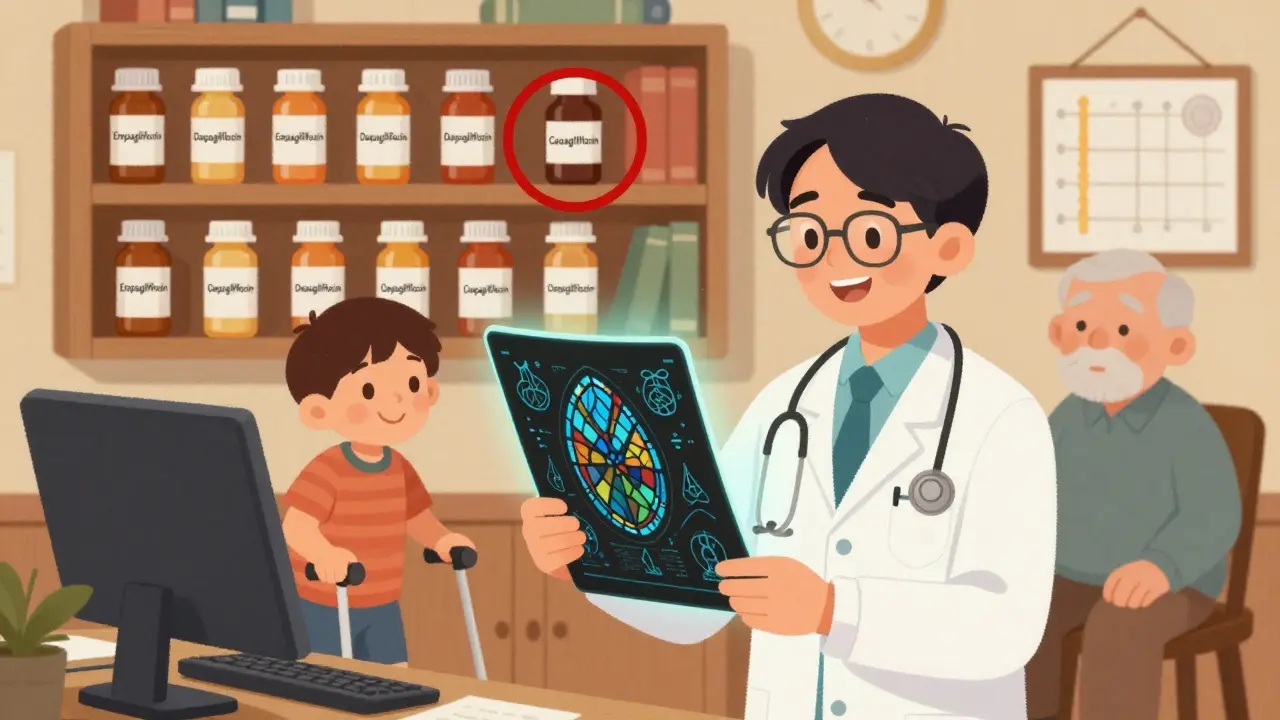
If you’re young, active, and have no history of fractures or osteoporosis, you likely don’t need to stress. But if you’re over 65, have a T-score below -2.5 on a DXA scan, or have already broken a bone from a minor fall, you’re in a higher-risk group.Endocrinologists now routinely check bone health before prescribing canagliflozin. The American Association of Clinical Endocrinologists recommends a DXA scan for anyone with osteoporosis or prior fracture. If the T-score is below -2.0, they often avoid canagliflozin altogether.
For empagliflozin and dapagliflozin? Most experts say no extra testing is needed unless you have other major risk factors-like long-term steroid use, rheumatoid arthritis, or a history of falls.
What Do Real Doctors Do?
A 2022 survey of 347 endocrinologists showed how practice has changed. Sixty-eight percent adjust prescriptions based on fracture risk. Eighty-two percent avoid canagliflozin in patients with osteoporosis. Only 34% do the same for dapagliflozin.One doctor in Mayo Clinic’s diabetes clinic said she sees about 3-4 fractures per 1,000 patient-years with canagliflozin in elderly, high-risk patients. With other SGLT2 inhibitors? Just 2-3. Another doctor at Johns Hopkins reviewed 15,000 patients and found no difference in fracture rates when he controlled for age and prior fracture history. So there’s still some disagreement.
But the trend is clear: fewer doctors are choosing canagliflozin. Between 2017 and 2022, its U.S. prescriptions dropped 22%. Meanwhile, empagliflozin and dapagliflozin prescriptions rose by 38% and 42% respectively. The market is responding to the data.
What About Other Diabetes Drugs?
It’s worth comparing SGLT2 inhibitors to other common diabetes meds. GLP-1 receptor agonists like semaglutide (Wegovy, Ozempic) and DPP-4 inhibitors like sitagliptin don’t carry fracture warnings either. In fact, a 2023 study in JAMA Network Open found SGLT2 inhibitors had either similar or lower fracture rates than these drugs in high-risk patients.That’s important. Some patients assume all diabetes drugs harm bones. They don’t. In fact, metformin may even protect bone density. The real issue is specific to canagliflozin-not the whole class.
What’s the Bottom Line?
If you’re considering an SGLT2 inhibitor:- Ask your doctor if you have osteoporosis, a prior fracture, or are over 65 with multiple fall risks.
- If yes, get a DXA scan before starting any medication.
- If your T-score is below -2.0, avoid canagliflozin. Empagliflozin or dapagliflozin are safer choices.
- If you’re healthy and active, all three drugs are fine-but still monitor for dizziness or balance issues.
- Don’t stop your medication without talking to your doctor. The heart and kidney benefits are real and often life-saving.
The American Diabetes Association now says SGLT2 inhibitors as a class don’t increase fracture risk-but they still list canagliflozin as a minor risk factor in their FRAX score calculator. That’s the nuance: not all drugs in the class are equal.
What’s Next?
The 2024 joint guidelines from the American Diabetes Association and the European Association for the Study of Diabetes are expected to add clearer algorithms for prescribing. They’ll likely recommend routine bone assessments only for canagliflozin in high-risk groups. Other SGLT2 inhibitors may get a clean bill of health for bone safety.For now, the message is simple: don’t fear all SGLT2 inhibitors. Fear the wrong one in the wrong person. Canagliflozin has risks. The others don’t. And for most people, the benefits still far outweigh the risks.
8 Comments
Steven Destiny
Let’s be real - canagliflozin is the red flag drug in this whole class. I’ve seen three elderly patients break hips on it in the last year. Not because they fell hard - just stood up too fast and went down. The FDA warning isn’t bureaucracy, it’s survival advice. If your doc pushes canagliflozin without checking your bones, find a new one. End of story.
Erwin Asilom
The data is clear: canagliflozin carries a statistically significant increase in fracture risk, particularly in patients with pre-existing bone density deficits. Empagliflozin and dapagliflozin, by contrast, demonstrate no such signal in large-scale, randomized controlled trials. The mechanism appears multifactorial-reduced bone mineral density, transient hypotension, and possible hormonal modulation. Clinical guidelines now reflect this distinction. Prescribing decisions should be individualized, with baseline DXA screening recommended for high-risk populations.
Nikki Brown
Of course people are breaking bones. 🤦♀️ You think losing weight and peeing out sugar doesn’t have consequences? People are treating these drugs like magic pills while ignoring basic physiology. If you’re over 65 and your bones are already crumbling, why are you even on this stuff? It’s not rocket science. Stop blaming the medication and start taking responsibility for your health. 😒
Peter sullen
It is imperative to recognize that the pharmacodynamic profile of canagliflozin, specifically its potent inhibition of SGLT2 at the proximal tubule, results in a distinct natriuretic and osmotic diuresis, which, in turn, induces a transient reduction in intravascular volume and orthostatic hypotension - a well-documented precipitant of falls. Additionally, the drug’s association with a measurable decline in bone mineral density - particularly in the lumbar spine and femoral neck - is substantiated by longitudinal imaging data from the FDA-mandated substudy. These findings, when contextualized within the broader risk-benefit calculus of cardiovascular and renal protection, necessitate a stratified prescribing approach.
Becky Baker
USA doctors are overcomplicating this. Just tell people: if you’re old and wobbly, don’t take Invokana. Pick Jardiance or Farxiga. Done. Why do we need a 10-page guide for this? My grandma’s on Farxiga, no falls, no drama. Canagliflozin? She’d be in a cast by now. Simple.
Natasha Sandra
Y’all are stressing too much 😊 I’m 70 and on Jardiance - no fractures, no dizziness, and my A1c is at 6.1! 🌟 The key is listening to your body. If you feel lightheaded when you stand up? Tell your doc. But don’t ditch the drug because of fear. These meds saved my kidneys. 💪❤️
Sumler Luu
I appreciate the nuance in this post. Many patients hear ‘SGLT2 inhibitor’ and panic - but the distinction between agents is critical. I’ve had patients switch from canagliflozin to dapagliflozin after a wrist fracture and immediately feel more stable. The bone density numbers don’t lie, but neither do patient outcomes. A balanced, individualized approach is the gold standard.
sakshi nagpal
As someone from India where osteoporosis is underdiagnosed in diabetics, this is incredibly timely. In our clinics, we rarely check DXA scans unless someone has already fractured. This data should change that. We need to educate both doctors and patients - not all diabetes drugs are equal, and bone health is part of diabetes care. Thank you for this clear breakdown.