
Side Effect Trade-Off Calculator
How this tool works
Based on the article, we help you evaluate treatment options by comparing benefits against side effect risks weighted by your personal priorities. Your values matter most.
How important is this side effect to you?
When a doctor suggests a new medication, you’re often told about the benefits - but what about the side effects? Not just the list, but what they actually mean for your daily life? That’s where shared decision-making comes in. It’s not just about signing a form. It’s about having a real conversation where your values, fears, and lifestyle matter as much as the medical facts.
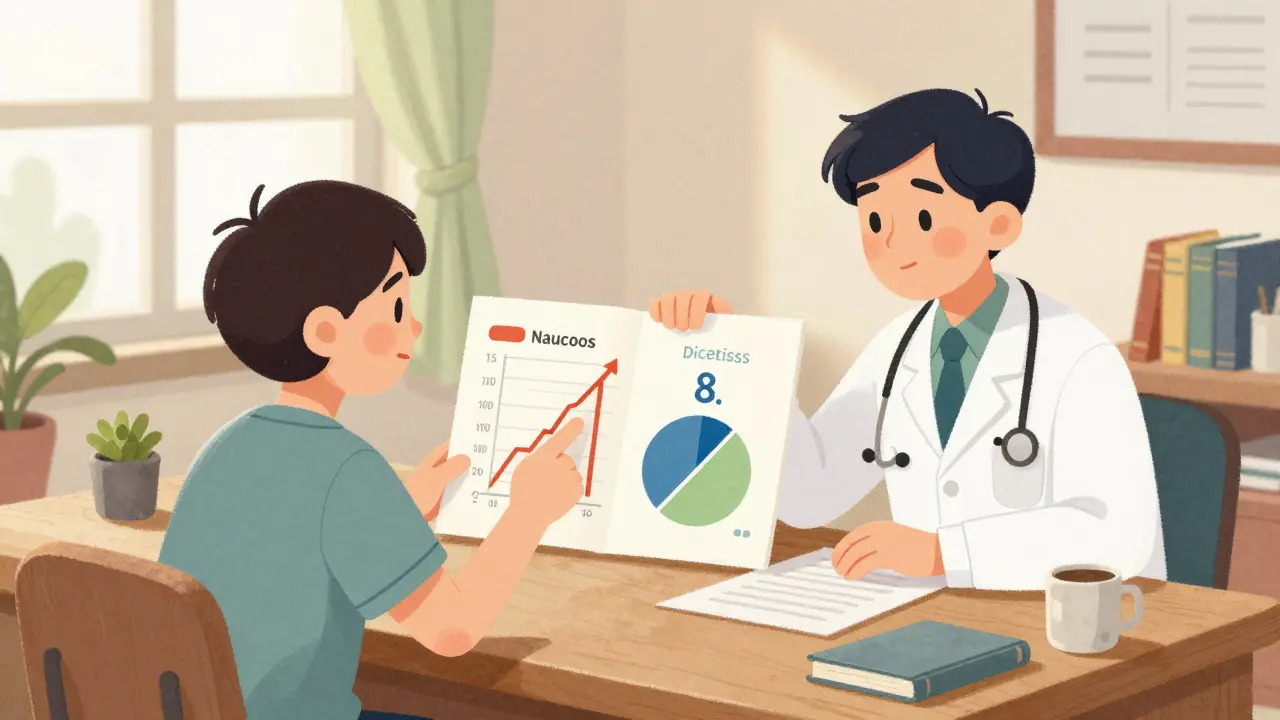
Imagine this: Your doctor says, "This drug reduces your chance of a heart attack by 20%." Sounds good, right? But then they add, "About one in ten people get severe nausea, and for some, it lasts weeks." Suddenly, you’re stuck. You don’t know if that 20% is worth losing your appetite, missing work, or feeling sick every day. That’s the trade-off. And without a clear way to talk about it, you might say yes out of pressure - or say no out of fear - and regret it later.
Why Side Effect Trade-Offs Are Hard to Talk About
Clinicians often say side effects are "rare" or "common." But those words mean nothing. Is rare one in a hundred? One in a thousand? Is common 30%? 70%? Patients don’t know. And that’s the problem.
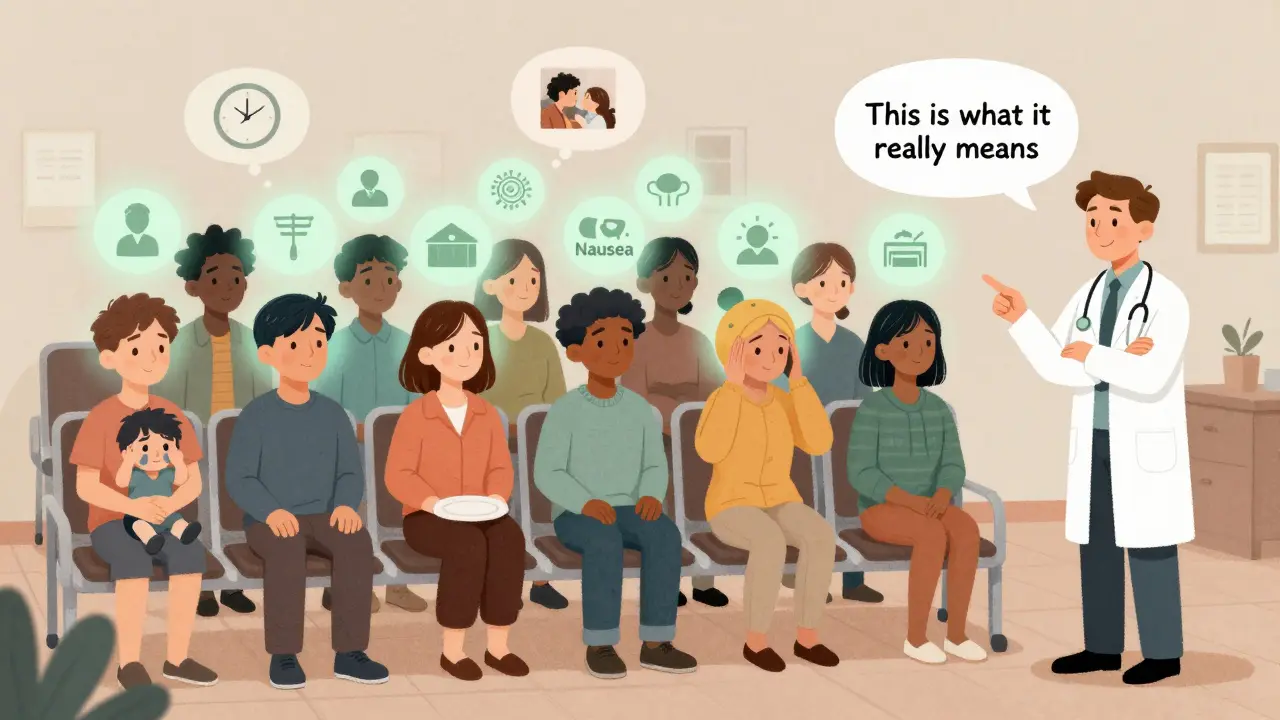
Research from the Annals of Internal Medicine (a leading medical journal that found patients understand risks better when given absolute numbers) shows that when doctors say "this side effect affects 15 out of 100 people," patients remember it 37% better than when told "this side effect is reduced by 30%." That’s because absolute numbers - real numbers - stick. They turn abstract fear into something you can picture: "If I sit in this waiting room with 100 people, 15 of them will feel sick every day. I need to decide if that’s something I can live with."
But numbers alone aren’t enough. You also need to know how side effects affect your life. That’s called treatment burden (the impact of treatment on daily activities like work, sleep, or family time). A 2022 study from the Massachusetts General Hospital Health Decision Sciences Center (a research group focused on how patients make medical choices) found that 42% of people who stopped their medication did so because of how it disrupted their life - not because of physical pain, but because it made them too tired to pick up their kids, too nauseous to work, or too anxious to leave the house.
The SHARE Approach: A Step-by-Step Script
The Agency for Healthcare Research and Quality (AHRQ) (a U.S. government agency that develops tools for better patient care) created a simple, five-step method called the SHARE Approach (a structured communication framework for shared decision-making). It’s not a script you memorize. It’s a way to think. Here’s how it works:
- Seek opportunities - Start by asking: "Would you like to be part of deciding which treatment is right for you?" This isn’t optional. It sets the tone.
- Help explore options - Don’t just list drugs. Compare them. "Option A lowers your risk by 25% but causes nausea in 15% of people. Option B lowers it by 18% but causes dizziness in 8%. Neither is perfect. Which trade-off feels less bad to you?"
- Assess values - This is the most important step. Ask: "What side effects would be a deal-breaker for you?" Some people can handle dizziness. Others can’t stand nausea. Some fear weight gain. Others fear dependency. There’s no right answer - only what matters to you.
- Reach a decision - Don’t rush. Say: "So, based on what you’ve told me, you’re okay with mild dizziness if it means avoiding nausea? Let me make sure I got that right." Then confirm: "Is this what you want to try?"
- Evaluate - Check in later: "How’s it going? Are the side effects worse than you expected? Should we adjust?" This isn’t a one-time talk. It’s an ongoing conversation.
These steps aren’t theory. A 2021 study in the Journal of General Internal Medicine (a medical journal that tracks patient outcomes and decision-making) found that patients who used this method had 23% less decision regret. They felt more confident. Less anxious. More in control.
The Three-Talk Model: When Things Get Complex
For serious conditions - like cancer, heart disease, or chronic pain - the SHARE Approach works, but it’s not enough. That’s where the three-talk model (a communication framework used in oncology and complex care settings) comes in. It’s used by top hospitals like Scripps Health (a major U.S. healthcare system that trains clinicians in shared decision-making) and endorsed by the National Institute for Health and Care Excellence (NICE) (a UK-based organization that sets clinical guidelines).
It breaks down into three parts:
- Option talk: Lay out all real choices - including doing nothing. "We can start with medication, or we can try lifestyle changes for three months and retest. Or we can combine both."
- Decision talk: Help the patient weigh what matters. "You said you hate being tired. Medication might make that worse. Lifestyle changes might take longer, but they could help you sleep better. Which outcome is more important to you?"
- Support talk: Validate emotions. "It’s okay to feel scared. This isn’t just a number. This affects your life. I’m here to help you figure it out - not push you toward one choice."
In oncology, where side effects can be brutal, this model cuts treatment dropout rates by 29%. Why? Because patients aren’t just hearing data - they’re being heard.
What Patients Say About Real Conversations
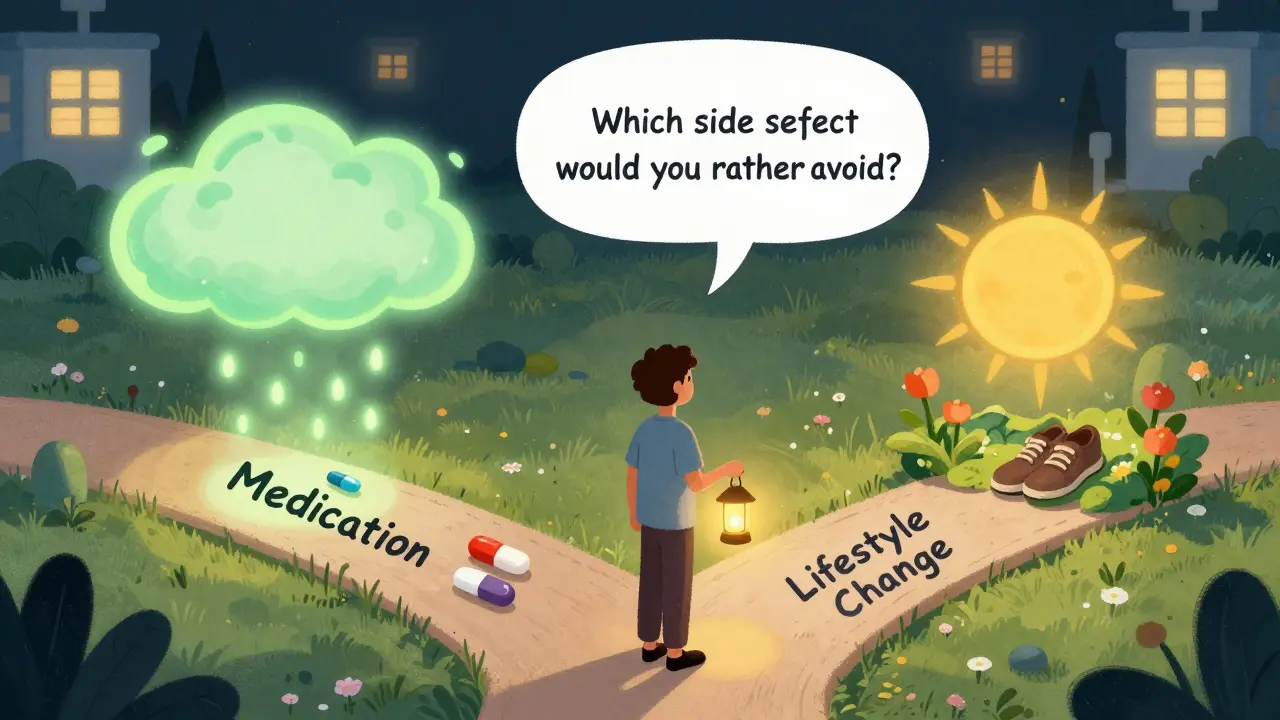
On Reddit, a patient wrote: "My doctor didn’t just say, 'You’ll get nausea.' She asked, 'If you had to pick between losing your appetite or feeling dizzy all day, which would you rather avoid?' That question changed everything. I chose the option that let me keep eating with my kids."
That’s the power of asking the right question. A 2022 survey by the Informed Medical Decisions Foundation (an organization that promotes patient understanding of treatment risks) found that 84% of people felt more confident in their choice when clinicians asked: "Which side effects would be a deal-breaker for you?"
But not all conversations are good. A 2022 Medscape survey showed 63% of patients felt frustrated when doctors read from scripts without listening. That’s the trap. Scripts aren’t meant to be robotic. They’re meant to guide real, human talk.
What Clinicians Are Doing About It
Hospitals aren’t ignoring this. Kaiser Permanente (a large U.S. healthcare provider that integrates patient education and decision-making) started using pre-visit videos that explain side effect risks in plain language. Patients watched them before seeing their doctor. Result? Consultations got shorter - by over three minutes - and statin discontinuation dropped by 33%.
Electronic health records are catching up too. Epic Systems (a major EHR platform that now includes built-in shared decision-making tools) added SDM modules in 2022. Now, when a doctor opens a patient’s chart for a new prescription, a pop-up suggests: "Ask about top side effect concerns." It’s not perfect - but it’s a step.
And now, insurance is backing it. In 2023, CMS (the U.S. Centers for Medicare & Medicaid Services that now requires documentation of shared decision-making for high-risk drugs) started requiring doctors to document shared decisions for medications with serious side effects. And they pay $45-$65 for each documented conversation. That’s not just a policy change - it’s a signal that this isn’t optional anymore.
What You Can Do - Right Now
You don’t need to be a doctor to use these tools. Here’s how to make sure your next appointment goes better:
- Before your visit: Write down: "What side effects scare me most?" and "What would make me stop taking this?"
- During the visit: Ask: "Can you tell me the risk in numbers? Like, out of 100 people, how many get this?"
- Ask: "What side effects would make you personally avoid this drug?"
- If they say "it’s rare," say: "Can you give me the exact percentage?"
- After the visit: If you’re unsure, call back. Say: "I’m still thinking about the side effects. Can we talk again?"
There’s no shame in asking. In fact, the best doctors expect it.
Why This Matters Long-Term
This isn’t about one pill. It’s about a shift in medicine. Back in 2001, the Institute of Medicine (a U.S. organization that set standards for patient-centered care) said care must be "respectful of and responsive to individual patient preferences." Now, 87% of U.S. medical schools teach that as core training.
By 2026, nearly all major health systems will use some form of shared decision-making for side effect discussions. It’s not a trend. It’s the new standard. And you’re not just a patient - you’re part of the team.
So next time you’re handed a prescription, don’t just nod. Ask. Talk. Share. Your life depends on it - not just the numbers on the page, but the choices you make with your eyes wide open.
13 Comments
APRIL HARRINGTON
I had a doctor tell me a drug was 'rarely' causing nausea and I ended up in the ER for a week
Turns out 1 in 6 got it
They don't care until you're suffering
Stop using vague language and start talking real numbers
Leon Hallal
This is why I stopped trusting doctors. They say 'shared decision-making' but they already made up their mind before you walked in. You're just there to sign the paper. I got prescribed something and when I asked about side effects they said 'you'll be fine' and that was it. No numbers. No options. Just 'trust me'.
Judith Manzano
I love that they're finally starting to train doctors to actually listen. My mom had a stroke last year and the whole time she was in recovery, the only thing that made her feel like she had control was when her neurologist sat down and asked her what she was scared of losing. Not the numbers. Not the stats. What she'd miss. That's when the real conversation started.
Peter Kovac
The SHARE approach is methodologically sound but suffers from implementation bias. Clinicians are incentivized for throughput, not deliberative discourse. The 23% reduction in decision regret is statistically significant but not clinically transformative without structural reform in EHR design and reimbursement architecture. The $45-$65 CMS payment is a band-aid on a hemorrhage.
rafeq khlo
You think this is new? This has been common sense since the 80s. Doctors have always been lazy. They don't want to explain because they're scared of being sued or because they don't know themselves. They say '15 out of 100' like it's magic. But most don't even know what 15% looks like. They just read from a pamphlet and move on. This is just corporate PR dressed up as patient care
Morgan Dodgen
Let's be real - this is all part of the pharma-industrial complex. They want you to think you're in control so you'll take the pills. The real goal? Keep you on meds forever. The 'three-talk model'? It's a distraction. The system doesn't care if you're tired or nauseous. It cares if you're on the drug. Look at the stats - 87% of med schools teach this? That's because Big Pharma funds the curriculum. Wake up.
Philip Mattawashish
You people are naive. Shared decision-making is a joke. Doctors don't want your input. They want compliance. The 'deal-breaker' question? That's just a script to make you feel heard while they slide you into the option they already picked. I've seen it. I've been the patient. I've been the nurse. The system is rigged. You think asking questions changes anything? You're just a number on a spreadsheet with a pulse.
Tom Sanders
I read this whole thing and I'm still not sure what I'm supposed to do. Just ask for numbers? Say 'what would you avoid'? That's it? That's the magic solution? I feel like I'm being told to go to therapy instead of getting a real answer. This is all very nice but it doesn't change the fact that I'm still stuck between a pill that might kill me and a pill that might make me useless.
Jazminn Jones
The notion that patients are capable of making informed decisions about pharmacological trade-offs is fundamentally flawed. Most lack the epistemic foundation to interpret absolute risk metrics, let alone weigh treatment burden against probabilistic outcomes. The AHRQ framework, while well-intentioned, is a performative gesture toward patient autonomy that obscures the deeper epistemological asymmetry between clinician and layperson.
Stephen Rudd
You're all missing the point. This isn't about drugs or side effects. It's about control. The system wants you to believe you have a choice so you don't revolt. But you don't. You're just being nudged toward the option that benefits the hospital, the insurer, and the drug company. The 'three-talk model'? That's just a fancy way of saying 'we're going to make you feel better about taking the pill we already chose'. Wake up. This is manipulation dressed as empowerment
Erica Santos
Oh wow. A whole article about how to ask better questions. And here I thought the solution was just... don't take the damn pill unless you're dying. But no. Let's turn medicine into a TED Talk. 'What side effects would be a deal-breaker?' What if the deal-breaker is that you're alive and your kid needs you? You don't need a script. You need a miracle. And nobody's giving you one.
George Vou
i read this and thought wow this is so true but then i remembered the last time i asked my doc about side effects they just said 'youll be fine' and handed me the scrip. no numbers no talk no nothing. so yeah its a good idea but in real life? no one cares. theyre just trying to get you out the door so they can see the next one. this whole thing is a fantasy.
Mantooth Lehto
I cried the first time my doctor asked me what I'd give up to live longer. Not 'what side effects scare you' - but what you'd lose. I said my mornings. My coffee. My quiet time. She didn't just write it down. She looked at me and said 'then let's find something that doesn't steal that'. That's the moment I stopped being a patient and started being a person. This isn't about scripts. It's about seeing each other.