
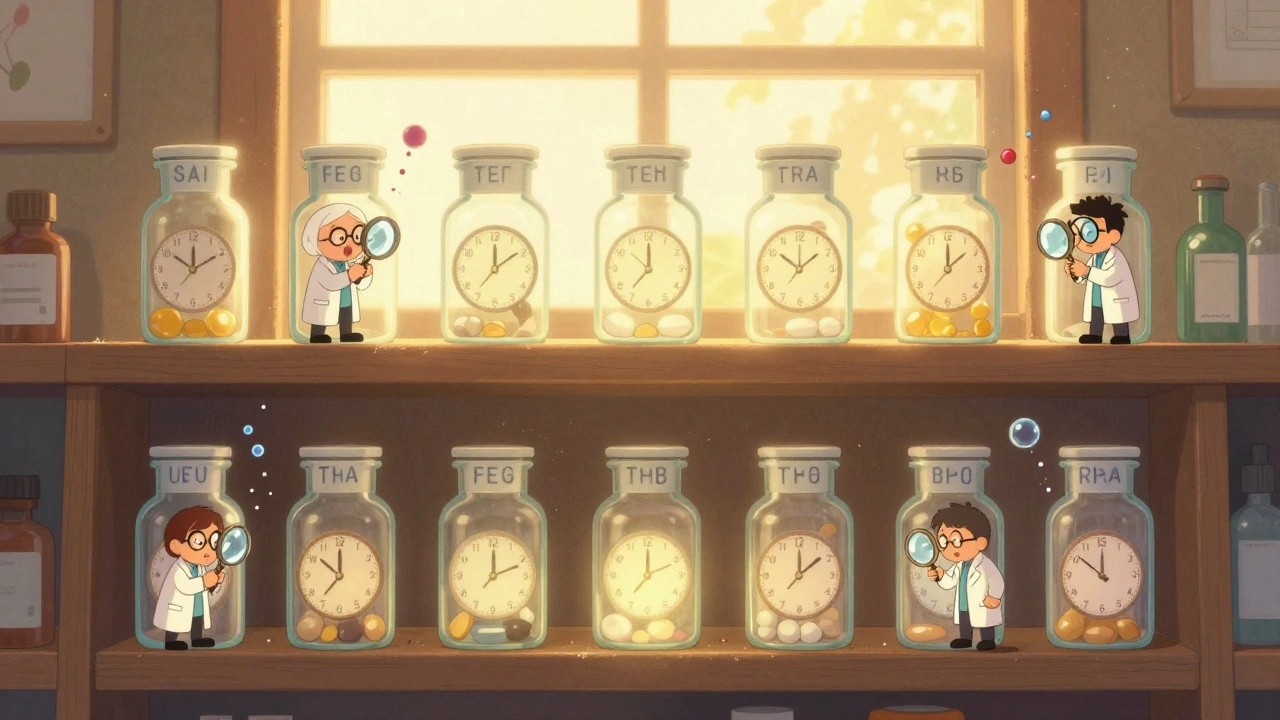
When a pill leaves the factory, it doesn’t stop being monitored. In fact, the real test of its quality begins after manufacture. Stability testing is the quiet, relentless process that tracks how a drug changes over time - in heat, humidity, light, and storage. It’s not optional. It’s not a formality. It’s the science that tells you whether that medication will still work safely two years from now, sitting on a shelf in a pharmacy, a home medicine cabinet, or a hospital supply room.
Why Stability Testing Exists
Imagine buying a painkiller that’s supposed to contain 100 mg of active ingredient. After 18 months, it’s down to 78 mg. You take it. Nothing happens. You take more. Now you’re at risk of side effects from extra filler or breakdown products. This isn’t hypothetical. In 2021, 17.3% of all drug recalls in the U.S. were tied to stability failures - potency loss, unexpected chemicals forming, or packaging that let moisture in. Stability testing exists to stop this before it reaches patients. The foundation of this process is the ICH Q1A(R2) guidelines, created in 2003 by regulators from the U.S., Europe, and Japan. These aren’t suggestions. They’re the rulebook. Every new drug application - whether it’s a brand-name biologic or a generic tablet - must include full stability data. Without it, the FDA won’t approve it. No exceptions.How It Works: The Lab That Never Sleeps
Stability testing doesn’t happen in a lab you visit once a week. It happens in rooms called stability chambers - climate-controlled, 24/7 monitored environments. These aren’t ordinary fridges. They’re precision machines holding samples at exact conditions: 25°C and 60% humidity for standard testing, or 40°C and 75% humidity for accelerated testing. Some chambers even simulate sunlight exposure, bombarding samples with 1.2 million lux hours of visible light to check for photodegradation. Each drug product - tablets, capsules, injectables, ointments - gets its own set of samples. These are pulled at regular intervals: 0, 3, 6, 9, 12, 18, 24, and 36 months. At each point, scientists test for:- Physical changes: Color, texture, odor, dissolution rate
- Chemical changes: How much active ingredient remains, what degradation products have formed
- Microbiological safety: Is the product still sterile? Has mold grown?
- Package integrity: Did the bottle leak? Did the blister pack break down?
Real-Time vs. Accelerated: The Trade-Off
You can’t wait three years to find out if a drug lasts three years. That’s why accelerated testing exists. By pushing samples to 40°C and 75% humidity for six months, manufacturers get early warning signs. But here’s the catch: accelerated data is predictive. Real-time data is definitive. A 2021 study in the Journal of Pharmaceutical Sciences showed that accelerated models often overestimated shelf life by 15-20% for complex formulations. That’s why regulators require both. Accelerated testing flags risks. Real-time testing confirms the actual expiration date. For a new cancer drug, this means 36 months of real-time data before the FDA will allow a three-year expiration label. The ICH Q1E guideline demands statistical certainty: you must prove with 95% confidence that 95% of all units in the batch will still meet specs at expiration. It’s not a guess. It’s math. And it’s non-negotiable.
Costs, Challenges, and Hidden Risks
Stability testing isn’t cheap. A single product study can cost between $50,000 and $150,000. Companies spend $500,000 to $2 million a year on infrastructure alone. Stability chambers need quarterly temperature mapping - a $8,500 test per unit - to prove they’re reliable. Calibration must follow ISO 17025 standards. Deviations trigger formal investigations. One humidity spike in a chamber can wipe out six months of data. One Reddit user described a delay that cost $2.3 million in lost market time. Even bigger risks come from poor data management. The FDA requires stability data to be stored for one year past the product’s expiration date. Paper records are a nightmare. Companies using electronic systems cut review time by 55%. But validating those systems takes 6-9 months. Many small biotechs outsource to CROs like SGS or Eurofins because they can’t afford the overhead.Success Stories and Near Misses
Stability testing has saved billions. In 2022, SGS identified a chemical interaction between a new biologic drug and its glass vial - a problem no one saw during development. The manufacturer changed the packaging before launch. A $500 million failure was avoided. On the flip side, a 2021 FDA warning letter cited a company that ignored out-of-spec results on a cancer drug. They didn’t investigate why potency dropped. Approval was delayed 14 months. Patients waited. The company lost trust. Some experts argue the system is too slow. Dr. Robert Elder says for simple, stable small-molecule drugs, 18-24 months of testing adds unnecessary delay. He’s pushing for risk-based approaches - testing fewer samples, using modeling, skipping redundant tests. The industry is listening. ICH Q12, introduced in 2018, lets companies make post-approval changes without restarting stability studies - if they can prove the product won’t change. Companies using this have cut sample sizes by 40% and saved $120,000 per product annually.
13 Comments
ian septian
This is the quiet hero of pharma. No one talks about it, but without stability testing, half the meds on shelves would be useless or dangerous.
Simple, vital, and underappreciated.
Carina M
One is compelled to observe that the regulatory framework governing pharmaceutical stability-namely, ICH Q1A(R2)-constitutes a paradigm of scientific rigor, wherein the sanctity of patient safety is enshrined in empirical protocol rather than speculative convenience. To dismiss such standards as bureaucratic is not merely naïve-it is ethically indefensible.
William Umstattd
Let me be perfectly clear: if a company cuts corners on stability testing, they’re not just breaking rules-they’re playing Russian roulette with people’s lives.
That 2021 FDA warning letter? That wasn’t a typo. That was negligence with a capital N.
And yes, I’m talking to you, the ones who ignored out-of-spec results.
Patients aren’t lab rats. They’re mothers, fathers, children.
And you owe them better.
Elliot Barrett
Stability testing costs a fortune, takes forever, and most drugs are stable anyway. Why not just trust the manufacturer and skip the 36-month wait?
It’s not like people are going to die from a 5% potency drop.
Let’s be real here.
Tejas Bubane
Everyone acts like this is some grand scientific achievement but it’s just expensive bureaucracy wrapped in jargon
ICH guidelines? Please. The real problem is pharma companies hoarding data to block generics
Stability testing is a gatekeeping tool disguised as safety
Ajit Kumar Singh
India makes 40% of the world’s generic drugs and we do stability testing better than anyone else
Our labs are clean our data is clean our people are honest
Why do you think the US imports so much from us
Because we deliver
Not because we lie
And don’t you forget it
Angela R. Cartes
Can we talk about how insane it is that we spend $2M/year on chambers just to wait 3 years?
Also I’m pretty sure the FDA doesn’t even read half the data they require 😅
It’s theater with a lab coat.
Lisa Whitesel
Accelerated testing is a lie
Real-time data is the only truth
Anything else is a gamble
And patients shouldn’t be the ones paying for it
Simran Chettiar
Think about it this way the pill you swallow is not just chemistry it is time itself frozen in a capsule
Every chamber is a clock ticking in silence every data point a whisper from the future
We test not because we fear decay but because we honor the promise we made to the human body
That it will be treated with the reverence of a sacred contract
Richard Eite
USA invented this system and now Europe and Japan want to copy it
Meanwhile China and India are trying to cut corners
Let me be clear-this is American science at its best
Don’t let anyone tell you otherwise
Katherine Chan
Love how this post highlights the quiet heroes behind every pill
Stability teams are unsung warriors
They sit in labs watching vials age while the world moves on
Thank you for doing the work no one sees
Keep going you’re making a difference
Philippa Barraclough
There’s an interesting tension here between the need for exhaustive real-time data and the pressure to accelerate drug availability. While ICH Q12 offers promising pathways for post-approval flexibility, the underlying assumption-that degradation kinetics are predictable across all formulations-may not hold for complex biologics or novel delivery systems. The statistical confidence thresholds of 95% for 95% of units, while mathematically elegant, may not account for heterogeneity in real-world storage conditions, especially in low-resource settings where temperature control is inconsistent. Are we optimizing for regulatory compliance or for global patient outcomes? The two are not always aligned.
Tim Tinh
Big respect to the people running those stability chambers
They’re literally watching medicine grow old
And yeah the system’s slow and expensive
But when your grandma’s blood pressure med still works after 2 years
That’s the kind of boring science that saves lives
Thanks for doing the grind
And yeah i typoed but you get the point 😅