
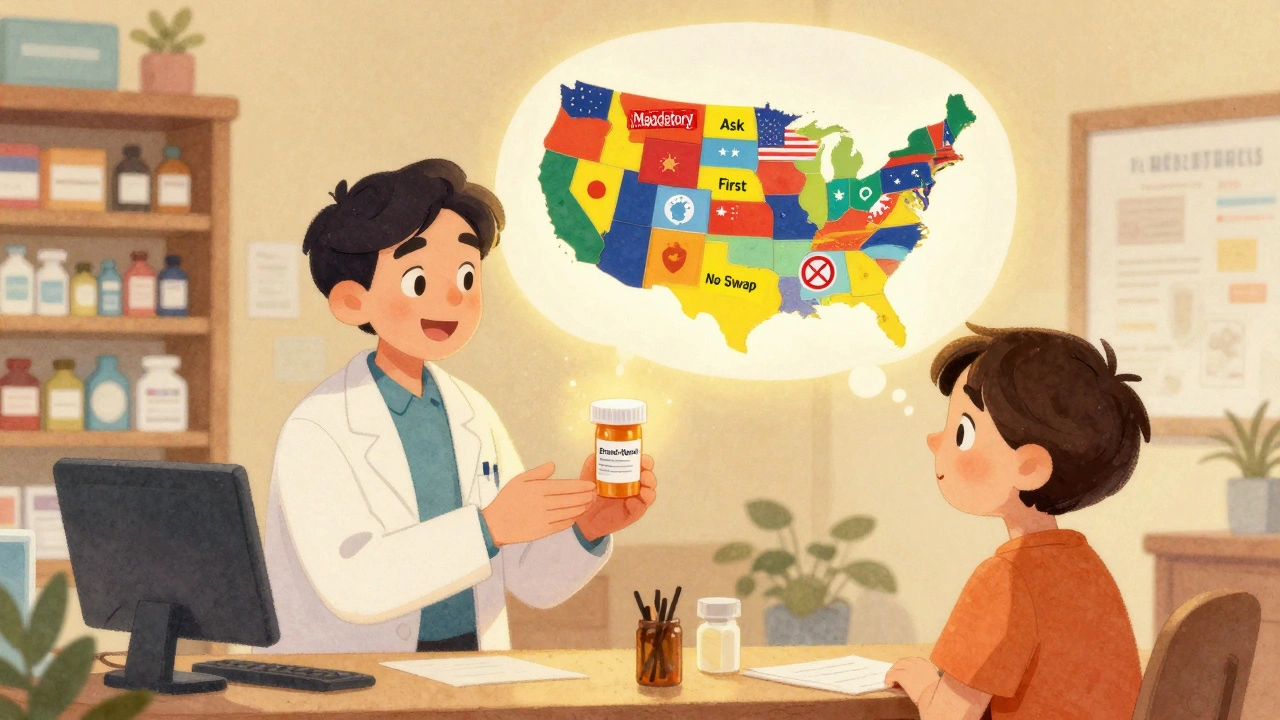
Every year, pharmacists in the U.S. fill over 6 billion prescriptions. About 92.5% of those are for generic drugs. But here’s the catch: whether a pharmacist can swap a brand-name drug for a generic isn’t the same across the country. It depends on the state you’re in. One state might require the substitution. Another might need your written permission. And in a few, certain drugs can’t be switched at all-even if they’re technically identical.
Why Do State Laws on Generic Substitution Even Exist?
The push for generic substitution started in the 1970s. Back then, brand-name drugs were expensive, and many people couldn’t afford them. The federal government stepped in with the Hatch-Waxman Act of 1984, creating a clear path for generic drugs to be approved by the FDA. The idea was simple: if a generic drug is proven to work the same way as the brand-name version, it should be allowed to replace it-saving money for patients and the system. But states didn’t just follow federal rules. Each one wrote its own laws. Some wanted to make substitution automatic to cut costs. Others worried about safety, especially for drugs where even tiny differences could cause harm. The result? A patchwork of rules that makes it hard for pharmacists to keep up-and confusing for patients who move between states.How Pharmacists Decide What to Dispense
When a prescription comes in for a brand-name drug, the pharmacist doesn’t just grab the cheapest version off the shelf. They have to check four things:- Does the state require substitution? In 22 states, pharmacists must substitute generics unless the doctor or patient says no. In the other 28 states and D.C., substitution is optional.
- Does the patient need to give consent? In 32 states, the law assumes you’re okay with the switch unless you say otherwise. In 18 states, the pharmacist must ask you outright and get your yes before swapping.
- Is the drug on a no-substitution list? Some drugs have a narrow therapeutic index (NTI)-meaning the difference between a safe dose and a dangerous one is tiny. Warfarin, levothyroxine, and certain seizure meds fall into this category. Fifteen states, including Kentucky and Minnesota, ban substitutions for these drugs, even if the FDA says they’re equivalent.
- Is it a biosimilar? These are newer, complex drugs like those used for cancer or autoimmune diseases. As of 2023, 49 states and D.C. have rules for substituting them, but rules vary. Hawaii, for example, requires both the doctor and patient to approve the switch for antiepileptic biosimilars.
Pharmacists use the FDA’s Orange Book to check if a generic is rated as therapeutically equivalent (an “A” rating). But they also have to pull up their state’s list of restricted drugs, check their pharmacy’s software for local rules, and sometimes verify with the prescriber. On average, this process takes over 12 minutes per prescription.
What Happens When Rules Clash
Imagine you live in New York but visit your sister in New Jersey. You refill your prescription at her local pharmacy. In New York, the pharmacist has to ask you if you want the generic. In New Jersey, they just swap it unless you object. You get home, and your pill looks different. You panic. Did they give you the wrong drug? This isn’t rare. About 18% of chain pharmacy transactions involve prescriptions that cross state lines. Patients get confused. Pharmacists get frustrated. One pharmacist in Ohio told a survey: “I’ve had patients come in mad because I switched their medication in Texas, but when they came back home, their pharmacist didn’t. They think we’re playing games with their health.” The confusion isn’t just emotional-it’s dangerous. Between 2020 and 2022, the FDA’s MedWatch system recorded 217 reports from patients who felt their condition worsened after a generic switch. Most involved levothyroxine (89 cases) or warfarin (53 cases). Even though the FDA says these generics are equivalent, some patients report differences in how they feel. Doctors often tell patients with NTI drugs to “dispense as written” to avoid any risk.
Cost Savings vs. Patient Safety
There’s no denying the financial upside. From 2009 to 2019, generic substitution saved the U.S. healthcare system $1.7 trillion. Medicaid programs alone saved $1.2 billion a year in states with mandatory substitution laws. In states where substitution is automatic, generic fill rates hit 94.1%. In states where pharmacists have to ask permission, it’s only 88.3%. But savings can’t come at the cost of safety. Minnesota saw a spike in adverse events after warfarin substitutions-even though the generics met FDA standards. A 2023 study found that 41% of cancer patients feared substitution of NTI drugs. For people with rare diseases, the stakes are even higher. The National Organization for Rare Disorders warns that overly permissive substitution rules could put 25 to 30 million Americans at risk.Technology Is Helping-But Not Solving Everything
Most pharmacies now use software that automatically checks the patient’s state, the drug’s FDA rating, and whether it’s on a restricted list. These systems cut substitution errors by 64%. That’s huge. But they’re not perfect. The software can’t always tell if a doctor’s note saying “dispense as written” is legally binding in that state. It can’t read the tone of a patient’s voice when they say, “I don’t like the generic.” And it can’t explain to a confused patient why the rules changed when they moved from Florida to Iowa. Pharmacy schools now teach 45 to 60 hours on state substitution laws. Licensing exams in 92% of states include this material. But the real challenge isn’t knowledge-it’s consistency.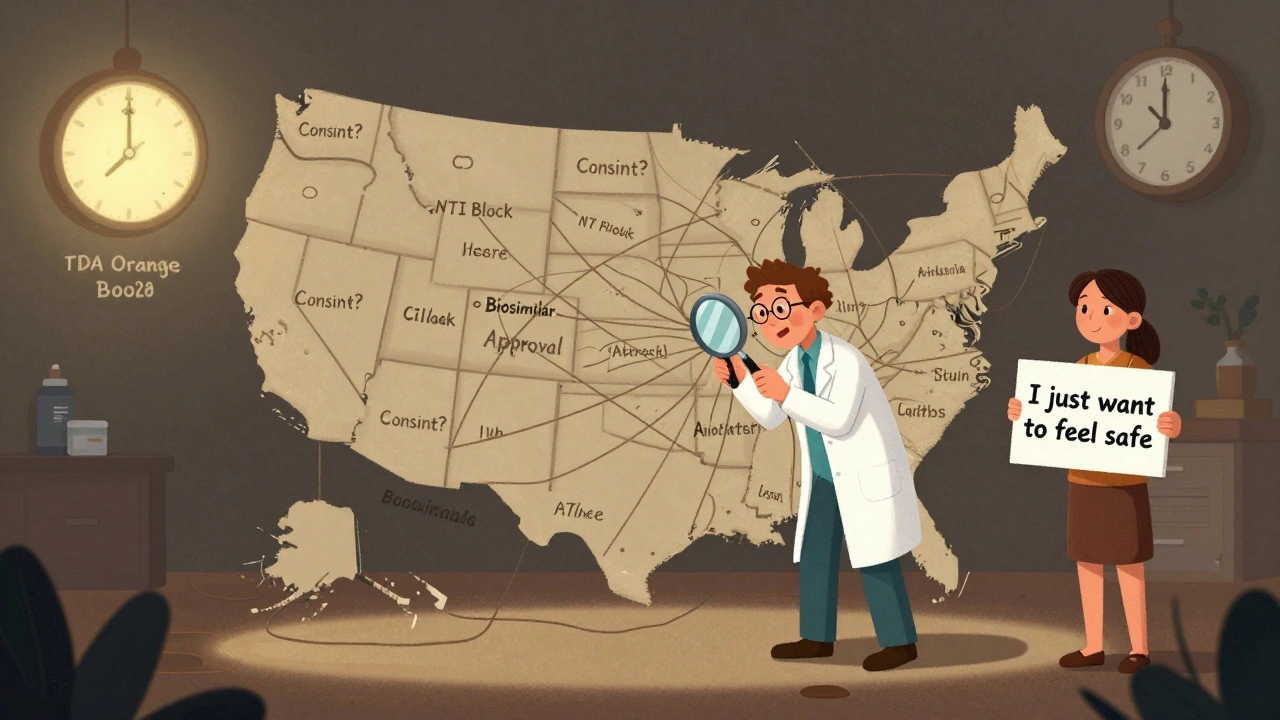
What’s Next? A Push for Standardization
The American Pharmacists Association says 78% of pharmacists are confused by the patchwork of state rules. The Uniform Law Commission is working on a Model State Biologics and Biosimilars Act to bring some order to the chaos. The goal? One set of clear rules for substitution that all states could adopt. Some states are already moving. Florida now requires pharmacies to build formularies that ensure biosimilar substitutions won’t harm patients. Iowa tells pharmacists to rely on the FDA’s Orange Book. But without federal intervention, the system will stay messy. The Congressional Budget Office estimates that if all states aligned their laws, the U.S. could save another $8.7 billion a year by 2028. But that’s only if patients don’t lose trust in the system.What You Should Do as a Patient
You don’t need to know every state law. But you do need to know your rights:- Ask: “Is this a generic? Can I get the brand instead?”
- If you’ve had bad reactions to a generic before, tell your doctor. Ask them to write “dispense as written” on the prescription.
- If your pill looks different and you feel worse, don’t assume it’s in your head. Call your pharmacist. Report it to the FDA’s MedWatch system.
- If you move states, check whether your medication is on a restricted list in your new home.
Generic drugs are safe, effective, and save billions. But they’re not one-size-fits-all. Your health depends on understanding the rules in your state-and speaking up when something feels off.
Can a pharmacist substitute a generic drug without my permission?
It depends on your state. In 32 states, pharmacists can substitute generics unless you say no (presumed consent). In 18 states, they must ask you and get your explicit approval before switching. In 22 states, substitution is mandatory unless blocked by the doctor or patient.
Are all generic drugs safe to substitute for brand-name drugs?
The FDA approves generics as therapeutically equivalent to brand-name drugs. But for drugs with a narrow therapeutic index (NTI)-like warfarin, levothyroxine, and some seizure medications-even small differences can cause problems. Fifteen states ban substitution for these drugs, regardless of FDA ratings.
Why do some states block substitution for certain drugs?
Some drugs have a narrow therapeutic index, meaning the difference between a safe dose and a harmful one is very small. Studies have shown that even FDA-approved generic versions can cause adverse effects in sensitive patients. States like Kentucky, Minnesota, and California have created lists of these high-risk drugs to prevent substitution and protect patient safety.
What’s the difference between a generic and a biosimilar?
Generics are exact chemical copies of small-molecule drugs. Biosimilars are copies of complex biological drugs, like those used for cancer or autoimmune diseases. They’re not identical, just very similar. Because of this, substitution rules for biosimilars are stricter. As of 2023, 49 states and D.C. have specific laws for them, with some requiring both doctor and patient consent.
Can I refuse a generic substitution even if my state allows it?
Yes. In every state, you have the right to refuse a generic substitution. You can ask for the brand-name drug, even if it costs more. Your pharmacist must honor your request. If they don’t, you can file a complaint with your state board of pharmacy.
How do I find out what my state’s substitution laws are?
Contact your state’s board of pharmacy. Most have websites with summaries of substitution laws. You can also ask your pharmacist-they’re required to know the rules. For a quick reference, check the National Conference of State Legislatures (NCSL) website, which tracks state laws on generic and biosimilar substitution.
What Pharmacists Should Watch Out For
If you’re a pharmacist, the biggest risk isn’t getting fined-it’s getting sued because a patient had a bad reaction after a substitution you made. Here’s how to stay protected:- Always check your state’s NTI drug list-even if the FDA says it’s okay.
- Document every patient refusal, even if you think they’re being difficult.
- Use your pharmacy software’s state verification tool. Don’t rely on memory.
- When in doubt, call the prescriber. A quick phone call can prevent a lawsuit.
There’s no perfect system. But with better communication, clearer rules, and more patient education, we can make sure generic substitution saves money without risking lives.
10 Comments
Fern Marder
OMG I just had this happen last month 😱 I moved from California to Texas and my levothyroxine looked totally different. I panicked and called my old pharmacy-they said ‘it’s the same!’ but I felt like a zombie for two weeks. Now I always ask for the brand and pay extra. Worth it. 🤷♀️💊
Carolyn Woodard
The regulatory fragmentation here reflects a deeper epistemological tension between utilitarian cost-efficiency and phenomenological patient experience. The FDA’s bioequivalence thresholds are statistically valid, yet they fail to account for interindividual pharmacodynamic variance-particularly in NTI drugs where even 5% fluctuation in plasma concentration may precipitate clinical decompensation. The state-by-state patchwork, while administratively inefficient, may inadvertently serve as a decentralized empirical trial of therapeutic individualism.
Allan maniero
Interesting read. I’m in the UK and we’ve got a similar system but way more centralized. Pharmacists here can swap generics unless the script says ‘dispense as written’-no need to ask permission. But we don’t have the NTI lists you guys do. I wonder if that’s because our NHS monitors outcomes better? Still, I get why people freak out when their pills change color. I had a mate who swore his generic antidepressant made him cry at cats. Turns out he just got a new batch with a different filler. Weird stuff.
Zoe Bray
As a regulatory affairs professional, I must emphasize that the current state-by-state framework violates the principle of uniformity in pharmaceutical distribution, which is a cornerstone of the FDA’s mission under the Federal Food, Drug, and Cosmetic Act. The absence of federal preemption in this domain creates an undue administrative burden on interstate pharmacy operations and introduces preventable patient safety risks. The Uniform Law Commission’s proposed Model Act is a necessary step toward harmonizing standards, reducing liability exposure, and ensuring equitable access to cost-effective therapeutics.
Girish Padia
People act like generics are poison. If you can’t afford the brand, you deserve what you get. I’ve been on generics for 10 years. Never had a problem. Stop being dramatic. Your body isn’t that special.
Saket Modi
lol why are we even talking about this? I just take whatever the pharmacy gives me. If I feel weird, I blame the weather. 😴
John Webber
wait so if i move states my med might change without me knowing?? that’s insane. my grandma had a stroke last year after they switched her warfarin and she never even got told. they just gave her a new pill. dumb.
Elizabeth Farrell
Thank you for writing this so clearly. I’m a nurse and I see patients confused about this every week. The biggest thing we teach them: it’s not about being ‘difficult’-it’s about being informed. If you’ve ever had a bad reaction, say so. Write ‘dispense as written’ on the script. And if your pill looks different? Call your pharmacist. They’re on your side. You deserve to feel safe with your meds.
John Biesecker
so like… if the FDA says they’re the same, why do people swear their generic makes them feel like a zombie? 🤔 maybe it’s the fillers? or the way it’s absorbed? i’ve heard some generics use different dyes or binders. not the active ingredient, but still… weird. also, i just moved from Oregon to Georgia and my levothyroxine changed from blue to white. i freaked out. called my doc. he laughed. said ‘it’s the same’. i still don’t trust it. 🤷♂️
John Morrow
The entire system is a grotesque parody of rational healthcare policy. We have a federal agency that approves generics based on flawed pharmacokinetic models, while states, acting on anecdotal fear and political expediency, enact contradictory statutes that no pharmacist can possibly comply with. The result? A labyrinthine regulatory nightmare that prioritizes liability avoidance over clinical outcomes. And yet, we’re shocked when patients experience adverse events? The real failure isn’t the substitution-it’s the institutionalized negligence that allows such a fragmented, uncoordinated, and fundamentally unscientific system to persist.