
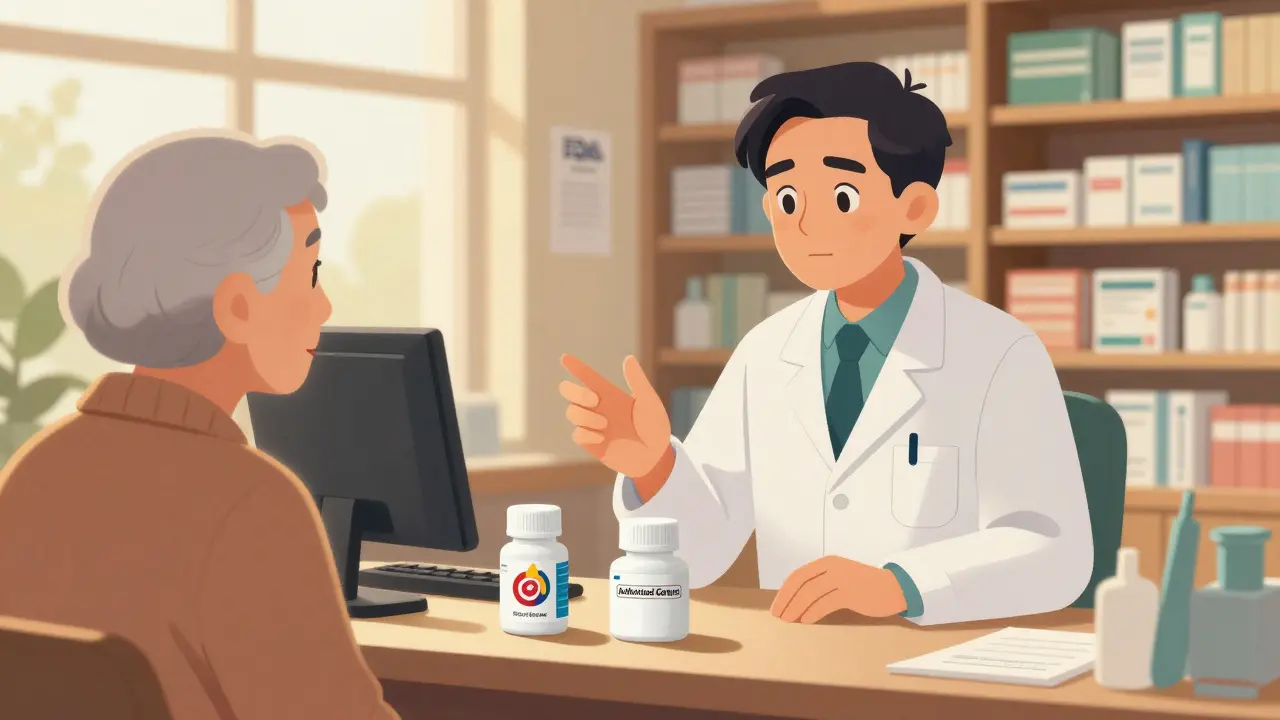
When a patient walks into the pharmacy with a prescription for a brand-name drug, the pharmacist’s first thought shouldn’t just be about cost-it should be about consistency. Many patients assume all generics are the same. But they’re not. That’s where authorized generics come in-and why pharmacists need to know exactly when to suggest them.
What Exactly Is an Authorized Generic?
An authorized generic is not just another cheap version of a brand-name drug. It’s the exact same pill, made by the same company, in the same factory, with the same active and inactive ingredients. The only difference? It doesn’t carry the brand name on the label. Think of it as the brand-name drug wearing a disguise-same formula, different packaging.
The FDA defines it clearly: an authorized generic is a drug approved under the original New Drug Application (NDA) but sold under a different label, often with a different color, shape, or markings. It’s not an Abbreviated New Drug Application (ANDA) product like regular generics. That means no bioequivalence studies are needed-it’s already proven to be identical because it’s the same product.
As of September 2023, the FDA lists 257 authorized generics. That’s about 5% of all brand-name drugs with generic alternatives. Most are oral tablets or capsules. And while regular generics can save 80-85% off the brand price, authorized generics typically cost 20-80% less-still a big savings, but with one major advantage: no ingredient changes.
When to Recommend Authorized Generics: Three Key Scenarios
1. Patients With Allergies or Dietary Restrictions
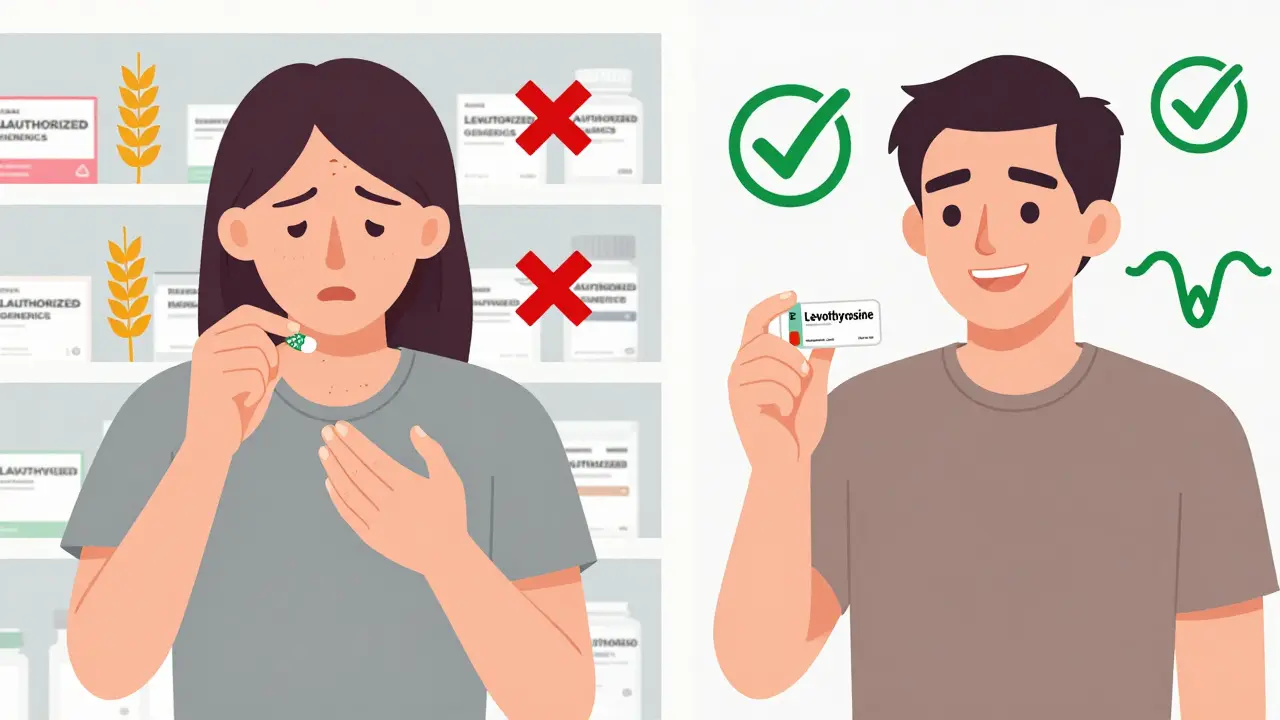
Regular generics often swap out inactive ingredients-fillers, dyes, preservatives-to cut costs. That’s fine for most people. But for patients with celiac disease, lactose intolerance, or religious dietary restrictions (like avoiding gelatin), those changes can be dangerous or unacceptable.
Take levothyroxine. A regular generic might use cornstarch instead of lactose. For someone with celiac disease, that’s fine. But if the brand-name version uses a gluten-free filler and the patient has tolerated it for years, switching to a generic with a different filler-even if it’s gluten-free-can cause unpredictable absorption issues. An authorized generic? Same filler. Same formulation. Same tolerance.
One 2021 survey of 1,200 community pharmacists found that 12% of patients reported unexpected side effects or reduced effectiveness after switching to a regular generic. In many of those cases, the issue wasn’t the active drug-it was the inactive ingredients.
2. Narrow Therapeutic Index (NTI) Drugs
Some medications have a razor-thin margin between effective and toxic. Warfarin, phenytoin, levothyroxine, lithium-these are NTI drugs. Even tiny differences in absorption can lead to blood clots, seizures, or thyroid storms.
The FDA has documented cases where switching from brand to regular generic caused measurable changes in blood levels of these drugs. In 3-5% of patients, those changes were clinically significant. Authorized generics eliminate that risk because they’re chemically identical. There’s no bioequivalence guesswork-just the same pill the patient was already stable on.
Pharmacists who manage anticoagulation clinics or epilepsy programs know this well. Many avoid switching NTI drugs entirely. When substitution is necessary, they ask: Is there an authorized generic? If yes, that’s the first recommendation.
3. Modified-Release Formulations
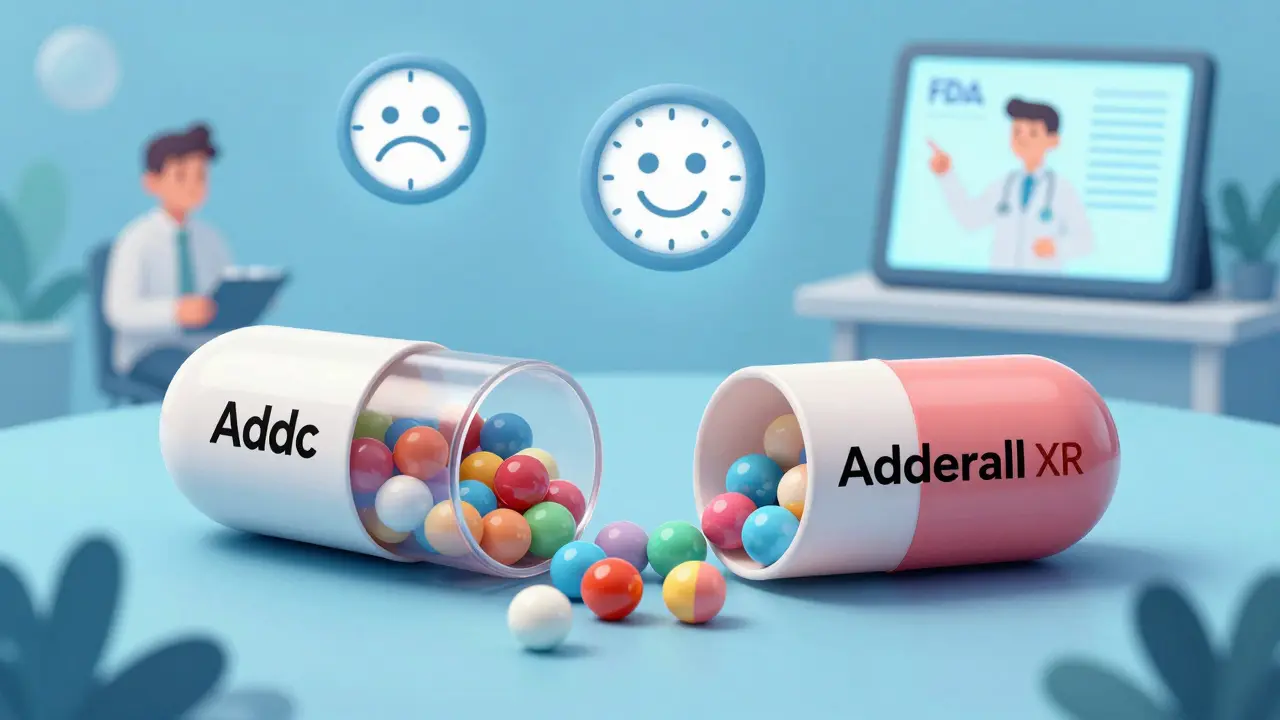
Extended-release, delayed-release, or controlled-release pills are tricky. The FDA’s bioequivalence standards for generics were designed for immediate-release tablets. But for a drug that releases medication over 12 hours, even small differences in coating or matrix can change how the drug behaves in the body.
Take Adderall XR. The brand uses a bead-based system to control release. Some generics use different bead technologies. Patients report inconsistent effects-too strong in the morning, too weak in the afternoon. An authorized generic? Same beads. Same release profile. Same results.
When a patient says, “This generic doesn’t work like my old pill,” don’t assume they’re being difficult. Ask: Is there an authorized generic available? It might be the missing piece.
How to Find Authorized Generics
There’s no single database that shows all generics. But there’s one place you can always check: the FDA’s quarterly updated list of authorized generics. It’s free, public, and updated every three months. You can search by brand name, active ingredient, or manufacturer.
Another trick: check the National Drug Code (NDC). Authorized generics will have the same active ingredient and strength as the brand, but the labeler code will match the original manufacturer (like Pfizer or Merck) or an authorized licensee (like Prasco or Greenstone). Regular generics will have a labeler code from a generic manufacturer (like Teva or Mylan).
And don’t rely on your pharmacy software alone. Many systems still group authorized generics under “generic” without flagging them as authorized. Always verify the NDC and cross-reference with the FDA list.
What to Tell Patients
Patients will notice the pill looks different. That’s normal. But if you don’t explain why, they’ll assume it’s a mistake-or worse, that the new pill is inferior.
Use simple language: “This is the same medicine your doctor prescribed, made by the same company. It just doesn’t have the brand name on it. That’s why it’s cheaper. The color and shape changed, but what’s inside is exactly the same.”
Studies show that 27% of patients stop taking their medication after a pill looks different-unless they’re told why. That number drops to 8% when pharmacists explain the change clearly. That’s not just good service-it’s adherence saved.
Also, warn them about insurance. Some pharmacy benefit managers (PBMs) treat authorized generics as brand-name drugs for billing purposes. That means even though it’s cheaper, your patient’s copay might be higher than expected. Always check the formulary before dispensing.
What You Can’t Assume
Not every brand has an authorized generic. Only about 5% do. And just because a generic exists doesn’t mean an authorized version is available.
Also, don’t assume authorized generics are always cheaper than regular generics. Sometimes they’re not. But they’re often cheaper than the brand-and always safer for sensitive patients.
And while authorized generics are identical to the brand, rare cases exist where the manufacturer made minor changes when launching the authorized version. Always check the FDA’s Orange Book and recent notifications for any formulation updates.
Legal and Documentation Notes
Federal law allows pharmacists to substitute brand for authorized generic unless the prescriber wrote “dispense as written.” But state laws vary. In 42 states, substitution is permitted without prescriber approval. In 18 states, you must notify the prescriber.
Document everything. Use the “DA” modifier in billing systems. Keep a record of the NDC, the brand name, and the reason for substitution. If a patient has an adverse reaction, you’ll need to prove you chose the most therapeutically equivalent option-and that’s the authorized generic.
The Bigger Picture
Authorized generics aren’t just a cost-saving trick. They’re a precision tool. For patients with allergies, chronic conditions, or complex drug regimens, they’re often the only safe way to switch without risking harm.
As more patients become aware of them-searches for “authorized generics” jumped 47% in 2021-2022-pharmacists will be asked more often. Be ready. Know when to recommend them. Know how to find them. Know how to explain them.
This isn’t about pushing cheaper drugs. It’s about making sure the right drug gets to the right patient-with no surprises, no risks, and no compromises.
Are authorized generics the same as brand-name drugs?
Yes. Authorized generics are manufactured by the same company that makes the brand-name drug, using the exact same formula, including active and inactive ingredients. The only differences are the label, packaging, and sometimes the color or shape of the pill. They are not bioequivalent-they are identical.
Why are authorized generics cheaper than brand-name drugs?
They’re cheaper because they don’t carry the brand name, marketing costs, or patent protections. The manufacturer sells them under a different label to compete with regular generics, often at 20-80% lower prices than the brand. But unlike regular generics, they don’t sacrifice ingredients to save money.
Can I substitute an authorized generic without the prescriber’s permission?
In most states, yes-unless the prescription says “dispense as written.” Federal law allows substitution, and 42 states permit pharmacists to switch to authorized generics without contacting the prescriber. But 18 states require notification. Always check your state’s pharmacy board rules.
Do insurance plans cover authorized generics as generics?
Not always. About 63% of pharmacy benefit managers (PBMs) classify authorized generics under brand-name tiers for reimbursement, even though the drug is identical. That means your patient might pay a higher copay than expected. Always check the formulary before dispensing.
How do I know if a drug has an authorized generic?
Check the FDA’s quarterly updated list of authorized generics. You can search by brand name or active ingredient. Also, verify the NDC code-if the labeler code matches the original brand manufacturer (like Pfizer or AbbVie), it’s an authorized generic. Regular generics have labeler codes from companies like Teva or Mylan.
9 Comments
Nina Stacey
So i just had a patient last week who switched from brand levothyroxine to a regular generic and started having heart palpitations and weird fatigue like crazy like she thought she was gonna pass out i was like oh no not again and i checked the ndc and turns out it was one of those generics with a different filler even though it was labeled gluten free the binding agent was totally different from what she was used to and she had been stable for 5 years on the brand
so i called her dr and we switched her to the authorized generic and within 48 hours she was back to normal like it was magic
people think generics are all the same but nope not even close especially when you got sensitive folks
also i wish pharmacy software would flag authorized generics better like why do they just lump them in with the rest
Kevin Motta Top
Authorized generics are the quiet heroes of pharmacy. No drama. No guesswork. Just the same pill.
Janelle Moore
wait a minute so you're telling me the government and big pharma are letting us think generics are safe but they're secretly poisoning people with cornstarch and gelatin
and now they're selling us the same pill but calling it 'authorized' so we think it's better but really they're just hiding the truth
they don't want us to know that the real brand is the only safe one because they make more money off it
and the FDA is in on it they update that list every 3 months but only when it's convenient for them
my cousin's neighbor's dog got sick after taking a generic and now i'm convinced this whole system is rigged
you ever notice how the pills change color every time you refill but no one ever tells you why
it's not about safety it's about control
they want you dependent on the brand so they can charge you more
and now they're selling you the same thing for less but calling it something else to make you feel better
it's psychological manipulation
Henry Marcus
Ohhhhh, so THIS is why my uncle’s lithium levels went haywire after his ‘generic’ switch??!!
Let me get this straight: Big Pharma is literally selling the exact same damn pill - same factory, same chemists, same batch code - but slapping a different label on it and calling it an ‘authorized generic’ so they can pocket the difference??
And the FDA? They’re just sitting there with their little ‘quarterly updates’ like it’s a tea party??
Meanwhile, patients are dropping like flies because some intern at Teva swapped out the magnesium stearate for ‘cost efficiency’ and now someone’s having a seizure because their phenytoin didn’t dissolve right??
I’ve been saying this for years: if it’s the same damn thing, why is it cheaper? Because the brand name is the ONLY thing keeping prices high!
It’s a scam. A beautiful, legal, FDA-approved scam.
And don’t even get me started on PBMs pretending authorized generics are ‘brand-tier’ - that’s just greed with a PowerPoint.
Someone needs to start a class-action lawsuit. I’ll bring the tinfoil hats.
Isabel Rábago
It's disgusting that pharmacists even have to explain this to patients. If you're taking a life-sustaining medication, you should be on the brand-name version. Period.
Generic drugs are for people who can't afford the real thing - and if you can't afford the real thing, you shouldn't be on a medication that could kill you if the filler changes.
Pharmacies should be required to only dispense brand-name drugs for NTI medications unless the patient signs a waiver acknowledging they're risking their life.
And why are we even allowing this? Because insurance companies are greedy. And pharmacists are complicit.
It's not about savings. It's about sacrificing safety for profit.
And if you think 'authorized generics' are safe, you're naive. They're still just generics - just with a nicer label.
Matt Davies
Man, this is one of those topics that makes me proud to be in pharmacy. It’s not about pushing the cheapest pill - it’s about pushing the right pill.
I had a guy come in last month swearing his Adderall XR wasn’t working anymore. Said it felt like he was ‘on a rollercoaster’ - super wired at 9am, zonked by 2pm.
Turns out his pharmacy had switched him to a generic with a different bead system. He didn’t even know the difference.
Switched him to the authorized generic. Same beads. Same release. Same guy.
He cried. Said he hadn’t slept properly in six months.
That’s not ‘cost-saving.’ That’s restoring someone’s life.
And yeah, the paperwork sucks. And yeah, the software doesn’t help. But if you’re doing this job right, you don’t do it for the convenience.
You do it because someone’s kid’s ADHD isn’t a ‘budget decision’.
Mike Rengifo
Been a pharmacist for 18 years. I used to think generics were all the same too. Then I saw a patient with celiac go from stable to full-blown GI meltdown because her levothyroxine switched from lactose-free filler to cornstarch.
Turns out the brand and the authorized generic both used rice starch. The regular generic? Cornstarch. And no one told her.
Now I check the NDC every time. Even if it takes 90 seconds. Even if the line is long.
It’s not about being a hero. It’s about not being the reason someone ends up in the ER.
Also - side note - if your pharmacy software doesn’t flag authorized generics, ask for a new system. Or quit. Your patients deserve better.
Dev Sawner
It is imperative to emphasize that the substitution of pharmaceuticals is a matter of profound clinical significance and must be governed by stringent regulatory oversight. The assertion that authorized generics are chemically identical to their branded counterparts is empirically valid under the FDA’s NDA framework; however, the potential for inter-manufacturer variability in excipient sourcing, even within authorized generics, remains a latent risk factor that has not been adequately addressed in the current pharmacovigilance infrastructure.
Furthermore, the assertion that patients experience improved adherence due to pharmacist counseling is statistically tenuous, as no longitudinal cohort studies have been published to substantiate the 27% to 8% reduction metric cited.
It is also noteworthy that the FDA’s authorized generic database is not harmonized with international pharmacopeial standards, thereby introducing potential compliance discrepancies for patients traveling abroad.
Consequently, it is recommended that all substitutions be accompanied by a signed, notarized patient consent form, and that pharmacists maintain digital logs with blockchain-based timestamping to ensure traceability and accountability.
Failure to adhere to these protocols constitutes a breach of professional duty and may constitute grounds for malpractice litigation.
Moses Odumbe
Y’all are overthinking this 😅
Authorized generic = same pill, different label. That’s it.
Stop acting like it’s a spy movie 🕵️♂️💊
My grandma takes her blood pressure med as an authorized generic - saves her $40/month, no side effects, no drama.
And yes, if your software doesn’t flag it, go to the FDA list. 2 minutes. Done.
Also - yes, insurance sometimes treats it like brand. That’s their problem. Not yours. Just explain it to the patient. They’ll get it.
Not every pharmacy battle needs to be a war. Sometimes it’s just a pill with a different color. 🤷♂️